
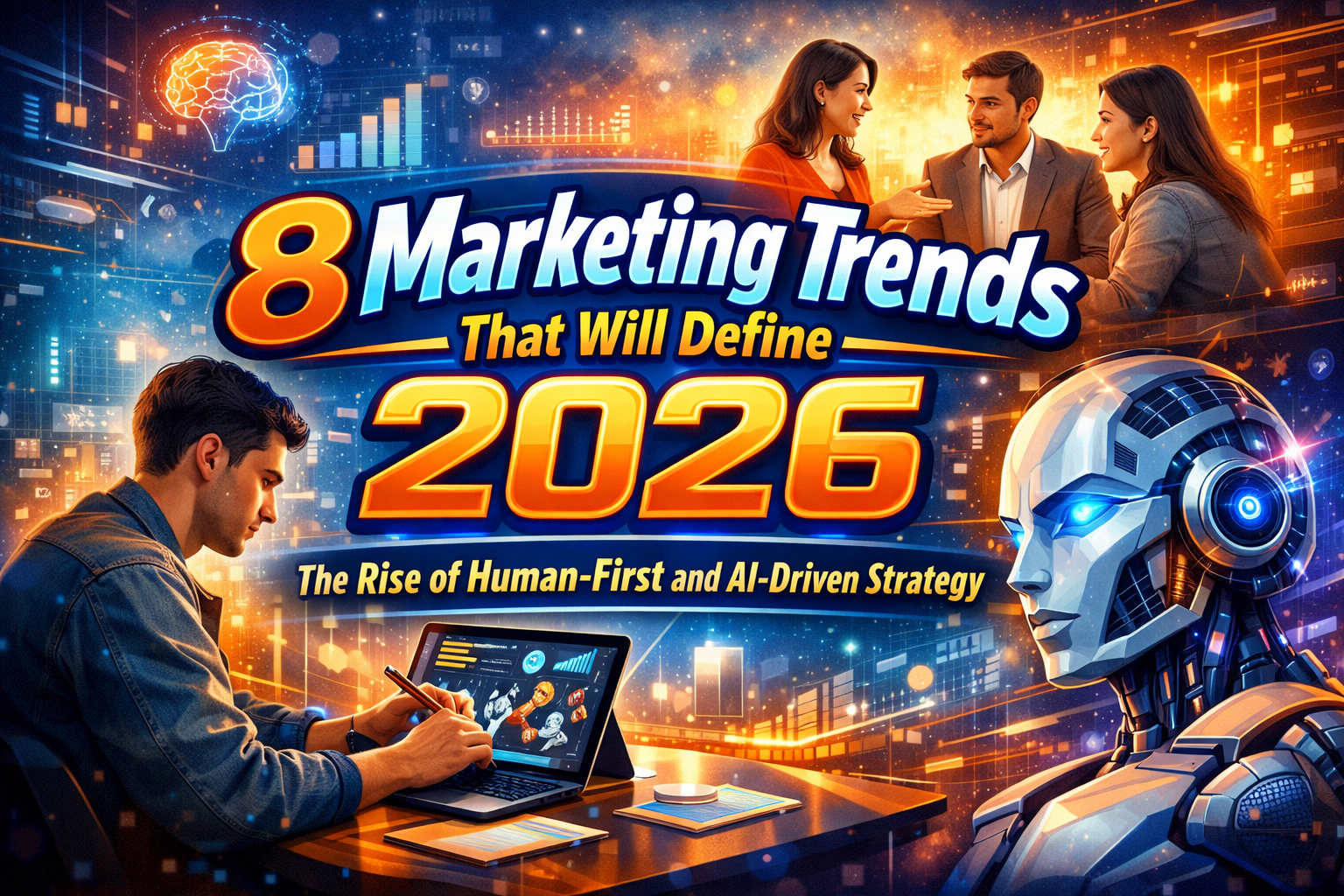
8 Key Marketing Trends for 2026: How AI and Human-Centered Media Are Reshaping Marketing
Introduction
Marketing is entering a new phase. The conversation is no longer about whether artificial intelligence will change the industry, but how deeply it will reshape the role of marketers themselves. Over the past few years, we have seen a shift from traditional campaign-driven marketing toward integrated systems where storytelling, product development, community building, and media creation merge into one strategic discipline.
Based on insights from marketers, founders, and creative teams, several patterns are becoming clear as we approach 2026. These trends are not speculative hype. Instead, they reflect real changes in how audiences consume content, how brands build trust, and how technology amplifies both creativity and competition.
In this article, we explore eight key marketing trends that will define 2026, along with practical implications for businesses and creative professionals looking to stay relevant in a rapidly evolving digital landscape.
The Evolution of the Modern Marketer
Before diving into specific trends, it is important to understand the broader shift happening within marketing roles.
Traditionally, marketers were responsible for executing campaigns: launching ads, managing channels, or optimizing conversion funnels. Today, marketers increasingly operate as product thinkers, creators, and internal leaders. They influence brand voice, user experience, community growth, and even product design decisions.
AI tools accelerate execution, but they also raise expectations. When everyone can generate content quickly, differentiation comes from taste, strategic thinking, and authentic human perspective.
1. Human-First Media Becomes the Core Advertising Asset
One of the biggest changes in modern marketing is the rise of human-centered media. Audiences are shifting away from purely corporate messaging toward content created by individuals or creator-led platforms.
People trust people more than logos.
Companies are investing in newsletters, YouTube channels, podcasts, blogs, and independent creator collaborations because these channels feel more authentic. Instead of interrupting users with traditional advertising, brands embed themselves within trusted voices.
This shift encourages brands to act like media companies. Rather than creating occasional campaigns, successful organizations build ongoing storytelling platforms.
From a design perspective, typography and visual identity play an important role in making creator content recognizable. Brands often use distinctive display fonts to create memorable branding. For example, creative typefaces from Putracetol such as Antiquera, Roleo Modern Display, or Retro Cloud styles can reinforce personality in creator-led media visuals, helping content stand out in crowded feeds.
2. Design Taste Becomes the #1 Marketing Skill
Technical skills remain important, but design taste is becoming the defining ability of modern marketers.
Design taste goes beyond visual aesthetics. It involves understanding simplicity, emotional impact, usability, and brand consistency. In a world where AI can generate thousands of variations instantly, the real value lies in choosing what works best.
Marketers who understand visual hierarchy, typography pairing, and user psychology will create more engaging experiences. This includes everything from landing pages and product interfaces to social media layouts and advertising creatives.
Fonts play a subtle but powerful role here. Choosing the right typeface can influence perception, readability, and emotional tone. For example:
- A playful script font can make food branding feel approachable.
- A bold display font can increase recognition in thumbnails or banners.
- A retro-inspired typeface can evoke nostalgia and authenticity.
The ability to combine these elements strategically will differentiate successful marketing teams from those relying solely on automation.
3. Marketers as Internal Influencers
Another major shift is the rise of internal influencers. Companies are encouraging employees to build personal brands on social platforms like LinkedIn, Instagram, or YouTube.
Why does this matter?
Audiences often perceive employee voices as more authentic than official brand accounts. Engineers explaining product features, designers sharing process insights, or marketers discussing strategy create a more human connection with audiences.
Internal influencers also expand reach without significantly increasing advertising costs. Each employee becomes a distribution channel, amplifying brand visibility organically.
For companies, this means investing in employee training, brand storytelling guidelines, and visual assets that maintain consistency across individual voices.
4. AI-Powered Video Ads Reach a New Level
Video remains the dominant content format, but generative AI is transforming how video advertising is created.
Tools capable of producing high-quality video from text prompts allow marketers to prototype ideas quickly and test multiple concepts without large production budgets. Creative teams can iterate faster, explore unconventional styles, and personalize content at scale.
However, as production becomes easier, storytelling becomes more important. AI removes technical barriers, which means creative direction and narrative quality determine success.
Brands that combine strong storytelling with distinctive design language will produce memorable campaigns even in a saturated environment.
5. SEO Blogging Makes a Comeback Through AEO
SEO blogging is returning, but in a new form aligned with AI-driven search engines and Answer Engine Optimization (AEO).
Instead of generic keyword-stuffed articles, platforms now prioritize:
- Authentic experiences
- Deep expertise
- Clear structure
- Helpful, actionable information
Content that demonstrates real insight and solves specific problems tends to perform better in AI-assisted search results.
This creates an opportunity for niche brands and creators to build authority through detailed blog content. Articles that integrate storytelling, visuals, and strong typography design can enhance readability and engagement.
Brands focused on creative industries, including digital design resources like Putracetol fonts, can benefit from publishing tutorials, case studies, and practical insights that attract targeted audiences.
6. Network Effects Become a Marketing Moat
Traditional marketing often relied on paid acquisition. Today, sustainable growth increasingly comes from built-in distribution loops.
Examples include:
- Communities that encourage user interaction
- Templates or tools that users share with others
- Collaborative platforms where each new user adds value
When a product has network effects, marketing becomes embedded within the product itself. This creates long-term advantages because growth is driven by user behavior rather than constant advertising spend.
Marketers must collaborate closely with product teams to design features that encourage sharing and engagement.
7. Specialists Become More Valuable Than Generalists
AI tools make it easier for anyone to perform basic marketing tasks. Writing, design, and data analysis are becoming more accessible.
As a result, deep specialization becomes more valuable.
Organizations will seek marketers who excel in specific areas such as:
- Brand storytelling
- Performance analytics
- UX design
- Community building
- Video storytelling
Specialists bring unique perspectives and refined skills that cannot easily be replicated by automation alone.
8. Marketers Become Product Managers
Perhaps the most transformative trend is the integration of marketing and product development.
With AI-powered tools, marketers can prototype landing pages, build MVP products, and test market demand quickly. This shifts marketing from promotion to creation.
Marketing teams increasingly participate in:
- Feature prioritization
- User experience design
- Pricing strategies
- Growth experimentation
This integration ensures that products align with real audience needs from the beginning rather than relying on marketing to fix weak positioning later.
Practical Implications for Businesses
These trends are not just theoretical. They lead to actionable changes in how companies structure teams and strategy:
- Specialization requires hiring or developing deep expertise rather than expecting individuals to handle everything.
- Product thinking means marketing must be integrated early into product development.
- SEO blogging should focus on niche authority and real experience rather than mass content production.
- Internal influencers help build trust through human storytelling.
- AI video ads reduce production costs while increasing creative experimentation.
- Network effects strengthen long-term growth.
- Design taste differentiates brands visually and emotionally.
- Human-first media creates stronger audience relationships.
If you want free fonts from putracetol.com, you can see this image.

Conclusion
Marketing in 2026 will be defined by a balance between technological acceleration and human creativity. AI will continue to remove friction from production, allowing marketers to move faster than ever before. Yet the core differentiator remains deeply human: storytelling, taste, authenticity, and emotional connection.
The most successful marketers will be those who specialize deeply, think like product builders, and invest in human-centered media that earns audience trust.
Rather than chasing every new tool, the focus should be on developing strategic judgment and creative clarity. Technology changes quickly, but strong ideas and meaningful experiences remain timeless.
For more insights into branding, design resources, and digital creative strategies, explore additional content at Putracetol.com.
Thank you for taking the time to read this article. If you are looking for more great articles, feel free to visit Putracetol Blog
Additionally, if you want to explore some free typography options, you can check out Putracetol Studio on Dafont. Happy reading and designing!