Apps Are Not Free 2026: Understanding the Real Cost of “Free”
Open an app store and thousands of products appear to cost nothing. There is no upfront payment, no credit card required, and sometimes no visible subscription.
But software still requires designers, developers, servers, customer support, security infrastructure, marketing, and continuous updates. Somebody has to pay for that system.
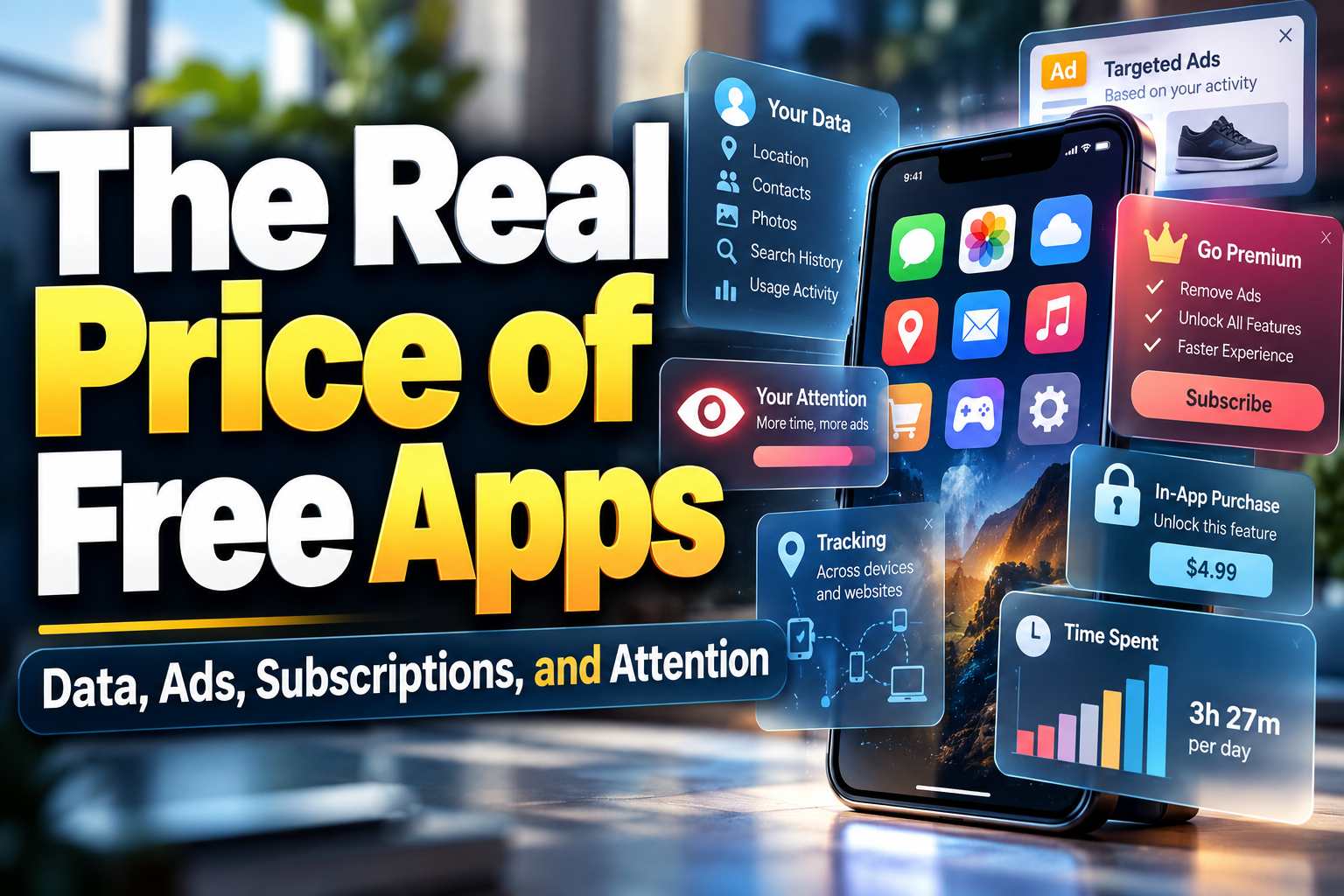
That is the idea behind apps are not free 2026. A zero-dollar download does not necessarily mean zero economic cost. Users may instead pay through advertising exposure, personal data, premium upgrades, recurring subscriptions, in-app transactions, or simply their time and attention.
Understanding these models helps consumers make better decisions and helps app companies build sustainable businesses without damaging user trust.
Initial Suggestion: Ask How the App Makes Money
Before installing a free app, ask a simple question:
What is the business model?
If the service does not charge you directly, revenue may come from advertisers, premium users, transaction fees, partnerships, analytics, or another part of the company’s ecosystem.
This does not automatically make the app harmful. Advertising-supported and freemium products can provide useful services to millions of people who would never pay an upfront fee.
The important issue is transparency.
Users should be able to understand what information is collected, what features eventually require payment, whether subscriptions renew automatically, and how difficult it is to leave.
Apple’s App Store provides privacy labels intended to show how apps may handle user information, while Google Play’s Data safety section requires developers to disclose relevant collection and sharing practices. Apple
Free Apps Often Sell Attention
Advertising remains one of the most familiar monetization strategies.
In an ad-supported app, users receive access while advertisers pay for visibility. The economic resource is therefore often not the software itself, but access to the user’s attention.
A mobile game might show a full-screen advertisement between levels. A social platform can insert sponsored posts into a feed. A free utility may use banner ads around its main interface.
The tradeoff can be reasonable when users understand it. Problems arise when advertising becomes excessively intrusive, disguises itself as interface controls, or pushes people toward accidental clicks.
For product teams, the challenge is balancing revenue with usability. Monetization that constantly interrupts the primary task can make a technically free product expensive in terms of frustration and time.
Personal Data Can Be Part of the Exchange
Data is another important part of the free-app economy, although the relationship is more complex than the phrase “your data is the product” suggests.
Apps may collect account details, device identifiers, usage information, purchases, diagnostics, location, or other information depending on their functionality and permissions.
That information can support legitimate purposes such as personalization, analytics, fraud prevention, or application performance. It can also support advertising and measurement ecosystems.
Google Play requires developers to maintain a Data safety section describing how their applications collect, use, and share user data, including relevant behavior by SDKs incorporated into the app. Google Help Apple similarly requires privacy disclosures and permission for certain forms of cross-app tracking. Apple
For users, the practical lesson is not to reject every data-driven service. Instead, review whether the amount of information requested makes sense for what the application actually does.
A flashlight application requesting extensive location and contact access, for example, deserves more scrutiny than a navigation app requesting location.
Freemium Makes the Entry Free, Not the Whole Product
Many modern applications use freemium pricing.
The basic product is free, while advanced features require payment. This model appears in productivity software, cloud storage, design platforms, language-learning apps, games, and business tools.
Freemium can be a fair arrangement because users can experience the product before paying. However, businesses need to communicate the boundary between free and premium functionality clearly.
If essential features suddenly become unavailable only after a user has invested significant time, the experience can feel manipulative even when the pricing model itself is legitimate.
For startups, the lesson is simple: free access should demonstrate value, while paid plans should provide additional value rather than deliberately making the free experience frustrating.
Subscriptions Create a Different Kind of Cost
Another common model begins with a free trial and eventually becomes a recurring subscription.
Subscriptions can support continuous development because companies receive predictable revenue instead of relying on one-time purchases. The problem is not recurring billing itself. The problem is unclear renewal terms, hidden charges, or cancellation processes designed to discourage users from leaving.
Consumer regulators continue to scrutinize these practices. In 2026, the U.S. Federal Trade Commission brought actions involving allegations of hidden recurring charges and difficult cancellation processes. Federal Trade Commission
Earlier international research coordinated with the FTC reviewed 642 subscription websites and apps and found that nearly 76% displayed at least one potential dark pattern, although the review did not determine that every identified practice was unlawful. Federal Trade Commission
Good subscription design should make pricing, renewal, and cancellation easy to understand.
Comparison: How “Free” Apps Actually Make Money
| Model | What Users Exchange | Main Benefit | Potential Concern |
|---|---|---|---|
| Advertising | Attention | No direct payment | Interruptive ads |
| Data-supported services | Information and usage signals | Personalization and free access | Privacy |
| Freemium | Optional premium payment | Try before buying | Feature restrictions |
| Subscription trial | Future recurring payment | Low entry barrier | Unclear renewal |
| In-app purchases | Payment for individual features/items | Flexible spending | Overspending |
| Transaction fees | Percentage of activity | No subscription required | Growing costs |
No model is inherently unethical. The important questions are whether users understand the exchange and whether the app gives them meaningful control.
Why Transparency Builds Better Apps
App developers sometimes treat privacy notices, subscription explanations, and permission dialogs as legal requirements separate from product design.
They should instead be viewed as part of the user experience.
A clear pricing page reduces uncertainty. A straightforward permission explanation can increase trust. An easy cancellation flow can leave a positive final impression even when the customer decides to leave.
For startups, transparency can also become a branding advantage.
A business that says exactly what is free, what costs money, what data is collected, and why permissions are required may appear more credible than a competitor using aggressive growth tactics.
Visual communication matters here as well. Clear typography, sensible hierarchy, and readable interfaces help users understand pricing and privacy information. Businesses building their own digital products can explore PutraCetol Studio for distinctive commercial fonts that support app branding, marketing, and broader digital identity.
Common Mistakes
One mistake consumers make is judging an app only by its download price. A free product might eventually cost more than a paid alternative through subscriptions, microtransactions, or the amount of advertising it presents. Before committing to an app, review its subscription structure, privacy disclosures, permissions, and cancellation terms. Do not assume that “free” means permanently unrestricted access.
Developers make the opposite mistake when they treat users as monetization metrics instead of customers. Excessive notifications, manipulative buttons, hidden renewal terms, and confusing privacy settings may improve certain short-term metrics while weakening long-term trust. Sustainable monetization should make the economic relationship understandable rather than intentionally obscure it.
Another mistake is assuming that collecting more data automatically creates a better product. Every additional data point introduces security, compliance, storage, and reputation responsibilities. Collect what the service genuinely needs, explain the purpose clearly, and give users appropriate choices.
Conclusion
The phrase apps are not free 2026 is not an argument against free software. It is a reminder that digital services operate through economic exchanges even when no money changes hands at installation.
Users may pay with attention, data, subscriptions, purchases, or participation in a broader platform ecosystem.
For consumers, the goal is awareness. For developers and founders, the opportunity is to create monetization models that users can understand and trust.
The best digital products are not necessarily the ones with no price. They are the ones that make the real price clear.
Explore these fonts and many more at PutraCetol.com to build a business identity that looks professional, trustworthy, and memorable.
Additionally, if you want to explore some free typography options, you can check out Putracetol Studio on Dafont. Happy reading and designing!