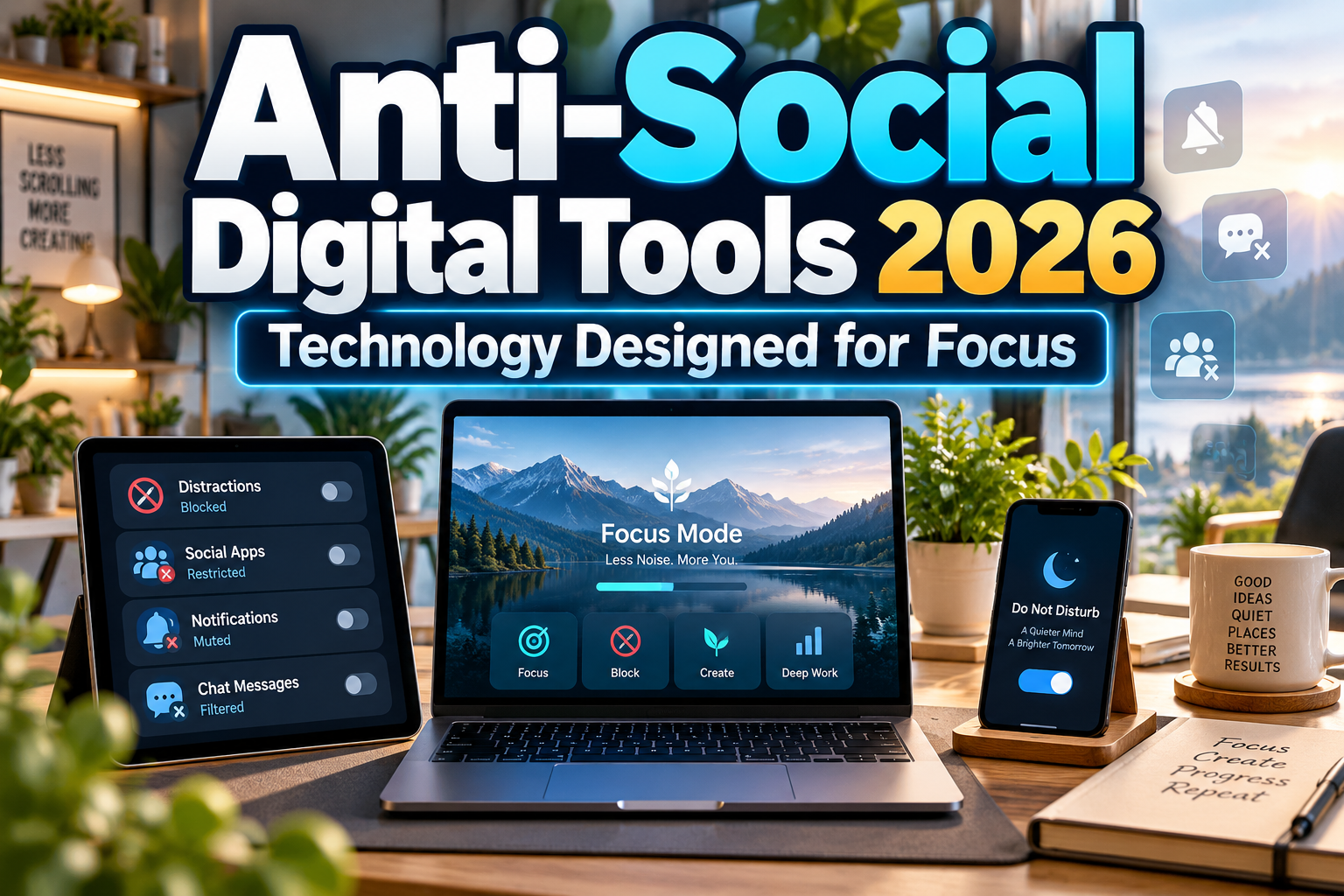
Anti-Social Digital Tools 2026: Technology Designed for Focus, Not Engagement
For years, digital products have competed to keep users connected for as long as possible. Notifications, activity feeds, badges, reactions, recommendations, and endless content streams became standard parts of the online experience.
In 2026, a different product philosophy is becoming increasingly relevant: tools that intentionally reduce interaction.
The idea behind anti-social digital tools 2026 is not necessarily to reject technology or human connection. Instead, these tools are designed to protect attention, reduce unnecessary social pressure, and create quieter digital environments for working, studying, writing, designing, or simply thinking.
For digital minimalists, entrepreneurs, UX designers, and creative professionals, this creates an interesting question: what happens when software stops trying to maximize engagement and starts helping users leave sooner?
Initial Suggestion: Identify the Distraction Before Choosing the Tool
Before installing another productivity app, identify what is actually interrupting your focus.
For some people, the problem is notifications. For others, it is repeatedly opening social media, checking email, joining too many group chats, or switching constantly between browser tabs.
A useful anti-social system should address that specific behavior.
If notifications are the issue, aggressive notification filtering may be enough. If website habits are the problem, scheduled blocking can work better. Writers and designers may benefit from full-screen environments that hide collaboration panels, comments, feeds, and real-time status indicators.
The goal is not maximum restriction. It is creating enough friction between intention and distraction.
What Makes a Digital Tool “Anti-Social”?
Anti-social technology is best understood as pro-focus design.
Instead of encouraging continuous participation, these products often remove common engagement mechanisms.
Typical characteristics include:
- limited or disabled notifications,
- no public activity feed,
- fewer likes, reactions, or follower metrics,
- scheduled access to distracting platforms,
- offline or local-first workflows,
- distraction-free editing modes,
- private progress tracking,
- delayed communication instead of constant messaging.
These design decisions change the relationship between the user and the software.
A traditional social platform asks, “What can we show next?” An anti-social tool asks, “Have you finished what you came here to do?”
Focus Tools Are Becoming More Deliberate
The simplest anti-social tools block distracting websites or applications during selected periods.
A student might prevent access to entertainment platforms from 8:00 to 10:00 PM while studying. A developer could block messaging apps during a 90-minute coding session. A writer might disable internet access entirely while drafting.
The important design principle is intentional access.
When opening a distracting application requires waiting, entering a reason, or changing a focus setting, impulsive checking becomes less automatic.
This small amount of friction can be more useful than relying entirely on self-discipline.
Quiet Interfaces Reduce Cognitive Noise
Anti-social design also appears in the interface itself.
Many productivity applications are beginning to emphasize cleaner layouts with fewer attention-grabbing elements. A focused writing environment might show only the document. A creative tool could hide community feeds and collaboration indicators until requested.
Typography plays an important role here.
Clear fonts, generous spacing, restrained hierarchy, and comfortable reading sizes can make digital spaces feel calmer. Too many styles, flashing badges, aggressive colors, and decorative elements create unnecessary visual competition.
For designers building focus-oriented digital products, typography can support the product philosophy itself. A clean interface paired with distinctive but readable fonts from PutraCetol Studio can create brand personality without turning every screen into another source of distraction.
Offline-First Tools Challenge the Always-Connected Model
Another interesting direction is software that continues to work effectively without constant connectivity.
Offline-first note systems, writing tools, local databases, and creative applications can give users more control over when synchronization and communication occur.
This changes the traditional expectation that every action should immediately reach a server, team, or social network.
For remote workers and creative professionals, offline capability can create psychological separation from online activity. The user can focus on producing the work first and reconnect later when sharing becomes necessary.
This pattern is particularly useful for activities that require concentration rather than collaboration every minute.
Delayed Communication Can Be More Productive
Modern work culture often treats instant response as a sign of productivity.
Anti-social tools challenge that assumption.
Instead of real-time messaging, teams can rely more heavily on asynchronous notes, project updates, structured documentation, and scheduled communication windows.
A designer might spend the morning working without chat interruptions, then review messages at noon. A development team could replace repeated status meetings with structured written updates.
This does not eliminate collaboration. It changes its timing.
The distinction is important because uninterrupted work and communication require different mental states. Trying to perform both continuously can make neither particularly effective.
Comparison: Always-Connected vs. Anti-Social Digital Tools
| Design Area | Always-Connected Model | Anti-Social Model |
|---|---|---|
| Notifications | Frequent and immediate | Filtered or scheduled |
| Social features | Central to experience | Optional or removed |
| Engagement | Longer sessions encouraged | Task completion prioritized |
| Communication | Real time | Often asynchronous |
| Interface | Activity-rich | Minimal and focused |
| Connectivity | Constant | Offline-friendly |
| Metrics | Likes, activity, engagement | Personal progress and completion |
Neither approach is universally correct. Collaboration software needs communication, and social communities need interaction. The important question is whether those features support the user’s purpose or simply increase time spent in the product.
Why Entrepreneurs Should Pay Attention
The anti-social positioning creates interesting product opportunities.
Most software companies compete by adding more features, integrations, feeds, and collaboration. A product that deliberately removes these elements can differentiate itself through simplicity.
Imagine a writing platform with no follower system, no public comments, and no algorithmic feed. The product promise becomes: write first, publish later.
Or consider a productivity app that does not send reminders unless the user specifically schedules them.
For startup founders, this creates an alternative business philosophy: success can be measured by helping users complete meaningful tasks rather than maximizing daily engagement.
Common Mistakes
One common mistake is turning digital minimalism into another complicated productivity system. Installing ten focus apps, configuring dozens of rules, and tracking every minute can create a new form of distraction. Start with one problem and one intervention. If social media interrupts your work, block it during a defined period. If notifications are the problem, reduce them before adding more software.
Another mistake is assuming that isolation automatically improves productivity. People still need feedback, collaboration, community, and social support. The goal of anti-social tools should be to make interaction intentional rather than eliminate it completely. A healthy workflow may include focused individual work followed by scheduled collaboration.
Finally, product designers should avoid using “wellness” as a marketing label while keeping engagement-maximizing mechanics underneath. If an application claims to support focus but constantly sends streak reminders, promotional notifications, and social comparison metrics, the product behavior contradicts the promise.
Conclusion
The rise of anti-social digital tools 2026 reflects a broader shift in how people think about technology.
More users are beginning to question whether constant connectivity, notifications, feeds, and instant communication genuinely improve their work or simply consume attention.
The most interesting tools are not anti-human or anti-community. They are pro-intention.
They give users greater control over when they communicate, when they consume information, and when they work without interruption.
For designers and founders, this creates a compelling opportunity: build technology that respects attention as a limited resource. And when creating those quieter digital experiences, thoughtful typography from PutraCetol Studio can help establish a calm but distinctive identity without adding unnecessary visual noise.
Explore these fonts and many more at PutraCetol.com to build a business identity that looks professional, trustworthy, and memorable.
Additionally, if you want to explore some free typography options, you can check out Putracetol Studio on Dafont. Happy reading and designing!