
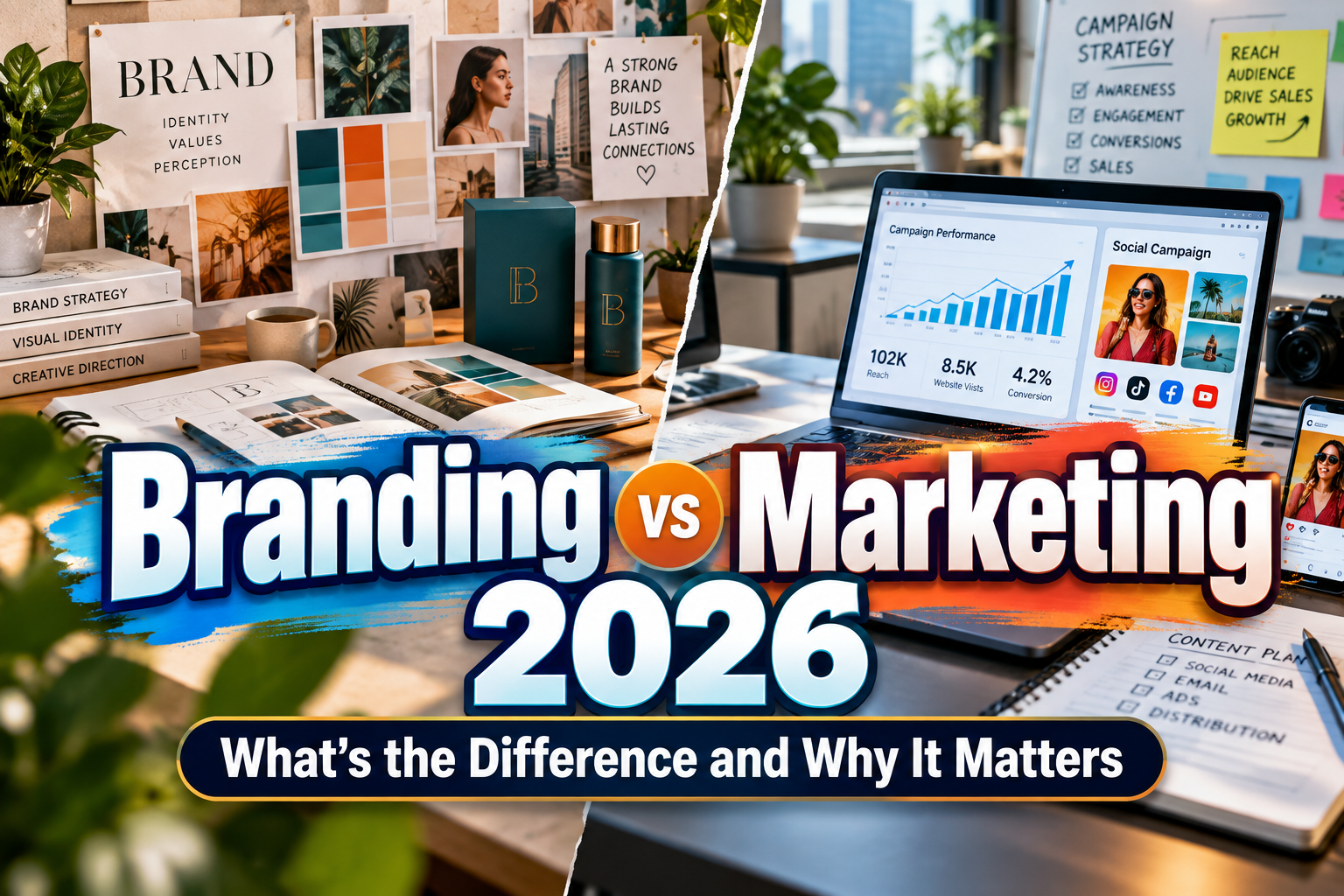
Branding or Marketing? How Both Work Together to Grow a Business
Branding and marketing are often treated as interchangeable terms, but they solve different business problems.
Branding defines who the business is, what it represents, and how people should perceive it. Marketing determines how the business reaches an audience, communicates an offer, and motivates people to take action.
Understanding branding vs marketing 2026 is particularly important because modern customers interact with businesses through many touchpoints: websites, apps, social media, advertising, packaging, marketplaces, email, video, and physical products. A company may run excellent campaigns but still struggle if its identity is inconsistent. Likewise, a beautiful brand identity cannot generate growth if nobody discovers it.
Strong businesses need both.
Initial Suggestion: Define the Brand Before Scaling Promotion
Before investing heavily in campaigns, clarify what the business should represent.
Start with questions such as: Who are we serving? What problem do we solve? Why should customers choose us? How should our company feel compared with alternatives? What promises must remain consistent across every interaction?
These answers form the foundation of brand strategy.
Imagine a new premium coffee company. Marketing could bring thousands of visitors through Instagram ads, influencer partnerships, search campaigns, and promotional discounts. But branding determines whether those visitors see the company as luxurious, sustainable, youthful, traditional, adventurous, or simply another coffee seller.
Promotion creates attention. Branding gives that attention meaning.
What Is Branding?
Branding is the process of shaping a recognizable and consistent identity around a business, product, or service.
It includes strategic elements such as positioning, values, personality, messaging, tone of voice, customer perception, and visual identity. The visual side can include the logo, typography, color system, imagery, packaging, iconography, and layout principles.
Typography is especially important because it influences how a brand communicates before customers consciously evaluate the words. A refined serif may support a premium editorial identity, while a bold geometric display font can create a more energetic and contemporary impression.
For businesses developing original visual identities, independent font foundries such as PutraCetol Studio can provide distinctive commercial typography for logos, packaging, websites, advertising, and other branded touchpoints.
Branding should also remain relatively consistent over time. Campaigns may change every few weeks, but the underlying personality should remain recognizable.
What Is Marketing?
Marketing is the collection of activities used to connect products or services with potential customers.
This includes advertising, SEO, email campaigns, social media, content marketing, influencer partnerships, events, promotions, affiliate programs, paid search, product launches, and sales funnels.
Marketing is therefore more directly connected to distribution and customer acquisition.
A footwear startup might run a paid campaign promoting “20% off this weekend.” The advertisement, targeting strategy, platform selection, landing page, and conversion objective belong largely to marketing.
But the typography, visual language, tone, photography style, and way the company communicates value should still follow the brand system.
That is where branding and marketing meet.
Branding Builds Meaning, Marketing Creates Movement
One useful way to understand the relationship is to think of branding as the foundation and marketing as activation.
Branding establishes why customers should remember and trust the company. Marketing gives people reasons and opportunities to interact with it.
Consider a skincare startup.
Its branding might define the company as scientifically credible, transparent, minimalist, and approachable. That identity would influence packaging, product naming, website design, fonts, photography, and tone.
Marketing could then translate those decisions into:
- educational skincare videos,
- Google search campaigns,
- influencer partnerships,
- email promotions,
- product-launch landing pages,
- retargeting advertisements.
The campaigns may change, but they should still sound and look like the same company.
Brand Identity Makes Marketing More Consistent
Marketing becomes harder when every campaign starts from zero.
A strong identity system provides predefined typography, logo rules, colors, image direction, writing style, and communication principles. Creative teams can then produce advertisements and content faster while maintaining consistency.
For example, a company might establish one bold font for campaign headlines, a neutral typeface for body text, specific color combinations, and a recognizable photography style.
When those elements repeat across a website, social ads, packaging, presentations, and email campaigns, customers begin connecting the visual patterns with the brand.
Consistency does not mean every advertisement should look identical. It means each execution belongs to the same visual family.
Marketing Data Can Improve Branding
The relationship also works in the opposite direction.
Marketing generates information about how audiences actually respond. Search queries can reveal what customers care about. Social engagement can show which messages resonate. Conversion data can reveal whether an offer is clear, while customer feedback can highlight gaps between brand promises and customer experience.
Brand teams can use these insights to refine positioning, messaging, visual communication, and even product strategy.
However, businesses should avoid changing their entire identity whenever one advertisement underperforms. Marketing experiments should happen frequently. Brand changes should be more deliberate.
Comparison: Branding vs Marketing 2026
| Area | Branding | Marketing |
|---|---|---|
| Primary focus | Identity and perception | Promotion and acquisition |
| Main question | “Who are we?” | “How do we reach customers?” |
| Time horizon | Long term | Short and long term |
| Examples | Logo, typography, positioning | Ads, SEO, email, campaigns |
| Main objective | Recognition and trust | Traffic, leads, sales, engagement |
| Consistency | Relatively stable | Changes frequently |
| Measurement | Awareness, perception, loyalty | CTR, conversions, CAC, ROAS |
Neither discipline replaces the other. Marketing without branding can create attention without differentiation, while branding without marketing can create a strong identity that few people ever encounter.
Common Mistakes
One common mistake is assuming that branding means designing a logo. A logo is only one visual asset within a much larger system. Businesses also need positioning, messaging, typography, tone, customer experience, and consistent application. Spending heavily on a logo while every social post, landing page, and advertisement communicates differently does not create a strong brand.
Another mistake is focusing entirely on marketing metrics while ignoring perception. A campaign can generate clicks and still damage long-term trust if its message feels misleading or inconsistent with the product experience. Short-term promotions should support rather than contradict the brand promise.
The opposite problem also occurs. Some businesses spend months perfecting logos, colors, packaging, and brand guidelines but delay publishing content or acquiring customers. Branding needs real-world exposure to create value. Build a solid foundation, then test it through marketing and refine it using genuine customer feedback.
Conclusion
The core difference in branding vs marketing 2026 is simple: branding shapes identity and perception, while marketing distributes messages and drives action.
Branding determines what customers should remember. Marketing determines how they encounter the business.
The strongest companies connect both disciplines. They build a recognizable identity, translate it into consistent campaigns, measure audience response, and refine the experience over time.
From typography and packaging to websites and advertisements, every customer touchpoint should reinforce the same core idea. Businesses creating that visual foundation can explore PutraCetol Studio for original commercial fonts designed for branding, digital campaigns, packaging, social media, and creative communication.
Explore these fonts and many more at PutraCetol.com to build a business identity that looks professional, trustworthy, and memorable.
Additionally, if you want to explore some free typography options, you can check out Putracetol Studio on Dafont. Happy reading and designing!