
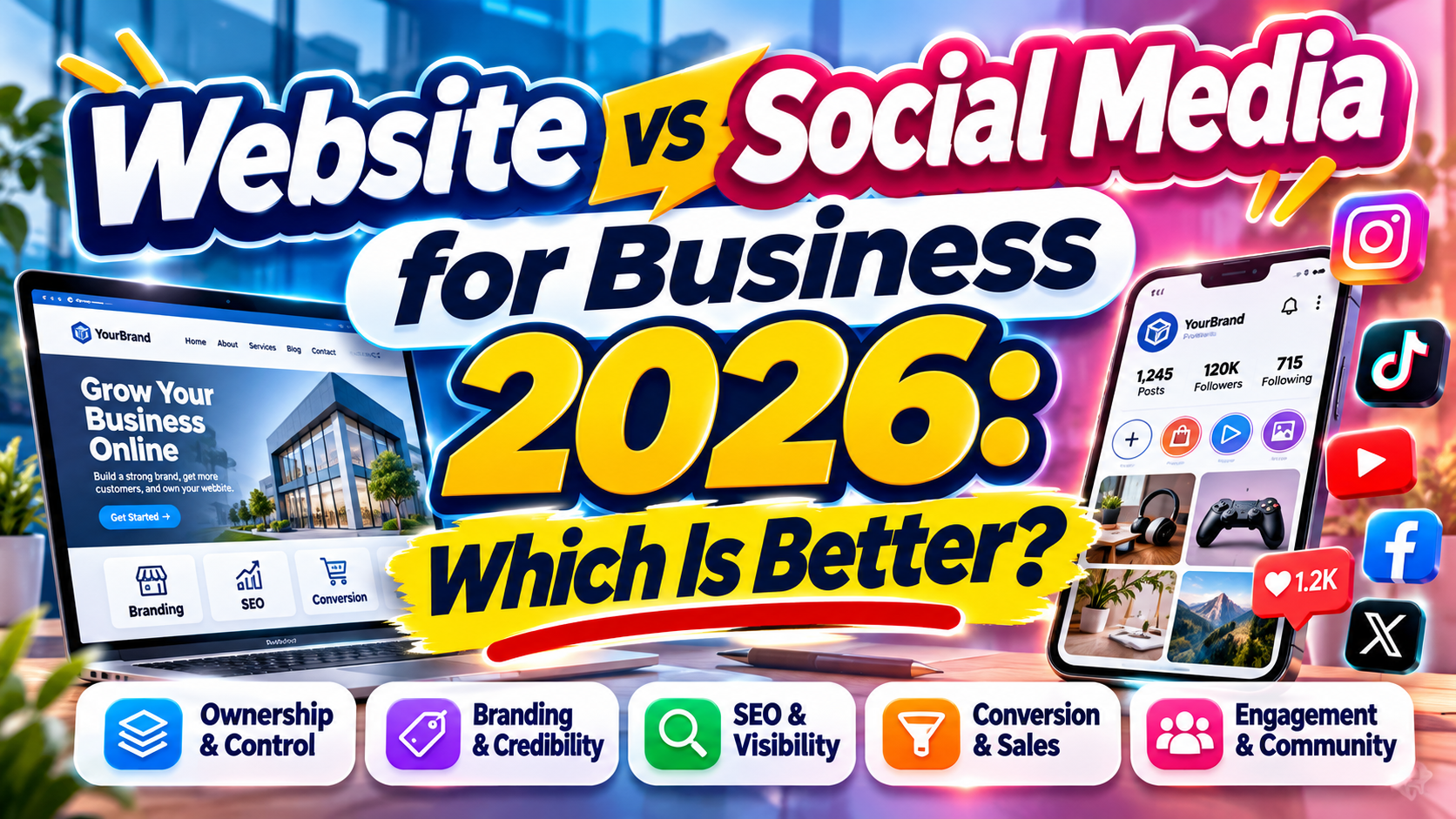
Website vs Social Media for Business 2026: Which Is Better for Long-Term Growth?
Building a strong online presence is essential for businesses competing in today’s digital marketplace. However, entrepreneurs often face an important question: should they invest in a professional website or concentrate on social media?
The website vs social media for business 2026 comparison reveals that both channels offer valuable but fundamentally different advantages.
Websites provide greater control over branding, content, and customer experiences, while social media platforms excel at audience interaction, content discovery, and community engagement.
Understanding their strengths helps businesses develop sustainable marketing strategies rather than relying entirely on one platform.
Build a Digital Presence Around Your Customers
Before choosing between a website and social media, consider how potential customers discover, evaluate, and purchase your products.
For example, a small clothing brand might attract attention through Instagram Reels but use its website to display collections, explain policies, and process purchases.
A consulting business could use LinkedIn to develop professional relationships while directing interested prospects to detailed service pages.
Start with the channels your audience already uses, then develop a reliable destination for essential business information.
6 Key Differences Between Websites and Social Media
1. Ownership and Control Over Digital Assets
A business website generally provides greater control over its domain, content, design, and customer experience.
Businesses can choose hosting providers, customize functionality, and establish independent branding systems.
Social media accounts operate within third-party platforms, where visibility, available features, and account access depend on platform policies.
However, website ownership still requires maintaining domains, hosting, software, and appropriate data protection.
WEBSITE ADVANTAGE: Greater independence and control over business infrastructure.
SOCIAL MEDIA ADVANTAGE: Easier access to established audiences.
2. Search Engine Visibility and Organic Discovery
Search engine optimization is a significant advantage of maintaining a business website.
Well-structured pages, helpful articles, product descriptions, and relevant keywords can help potential customers discover a business through search engines.
For example, a bakery website could target searches such as “custom birthday cakes near me.”
Social media also supports discovery through recommendations, hashtags, and platform search features.
However, website SEO provides additional opportunities to reach customers actively researching specific products or services.
WEBSITE ADVANTAGE: Searchable information and long-term organic traffic opportunities.
SOCIAL MEDIA ADVANTAGE: Content discovery through social feeds and recommendations.
3. Branding and Professional Credibility
A website allows businesses to establish a consistent visual identity through customized layouts, typography, colors, and imagery.
Dedicated pages can communicate company values, customer testimonials, product information, and business policies.
Social media profiles provide fewer layout customization options but help brands express personality through everyday content.
For distinctive branding, businesses can explore professional fonts at PutraCetol Studio to develop memorable logos, website headlines, and promotional graphics.
WEBSITE ADVANTAGE: Comprehensive brand presentation.
SOCIAL MEDIA ADVANTAGE: Personal communication and recognizable brand personality.
4. Customer Engagement and Community Building
Social media platforms are particularly effective for encouraging conversations, sharing updates, and building communities.
Comments, direct messages, live broadcasts, and interactive content allow businesses to communicate with audiences.
For example, a beauty brand could demonstrate products through short videos and answer customer questions directly.
Websites support engagement differently through educational content, contact forms, customer accounts, and support resources.
WEBSITE ADVANTAGE: Structured information and dedicated customer services.
SOCIAL MEDIA ADVANTAGE: Immediate interaction and community participation.
5. Conversions, Sales, and Customer Experience
Websites give businesses considerable flexibility when designing purchase journeys.
E-commerce stores can provide product filtering, checkout options, account management, and detailed shipping information.
Social media can also generate direct sales through messaging, platform-supported shopping features, and advertising.
However, dedicated websites often provide more flexibility for customized transactions and conversion measurement.
For example, a digital product business may use social media for demonstrations while managing orders, downloads, and customer support through its website.
WEBSITE ADVANTAGE: Customizable purchasing experiences.
SOCIAL MEDIA ADVANTAGE: Convenient product discovery and conversational selling.
6. Marketing Costs and Long-Term Sustainability
Social media accounts are often inexpensive to establish, making them accessible to startups and small businesses.
However, consistent content creation, advertising, and audience management require ongoing resources.
Websites involve domain, hosting, development, and maintenance expenses.
Although SEO and useful website content can generate traffic over time, results are not guaranteed and require continued optimization.
The right investment depends on customer acquisition costs and measurable business outcomes.
WEBSITE ADVANTAGE: Greater control over long-term marketing assets.
SOCIAL MEDIA ADVANTAGE: Accessible entry and flexible promotional campaigns.
Comparison: Website vs Social Media for Business
| Business Factor | Website | Social Media |
|---|---|---|
| Digital control | Greater business control | Platform-dependent |
| Branding | Highly customizable | Limited profile layouts |
| SEO | Strong search opportunities | Mainly platform discovery |
| Engagement | Structured interactions | Community-focused |
| Sales | Customizable checkout | Messaging and social commerce |
| Costs | Hosting and maintenance | Content and advertising |
| Customer data | More direct collection options | Platform access limitations |
| Best role | Business destination | Awareness and relationships |
How Websites and Social Media Work Better Together
The most effective digital marketing strategy often combines both channels.
Social media helps introduce businesses to new audiences, while websites provide detailed information and support meaningful customer actions.
For example, a graphic design studio could publish portfolio previews on Instagram, explain its services on its website, and encourage visitors to submit project inquiries.
Businesses can also connect blog articles, email marketing, and social campaigns into a coordinated customer journey.
Use appropriate analytics to measure which channels contribute to inquiries, purchases, and other important business outcomes.
Rather than comparing follower counts alone, focus on qualified traffic, customer acquisition costs, and conversions.
Common Mistakes When Choosing Between Websites and Social Media
One common mistake is relying exclusively on social media because creating an account appears easier than developing a website. Although social platforms provide convenient access to potential customers, businesses remain dependent on changing algorithms, account policies, and platform-specific limitations. A sudden reduction in reach or account restriction can disrupt marketing activities. Businesses should consider maintaining an independent website and developing permission-based customer communication channels, such as email newsletters, to reduce dependence on individual platforms.
Another mistake is creating a professional website without developing a realistic strategy for attracting visitors. A visually impressive website does not automatically generate traffic or sales. Businesses need relevant content, search optimization, clear calls to action, and consistent promotional activities. Social media can support these efforts by distributing useful content and developing customer relationships. Poor brand consistency across channels can also confuse audiences, making coordinated typography, messaging, imagery, and customer experiences essential.
Conclusion
The website vs social media for business 2026 comparison shows that neither channel should automatically replace the other.
Websites offer greater control, branding flexibility, SEO opportunities, and customizable customer experiences.
Social media excels at brand awareness, audience engagement, and relationship building.
For sustainable digital growth, businesses should use both strategically, allowing social platforms to attract and engage audiences while websites support deeper exploration and customer conversions.
A recognizable visual identity strengthens this connection. Explore creative typography at PutraCetol Studio to build consistent branding across your website, social media content, and marketing materials.
Explore these fonts and many more at PutraCetol.com to build a business identity that looks professional, trustworthy, and memorable.
Additionally, if you want to explore some free typography options, you can check out Putracetol Studio on Dafont. Happy reading and designing!