
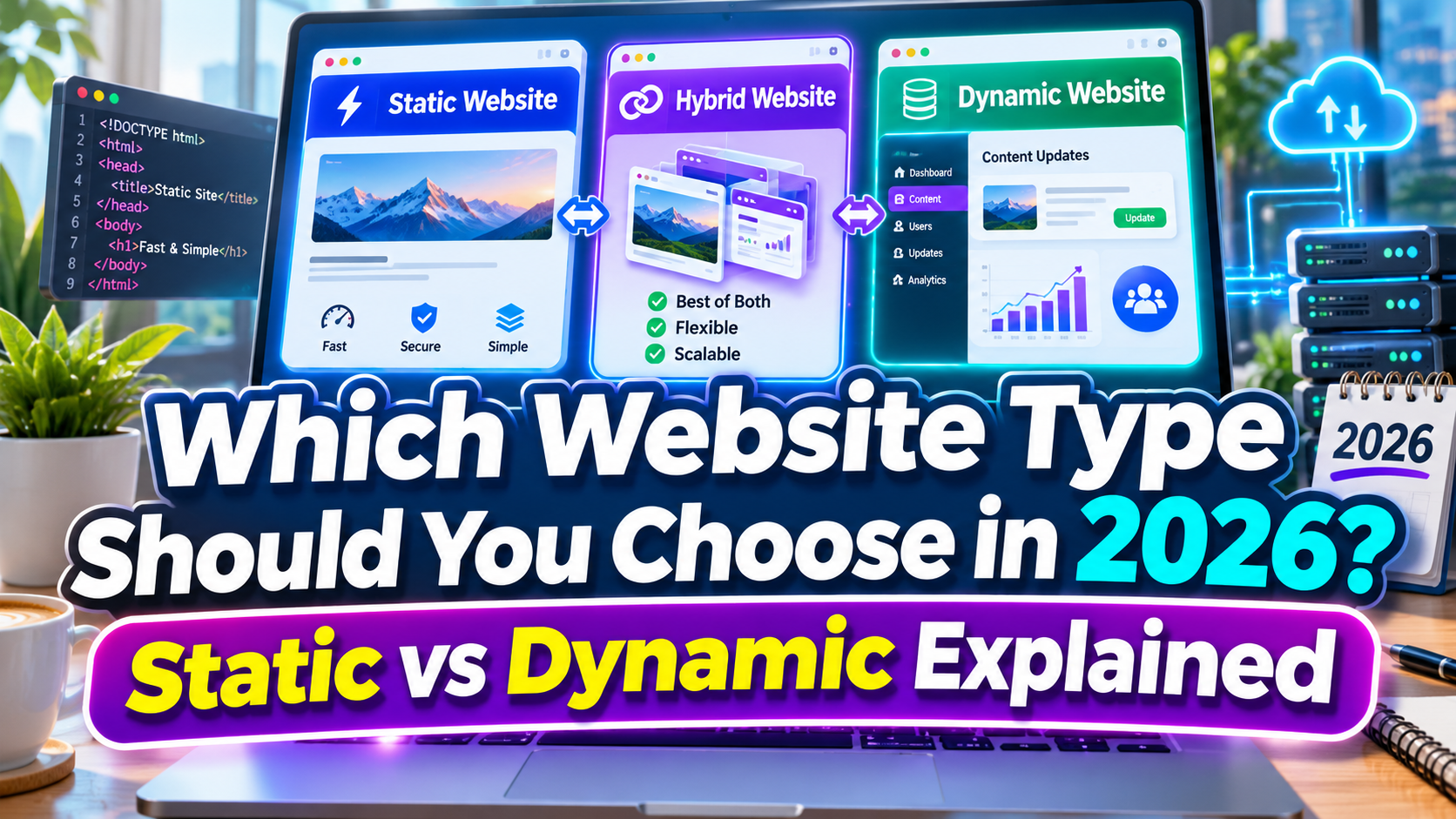
Static vs Dynamic Websites 2026: Which Architecture Is Better for Your Business?
Choosing the right website architecture is an important decision for businesses, developers, and digital creators. Website structure affects performance, maintenance, functionality, and the experience visitors receive.
The static vs dynamic websites 2026 comparison explores two established approaches to building websites, alongside hybrid architectures that combine their advantages.
Static websites prioritize prebuilt content and straightforward delivery, while dynamic websites support database-driven information, personalized experiences, and interactive business operations.
Understanding these differences helps organizations select technology that supports their immediate needs and future growth.
What Is a Static Website?
A static website delivers prebuilt HTML pages, typically accompanied by CSS, JavaScript, and images.
The server generally provides the same page content to visitors requesting a particular URL.
Static websites can still include animations, interactive components, and browser-based functionality. The defining characteristic is how the initial content is generated and delivered.
Advantages of Static Websites
Static websites are often straightforward to host, cache, and distribute through content delivery networks.
Their smaller server-side attack surface can simplify security management, while prebuilt pages can provide excellent loading performance.
They are particularly effective when content changes infrequently or can be regenerated automatically.
PROS: Efficient delivery, simpler hosting, lower maintenance requirements, and strong caching potential.
BEST FOR: Portfolio websites, landing pages, documentation, event websites, and informational business pages.
What Is a Dynamic Website?
A dynamic website generates or retrieves content according to requests, application logic, database information, or user activity.
For example, an online store may display personalized account information, current inventory, and individual order histories.
Dynamic websites commonly use server-side technologies, databases, and content management systems.
Advantages of Dynamic Websites
Dynamic architecture supports frequently updated content, authentication, personalization, and transactions.
Business owners can manage information through administrative interfaces without manually editing individual HTML files.
However, database operations, server configuration, security updates, and application complexity require appropriate maintenance.
PROS: Flexible functionality, database integration, content management, and personalized experiences.
BEST FOR: E-commerce stores, membership websites, SaaS applications, customer portals, and interactive platforms.
Identify Your Website’s Functional Requirements
Before choosing an architecture, determine what visitors need to accomplish.
A creative portfolio displaying selected projects may work perfectly as a static website. An online store processing payments and managing customer accounts requires dynamic functionality.
Consider how frequently content changes, whether users need accounts, and which integrations support daily operations.
Also evaluate hosting costs, technical expertise, expected traffic, and future expansion.
Choose an architecture that solves actual business requirements rather than following technology trends.
What Is a Hybrid Website?
Hybrid websites combine prebuilt pages with dynamic functionality.
Instead of generating every page for each request, developers can pre-render informational content while using server-side processing or APIs for interactive features.
For example, an e-commerce website could deliver cached product information while handling inventory checks, shopping carts, and checkout operations dynamically.
Frameworks such as Next.js and Astro support combinations of static and on-demand rendering.
Why Hybrid Websites Are Popular in 2026
Hybrid architecture gives developers more control over which parts of a website require real-time processing.
Static site generation (SSG) creates pages ahead of time, while server-side rendering (SSR) generates content when requested.
Incremental Static Regeneration (ISR) can update prebuilt pages without rebuilding an entire website.
These techniques help balance delivery efficiency with changing content and personalized functionality.
PROS: Flexible rendering, improved caching opportunities, dynamic features, and adaptable performance.
BEST FOR: Growing businesses, content platforms, modern e-commerce websites, and scalable web applications.
5 Key Differences Between Static and Dynamic Websites
1. Website Speed and Performance
Static pages can load efficiently because their content is already generated.
Dynamic pages may require additional processing, but effective caching and optimized infrastructure can deliver comparable performance.
Neither architecture guarantees speed without proper optimization.
2. Security and Maintenance
Static websites generally expose fewer server-side application components.
Dynamic websites require additional protection for databases, authentication systems, plugins, and administrative interfaces.
Both still need secure hosting, dependency updates, and responsible configuration.
3. Content Management
Static websites may use code repositories, build systems, or headless CMS platforms.
Dynamic websites frequently provide integrated dashboards for managing products, articles, and customer information.
The best choice depends on publishing frequency and editorial requirements.
4. SEO and Search Visibility
Both static and dynamic websites can perform well in search engines.
Search visibility depends on crawlable content, meaningful page structure, metadata, performance, and useful information.
Pre-rendered HTML can simplify content discovery, while poorly implemented client-side rendering may introduce indexing challenges.
5. Scalability and Business Growth
Static hosting can efficiently distribute substantial traffic through CDNs.
Dynamic platforms offer greater operational flexibility but may require database optimization, caching, and infrastructure scaling.
Hybrid architectures can distribute workloads according to the requirements of individual pages.
Comparison: Static vs Dynamic vs Hybrid Websites
| Feature | Static Website | Dynamic Website | Hybrid Website |
|---|---|---|---|
| Content delivery | Prebuilt pages | Generated or retrieved dynamically | Combination |
| Performance | Often fast | Depends on optimization | Flexible |
| Security maintenance | Generally simpler | More application components | Varies |
| Personalization | Requires added services | Built-in possibilities | Selective |
| Content updates | Rebuild or publishing workflow | CMS or database | Both |
| Best for | Portfolios and landing pages | Stores and applications | Growing digital platforms |
Which Architecture Should You Choose?
Choose static architecture for relatively simple informational websites. Select dynamic architecture when transactions, user accounts, or database-driven operations are central to the experience.
Consider hybrid architecture when your project requires both efficient content delivery and advanced interactive features.
Regardless of architecture, branding matters. Explore professional fonts at PutraCetol Studio to create distinctive website headlines, logos, and promotional graphics.
Common Mistakes When Choosing Website Architecture
One common mistake is assuming static websites cannot support interactive functionality. Modern static websites can use JavaScript, external APIs, and serverless services to introduce forms, search features, and other interactive elements. Similarly, dynamic websites are not automatically slow or insecure. Proper caching, secure authentication, optimized databases, and reliable infrastructure can significantly improve their performance. Developers should compare real implementation requirements rather than relying on outdated assumptions.
Another mistake is selecting an architecture without considering long-term maintenance and business growth. A completely static structure may become inconvenient when a project develops extensive personalized features, while an unnecessarily complex dynamic application can increase operational costs. Businesses should evaluate content workflows, integration requirements, hosting expenses, and security responsibilities before development. Performance testing and realistic scalability planning are essential regardless of the chosen approach.
Conclusion
The static vs dynamic websites 2026 comparison demonstrates that no single architecture is ideal for every project.
Static websites offer efficient content delivery and simpler infrastructure, while dynamic websites support sophisticated functionality and personalized interactions.
Hybrid websites provide another option by combining pre-rendered content with dynamic processing.
The right solution depends on your business goals, content requirements, technical resources, and expected growth.
Pair an appropriate website architecture with thoughtful design and professional typography from PutraCetol Studio to create a fast, functional, and memorable digital experience.
Explore these fonts and many more at PutraCetol.com to build a business identity that looks professional, trustworthy, and memorable.
Additionally, if you want to explore some free typography options, you can check out Putracetol Studio on Dafont. Happy reading and designing!