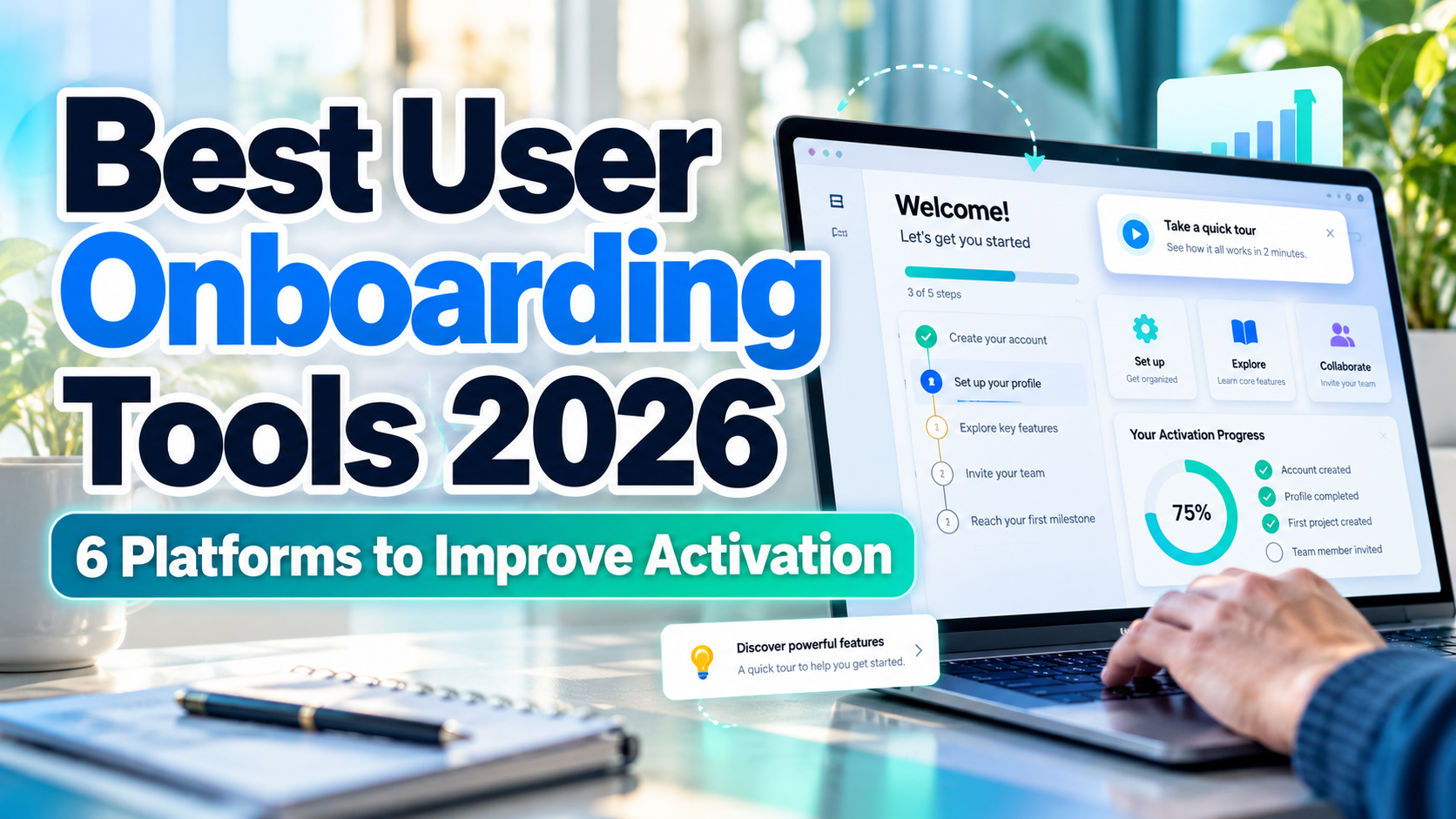
Best User Onboarding Tools 2026: 6 Platforms for Faster Product Adoption
A new user signing up is not the same as a successfully activated user.
The critical moment comes when that person understands the product, completes an important action, and experiences enough value to return. If that process takes too long, even an excellent product can lose potential customers before they discover why it matters.
The best user onboarding tools 2026 help product teams shorten this time-to-value through interactive walkthroughs, checklists, contextual tooltips, personalized messages, analytics, and self-service support.
Modern onboarding has also moved beyond the traditional product tour. The strongest platforms increasingly respond to user behavior, segment experiences by role or lifecycle stage, and measure whether guidance actually improves activation.
Define the Activation Event First
Before building onboarding screens, determine what successful activation actually means.
For project-management software, it might be creating the first project and inviting a teammate. For an analytics platform, it may be connecting a data source and viewing the first report.
Build onboarding around those meaningful actions rather than introducing every feature.
A five-step checklist that moves users toward real value is usually more useful than a 20-step tour explaining the entire interface.
Recommended User Onboarding Tools for 2026
1. Appcues: Best Overall for Product-Led Onboarding
Appcues combines product tours, checklists, launchers, persistent pins, banners, embedded content, NPS surveys, and behavioral targeting.
Its experiences can be personalized according to product behavior and user attributes, allowing teams to show different onboarding journeys to different audiences. Once Appcues is installed, product teams can create and publish experiences without repeatedly changing application code.
Its checklists are particularly useful for guiding new users through activation milestones while allowing them to complete tasks at their own pace.
PROS: Broad onboarding patterns, behavioral targeting, personalization, analytics, no-code publishing.
BEST FOR: SaaS companies, product-led growth teams, startups, feature adoption campaigns.
2. Userpilot: Best for Onboarding Plus Product Analytics
Userpilot connects onboarding directly with behavioral product analytics.
Teams can create tours, tooltips, banners, checklists, personalized flows, and resource centers while tracking funnels, paths, retention, feature adoption, and onboarding completion. Its checklists support real-time triggering and can adapt items according to user behavior.
Userpilot’s current platform also combines in-app, mobile, and behavior-triggered email experiences, while its AI agent Lia is designed to identify activation friction and assist with creating interventions.
PROS: Onboarding and analytics together, segmentation, autocapture, resource center, multi-channel engagement.
BEST FOR: Product managers, growth teams, mid-size SaaS companies, data-driven onboarding.
3. Pendo: Best for Enterprise Product Experience
Pendo combines product analytics, in-app guides, feedback, NPS, and resource-center functionality in a broader product-experience platform.
Its analytics can identify friction through funnels and paths, while Guides can deliver personalized onboarding, walkthroughs, announcements, and contextual support. Pendo also added Guide Effectiveness reporting in 2026 to compare engagement, completion, and goal adoption across guides.
This deeper combination of analytics and guidance makes Pendo particularly useful for organizations managing multiple products or large user populations.
PROS: Strong analytics, targeted guidance, feedback tools, enterprise-scale product insights.
BEST FOR: Enterprises, large SaaS portfolios, Product Operations, mature product organizations.
4. Chameleon: Best for Highly Customized In-App Experiences
Chameleon focuses on creating onboarding that feels integrated with the underlying product rather than layered on top of it.
Teams can build tours, tooltips, embeddable cards and banners, and microsurveys while controlling exactly who sees each experience and when.
Its current Tour workflow also includes AI-assisted capabilities such as Copilot-generated walkthroughs, automatic experimentation, and timing optimization.
PROS: Flexible visual experiences, precise targeting, embedded UI patterns, AI-assisted optimization.
BEST FOR: Design-focused SaaS, sophisticated product teams, branded onboarding experiences.
5. Userflow: Best for Fast No-Code Implementation
Userflow is designed around quickly building in-app onboarding without constant developer involvement.
Its platform includes flows, checklists, announcements, banners, surveys, resource centers, event trackers, and an AI Adoption Agent. Teams can automatically trigger onboarding according to user attributes and other conditions.
Persistent checklists are especially useful for complex products because users can leave the guided experience and return to their remaining onboarding tasks later.
PROS: Fast setup, no-code flows, flexible checklists, AI support, resource center.
BEST FOR: Startups, lean product teams, B2B SaaS, companies wanting rapid deployment.
6. Intercom Product Tours: Best for Support-Led Onboarding
Intercom Product Tours works particularly well when onboarding is closely connected with customer messaging and support.
Teams can build multi-step tours without coding, automatically target specific audiences, introduce new features, and send users directly into tours from conversations, messages, bots, or email links.
That makes it useful for companies where Customer Success and support teams actively participate in adoption.
PROS: Product tours, audience targeting, messaging integration, support-driven engagement.
BEST FOR: Customer Success teams, support-heavy SaaS, Intercom users, feature education.
Comparison: Best User Onboarding Tools 2026
| Platform | Main Strength | Best For |
|---|---|---|
| Appcues | Complete product-led onboarding | SaaS and PLG |
| Userpilot | Onboarding + analytics | Data-driven product teams |
| Pendo | Enterprise product experience | Large organizations |
| Chameleon | Custom in-app design | Design-focused products |
| Userflow | Fast no-code deployment | Startups and lean teams |
| Intercom | Support-connected onboarding | Customer Success |
What Makes Effective Onboarding in 2026?
The strongest onboarding adapts to the user instead of forcing everyone through the same tutorial.
A marketing manager, administrator, developer, and first-time business owner may use the same software for completely different reasons. Segmenting users by role, objective, behavior, or account type allows the onboarding experience to focus on the value most relevant to each person.
Visual consistency also matters. Onboarding modals, emails, help content, launch graphics, and educational materials should feel connected to the wider brand. Businesses can explore fonts from PutraCetol Studio for marketing graphics and branded onboarding materials while keeping interface typography highly readable.
Common Mistakes
One common mistake is turning onboarding into a product feature tour. New users rarely need to understand every menu immediately. Instead, identify the shortest path between signup and meaningful value, then reveal additional capabilities contextually as users become ready for them.
Another mistake is measuring completion instead of activation. A user can finish every onboarding screen and still fail to experience the product’s core value. Track actions such as successful setup, feature adoption, collaboration, repeat usage, and conversion rather than celebrating tour completion alone.
Finally, avoid interrupting users constantly. Too many pop-ups, tooltips, surveys, and announcements create friction instead of removing it. Effective onboarding appears when guidance is useful and disappears when users can succeed independently.
Conclusion
The best user onboarding tools 2026 solve different parts of the adoption journey.
Appcues delivers strong all-around product-led onboarding, Userpilot connects guidance with behavioral analytics, Pendo suits enterprise product organizations, Chameleon emphasizes customized in-app experiences, Userflow enables rapid no-code deployment, and Intercom works well when support and onboarding are closely connected.
The goal is not to show users more instructions. It is to help them reach meaningful value faster and give them fewer reasons to leave.
Explore these fonts and many more at PutraCetol.com to build a business identity that looks professional, trustworthy, and memorable.
Additionally, if you want to explore some free typography options, you can check out Putracetol Studio on Dafont. Happy reading and designing!