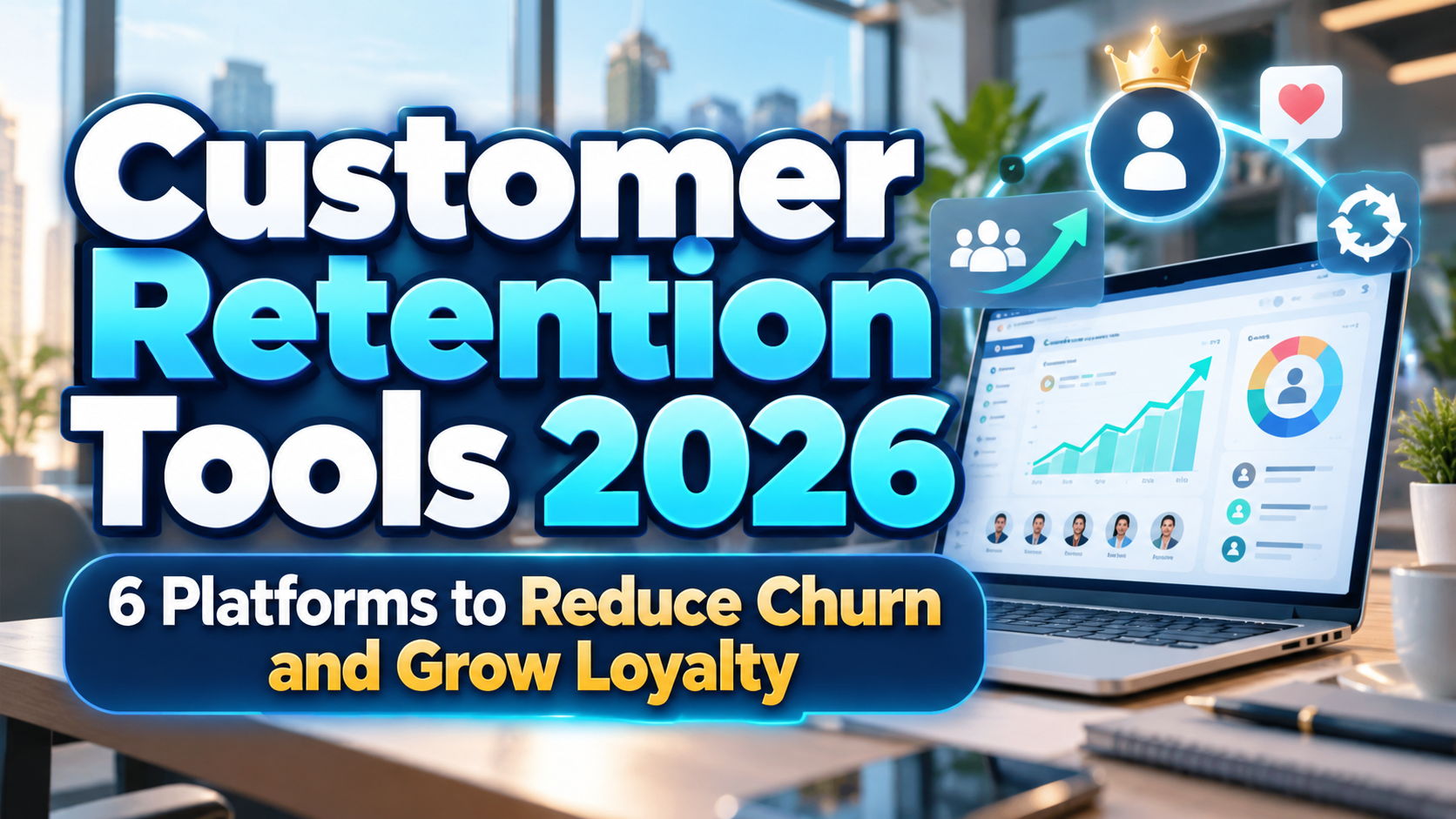
Customer Retention Tools 2026: 6 Platforms for Sustainable Customer Growth
Acquiring customers is only the beginning of growth.
If users subscribe, purchase once, or create an account but never return, increasing acquisition spending simply pours more customers into a leaking funnel. Sustainable businesses therefore pay close attention to retention, repeat purchases, product adoption, renewals, customer satisfaction, and customer lifetime value.
The strongest customer retention tools 2026 help companies understand why customers stay, recognize early signs of churn, and respond before relationships deteriorate.
However, retention software is not one category. SaaS companies may need health scores and renewal workflows, while ecommerce stores require lifecycle messaging, loyalty programs, and repeat-purchase incentives. Product teams often need behavioral analytics to understand which features actually make users return.
Measure Retention Before Automating It
Before purchasing another platform, define what “retained” means for your business.
For a SaaS company, it might mean an active subscription plus regular product usage. An ecommerce store may measure second-purchase rate, purchase frequency, or customer lifetime value. A mobile app may track Day 7, Day 30, and monthly active-user retention.
Then identify leading indicators.
For example, users who finish onboarding, invite teammates, or use a core feature repeatedly may retain better than users who do not. Once those behaviors are understood, retention tools can trigger the right intervention instead of sending generic “We miss you” messages.
Recommended Customer Retention Tools for 2026
1. Gainsight: Best for Enterprise Customer Success
Gainsight is one of the strongest choices for organizations where customer retention is managed by dedicated Customer Success teams.
Its platform combines customer data, health scoring, risk signals, workflows, product adoption, education, and community capabilities. Gainsight’s current platform also uses AI agents to interpret customer context and support retention and expansion workflows. Its Customer 360 system can combine engagement, product activity, account information, and other inputs into customer-health views.
PROS: Enterprise customer health, risk detection, automation, product adoption, customer education.
BEST FOR: B2B SaaS, enterprise subscriptions, mature Customer Success organizations.
2. ChurnZero: Best for B2B SaaS Churn Prevention
ChurnZero is designed specifically around customer growth and recurring-revenue relationships.
Its platform provides a 360-degree account view, product engagement data, customer health and relationship insights, renewal forecasting, digital engagement, and churn-risk identification. Its 2026 platform also emphasizes AI agents that can perform follow-up actions rather than simply presenting recommendations.
This focus makes ChurnZero particularly suitable when renewals, adoption, and account expansion are central business metrics.
PROS: Churn monitoring, renewal visibility, in-app engagement, AI workflows, SaaS focus.
BEST FOR: Subscription software, Customer Success teams, recurring-revenue businesses.
3. Vitally: Best for Flexible Customer Success Operations
Vitally combines customer data with highly configurable health scoring and automated playbooks.
Teams can create different health models according to lifecycle stage, customer segment, plan, or region. Health changes can automatically trigger tasks, alerts, emails, renewal workflows, or other playbooks. Vitally also connects customer health with product usage, NPS, account information, meetings, and collaborative documents.
This flexibility is useful for businesses where one retention model cannot accurately represent every customer.
PROS: Flexible health scores, playbooks, automation, customer collaboration, integrated CS workspace.
BEST FOR: Growing B2B SaaS companies, CS Operations, segment-based retention programs.
4. Amplitude: Best for Product-Led Retention
Amplitude approaches retention from user behavior rather than account management.
Its product analytics tools can measure onboarding, feature adoption, engagement, funnels, cohorts, journeys, and retention over time. Teams can compare behavioral cohorts to discover which actions correlate with customers continuing to use a product.
For example, a SaaS company might discover that customers who use one collaboration feature during their first week retain significantly better. Product teams can then redesign onboarding to move more users toward that value moment.
PROS: Behavioral analytics, cohort analysis, funnels, feature adoption, retention measurement.
BEST FOR: Product-led SaaS, mobile apps, digital platforms, Product and Growth teams.
5. Klaviyo: Best for Ecommerce Lifecycle Retention
Klaviyo is particularly useful when retention depends on personalized communication after a purchase.
Businesses can organize customer profiles using behavior and transaction data, build segments, and coordinate email and SMS engagement. Retention flows can respond to customer behavior and RFM groups, allowing brands to send different recommendations or re-engagement messages according to purchase history and customer value.
This makes Klaviyo especially useful for turning first-time ecommerce buyers into repeat customers.
PROS: Lifecycle automation, segmentation, email and SMS, behavioral profiles, ecommerce focus.
BEST FOR: DTC brands, Shopify stores, ecommerce retention, repeat-purchase campaigns.
6. Yotpo Loyalty & Referrals: Best for Loyalty Programs
Yotpo approaches customer retention through rewards, VIP tiers, referrals, and repeat-purchase incentives.
Businesses can reward purchases and engagement, create VIP tiers based on spending or purchase frequency, and operate referral programs that turn existing customers into advocates. Its retention reporting can also measure repeat-purchase rates and revenue coming from returning customers.
PROS: Loyalty points, VIP tiers, referrals, repeat-purchase tracking, ecommerce integrations.
BEST FOR: Ecommerce brands, retail loyalty, DTC companies, repeat-purchase businesses.
Comparison: Customer Retention Tools 2026
| Platform | Main Strength | Best For |
|---|---|---|
| Gainsight | Enterprise customer success | Large B2B SaaS |
| ChurnZero | Churn and renewals | Subscription businesses |
| Vitally | Flexible CS automation | Growing SaaS teams |
| Amplitude | Product retention analytics | Product-led companies |
| Klaviyo | Lifecycle marketing | Ecommerce |
| Yotpo | Loyalty and referrals | Repeat-purchase brands |
The strongest retention stack may combine categories. A SaaS company might use Amplitude to identify risky behavior and Gainsight to coordinate CSM intervention. An ecommerce business could combine Klaviyo lifecycle messaging with Yotpo loyalty incentives.
Build Retention Around the Entire Customer Experience
Retention is influenced by more than software.
Product quality, customer support, onboarding, communication, pricing, fulfillment, and brand consistency all shape whether someone returns.
Visual identity also contributes to recognition. Businesses can use typography from PutraCetol Studio across loyalty campaigns, email graphics, packaging, social content, member promotions, and customer-facing brand materials so that every retention touchpoint feels connected to the same brand.
Common Mistakes
A common mistake is treating churn as something to address only when cancellation begins. By then, disengagement may have been developing for weeks. Monitor earlier signals such as declining product usage, incomplete onboarding, reduced purchase frequency, repeated support problems, poor survey scores, or falling engagement.
Another mistake is automating every customer interaction. Automation works well for reminders, segmentation, alerts, and routine engagement, but high-value customers may still require human intervention. The goal is not to eliminate relationships. It is to use automation so teams can recognize the moments where personal attention matters most.
Finally, avoid measuring retention with one universal benchmark. A daily productivity app, annual SaaS contract, fashion store, and subscription service naturally have different return cycles. Define retention around the customer’s expected behavior and business model.
Conclusion
The best customer retention tools 2026 solve different parts of the retention problem.
Gainsight supports enterprise Customer Success, ChurnZero focuses on recurring-revenue relationships, Vitally offers flexible CS operations, Amplitude reveals product behaviors that drive retention, Klaviyo manages ecommerce lifecycle communication, and Yotpo strengthens loyalty and referrals.
The winning strategy is not simply acquiring more customers. It is understanding why valuable customers stay, helping more customers reach the same value, and creating reasons for them to continue the relationship.
Explore these fonts and many more at PutraCetol.com to build a business identity that looks professional, trustworthy, and memorable.
Additionally, if you want to explore some free typography options, you can check out Putracetol Studio on Dafont. Happy reading and designing!