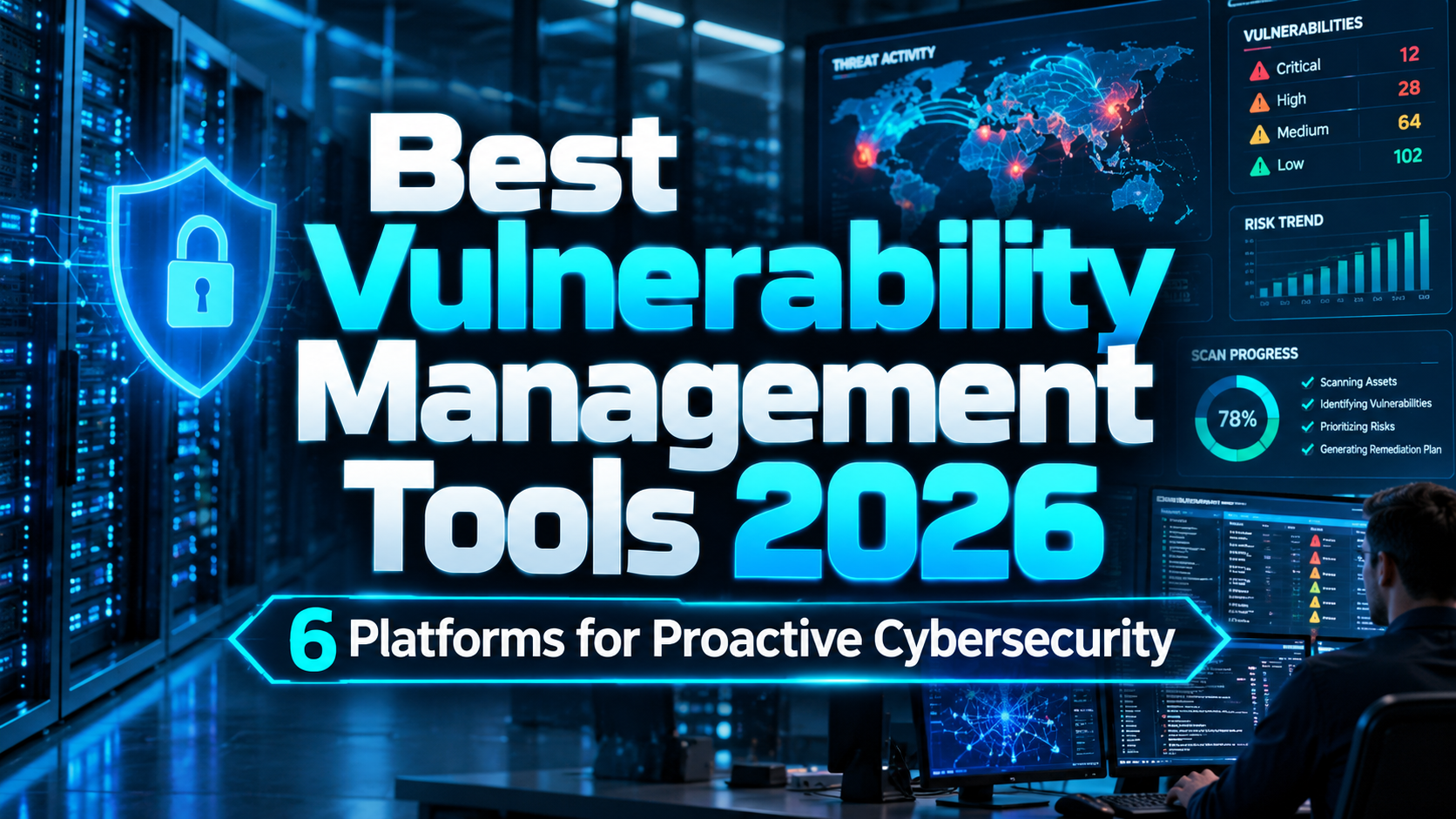
Best Vulnerability Management Tools 2026: 6 Platforms for Proactive Security
Modern organizations can have thousands or even millions of vulnerability findings across endpoints, servers, cloud workloads, applications, network devices, containers, and remote infrastructure.
Finding vulnerabilities is therefore only the beginning.
The best vulnerability management tools 2026 increasingly focus on determining which weaknesses create meaningful business risk. Instead of treating every high CVSS score as equally urgent, modern platforms combine exploitability, asset criticality, threat intelligence, attack paths, exposure, and business context.
This shift toward risk-based vulnerability management and broader exposure management helps cybersecurity teams focus limited remediation resources where they can reduce risk most effectively.
Prioritize Risk, Not Vulnerability Count
Do not judge a security program by how many vulnerabilities it closes.
A critical vulnerability on an isolated test machine may present less immediate risk than a medium-rated weakness on an internet-facing production system containing sensitive customer data.
Modern vulnerability management should answer four questions: What assets exist? What is vulnerable? Which vulnerabilities are realistically exploitable? Who owns the remediation?
Tenable describes this approach as moving beyond discovery by correlating severity, threat activity, asset criticality, and business impact.
Recommended Vulnerability Management Tools for 2026
1. Tenable Vulnerability Management: Best Overall for Risk-Based Vulnerability Management
Tenable combines continuous asset discovery, vulnerability assessment, threat intelligence, and risk-based prioritization across traditional IT, cloud environments, containers, OT/IoT, and other modern assets.
Its Vulnerability Priority Rating helps organizations move beyond static severity scores by considering exploitability and threat context. Tenable also supports remediation guidance, ticketing workflows, compliance monitoring, and increasingly automated remediation through the broader Tenable One platform.
PROS: Broad asset coverage, mature vulnerability research, risk prioritization, strong exposure-management capabilities.
BEST FOR: Enterprises, hybrid infrastructure, security teams managing large and diverse attack surfaces.
2. Qualys VMDR: Best for Integrated Detection and Remediation
Qualys VMDR combines asset inventory, vulnerability detection, threat prioritization, patch identification, and remediation workflows inside one cloud platform.
Continuous cloud agents and other sensors can assess assets across hybrid IT environments, while Qualys TruRisk incorporates multiple threat signals rather than relying exclusively on CVSS. Its VMDR workflow can identify vulnerable assets, determine missing patches, and move directly toward remediation.
PROS: Continuous assessment, integrated patching, asset inventory, risk scoring, strong enterprise scalability.
BEST FOR: Large enterprises, compliance-heavy organizations, distributed endpoints, hybrid IT.
3. Rapid7 InsightVM: Best for Security Operations Integration
Rapid7 InsightVM combines vulnerability scanning with asset organization, remediation prioritization, dashboards, reporting, and integrations.
Its vulnerability intelligence draws from Rapid7 research, Metasploit exploit knowledge, attacker behavior, internet-wide scanning, and exposure analytics. Security teams can organize assets by business context and use remediation reports to identify fixes that deliver meaningful risk reduction.
Rapid7 is also expanding InsightVM into its broader Exposure Command strategy, connecting internal vulnerability data with attack-surface, cloud, and application context.
PROS: Strong security analytics, Metasploit context, reporting, SIEM and workflow integration.
BEST FOR: SOC teams, mid-market enterprises, organizations already using Rapid7 security products.
4. Microsoft Defender Vulnerability Management: Best for Microsoft-Centric Environments
Microsoft Defender Vulnerability Management is particularly attractive to organizations already invested in Defender, Intune, Windows, and Microsoft security infrastructure.
The platform provides continuous asset discovery, software and device inventories, security recommendations, vulnerability prioritization, and remediation tracking. Microsoft combines threat intelligence, breach-likelihood predictions, business context, and device information to determine which weaknesses deserve attention first.
Its updated exposure model also incorporates factors including EPSS, internet-facing status, and asset criticality.
PROS: Deep Microsoft integration, continuous assessment, endpoint context, actionable remediation workflows.
BEST FOR: Microsoft-heavy enterprises, Defender for Endpoint users, IT teams using Intune.
5. Wiz: Best for Cloud and Code-to-Cloud Vulnerability Context
Wiz approaches vulnerability management through cloud and exposure context.
Its Unified Vulnerability Management combines native scanning with findings from third-party vulnerability, SAST, DAST, penetration-testing, and other tools. The Wiz Security Graph then adds context such as internet exposure, identity access, sensitive data, and attack paths to help distinguish dangerous vulnerabilities from background noise.
In September 2026, Wiz introduced Continuous Vulnerability Assessment, which reassesses exposure when newly published vulnerabilities enter its catalog rather than waiting for the next scheduled scan.
PROS: Agentless cloud assessment, graph-based prioritization, code-to-cloud visibility, strong attack-path context.
BEST FOR: Cloud-native enterprises, DevSecOps teams, multi-cloud environments.
6. CrowdStrike Falcon Exposure Management: Best for Threat-Informed Prioritization
CrowdStrike combines vulnerability management with real-world adversary intelligence.
Falcon Exposure Management continuously identifies vulnerabilities, misconfigurations, and attack paths across endpoints, cloud, networks, external assets, OT/IoT, and other environments. Its prioritization incorporates exploitability, adversary behavior, asset criticality, and attack-path context.
CrowdStrike also supports network vulnerability assessment and can map newly published CVEs against an environment without waiting for a conventional scan cycle.
PROS: Threat intelligence, continuous exposure visibility, exploitability analysis, endpoint and attack-path context.
BEST FOR: SOC teams, CrowdStrike environments, threat-driven security programs.
Comparison: Best Vulnerability Management Tools 2026
| Platform | Main Strength | Best For |
|---|---|---|
| Tenable | Risk-based vulnerability management | Large hybrid enterprises |
| Qualys VMDR | Detection through remediation | Enterprise IT |
| Rapid7 InsightVM | Security analytics integration | SOC and mid-market |
| Microsoft Defender VM | Microsoft ecosystem | Microsoft-centric companies |
| Wiz | Cloud contextualization | Cloud and DevSecOps |
| CrowdStrike | Adversary-driven prioritization | Threat-focused security teams |
The major 2026 trend is clear: vulnerability management is becoming exposure management. Leading platforms increasingly combine CVEs with asset importance, network reachability, identity, cloud context, and active attacker behavior.
Common Mistakes
A common mistake is attempting to patch every vulnerability according to severity alone. CVSS provides useful technical information, but it does not automatically tell an organization which vulnerability represents the greatest immediate business risk. Add exploit intelligence, exposure, asset criticality, and known attacker activity to the prioritization process.
Another mistake is running scans without establishing remediation ownership. A security team can identify thousands of weaknesses, but risk will not decrease unless findings reach the correct infrastructure, endpoint, cloud, or development teams. Define owners, SLAs, exceptions, ticketing workflows, and verification procedures before measuring program success.
Finally, avoid treating vulnerability management as a monthly compliance exercise. Assets and cloud resources change continuously, and new vulnerabilities can emerge between scheduled scans. Effective programs combine ongoing asset visibility with continuous assessment and measurable remediation.
Conclusion
The best vulnerability management tools 2026 increasingly compete on context rather than vulnerability volume.
Tenable provides broad risk-based coverage, Qualys connects discovery with remediation, Rapid7 integrates strongly with security operations, Microsoft Defender fits Microsoft environments, Wiz excels in cloud context, and CrowdStrike brings deep adversary intelligence into prioritization.
Cybersecurity teams should select the platform that best matches their attack surface, existing security stack, cloud strategy, remediation workflow, and compliance requirements.
For security reports, awareness campaigns, dashboards, presentations, and cybersecurity brand materials, organizations can also build a consistent visual identity using professional typography from PutraCetol Studio.
The goal is not to eliminate every vulnerability instantly. It is to continuously find and remove the exposures most likely to become the next breach.
Explore these fonts and many more at PutraCetol.com to build a business identity that looks professional, trustworthy, and memorable.
Additionally, if you want to explore some free typography options, you can check out Putracetol Studio on Dafont. Happy reading and designing!