
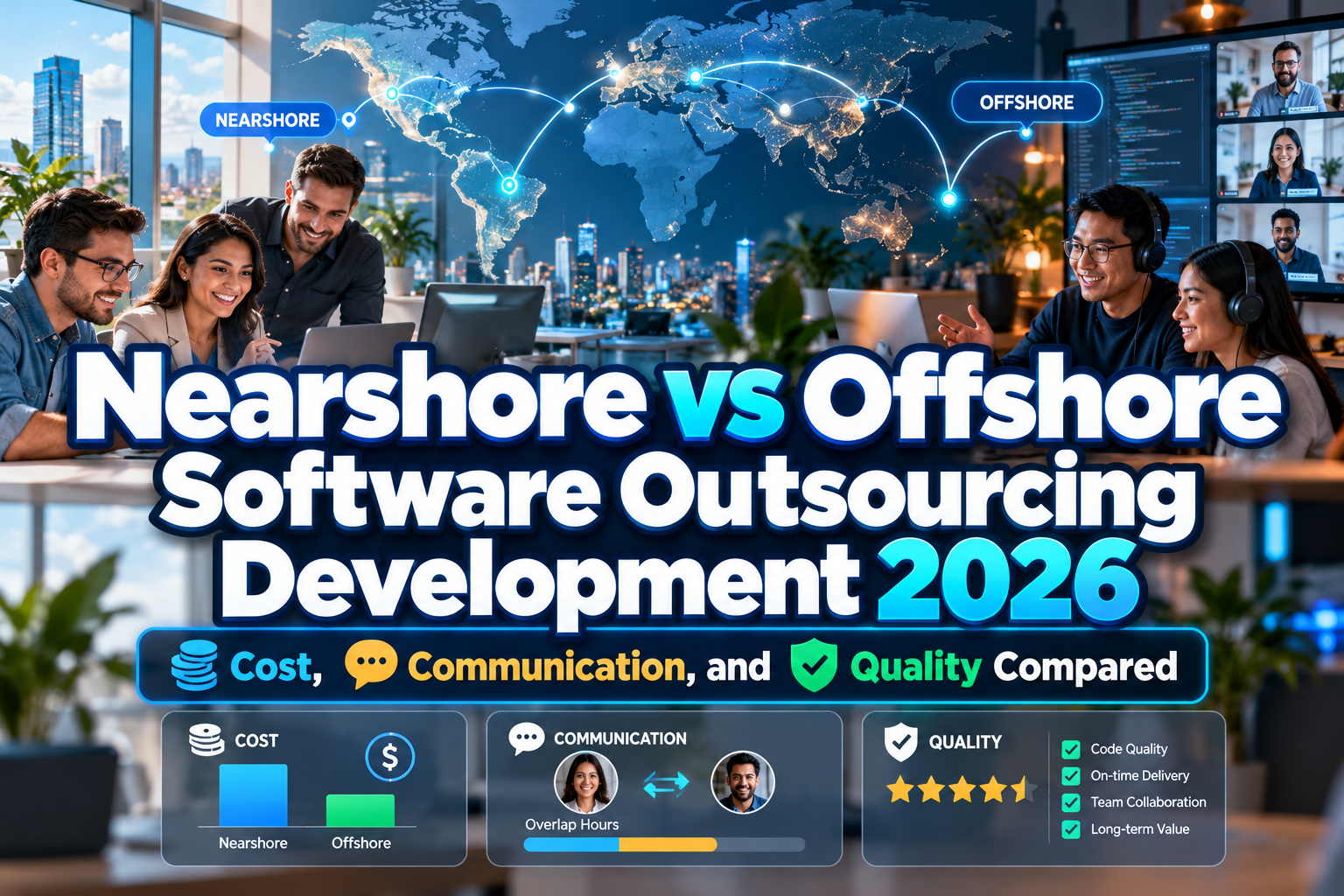
Nearshore vs Offshore Software Development 2026: Which Strategy Fits Your Business?
Software outsourcing is no longer simply a way to find cheaper developers.
Companies increasingly use external engineering teams to access specialized talent, accelerate product releases, expand development capacity, and avoid lengthy local recruitment cycles. This has made the nearshore vs offshore software development 2026 decision more strategic than a basic comparison of hourly rates.
Nearshore development places external teams in countries geographically or temporally close to the client. Offshore development usually involves a more distant region with a larger time-zone difference.
Both can work extremely well.
The important question is how each model affects the complete development process, including communication, decision speed, rework, security, technical expertise, and project management.
Compare Total Delivery Cost, Not Hourly Rates
The lowest developer rate does not automatically produce the cheapest software.
Imagine one team charges substantially less per hour but requires additional meetings, more detailed documentation, repeated clarification, and extra revisions. The apparent saving can shrink quickly.
Instead, calculate total delivery cost.
Consider engineering rates, project-management overhead, QA, rework, communication time, infrastructure, onboarding, security reviews, and the cost of delayed releases.
This matters even more in 2026 as AI-assisted engineering increases coding productivity. Simply purchasing the largest number of inexpensive development hours is becoming less valuable than finding teams capable of making good architectural and product decisions.
What Is Nearshore Software Development?
Nearshore outsourcing means working with developers in a nearby country or region, usually with substantial overlap between working hours.
For a U.S. company, Latin American teams are a common example. For Western European businesses, nearby European countries can serve the same purpose.
The defining advantage is not physical distance alone. It is collaboration availability.
Deloitte has highlighted real-time collaboration as an important benefit of nearshore engineering, particularly for work requiring frequent interaction between technical disciplines.
Where Nearshore Works Best
Nearshore development is especially effective for Agile product teams where requirements evolve continuously.
Product managers can discuss features with developers during normal working hours. Designers can review implementations immediately. Engineers can troubleshoot production problems without waiting for the next day’s handoff.
This makes nearshore teams attractive for SaaS development, user-facing products, AI features, fintech platforms, ecommerce systems, and applications requiring rapid iteration.
What Is Offshore Software Development?
Offshore development usually involves working with engineering teams located much farther away.
South and Southeast Asia remain major offshore technology regions because of their large developer populations and competitive labor economics. Eastern Europe can also operate as offshore for companies located far enough west, depending on working-hour overlap.
The main advantage is access to a large global talent pool at potentially lower labor costs.
Offshore teams can be particularly effective when tasks are clearly documented and can progress asynchronously.
For example, a U.S. team may finish requirements during its working day, an Asian development team works while the U.S. team sleeps, and completed work is ready for review the following morning.
This “follow-the-sun” workflow can increase throughput when responsibilities and handoffs are carefully structured.
Nearshore vs Offshore: Communication and Time Zones
Time-zone alignment is one of the biggest practical differences.
Nearshore teams usually allow several hours of live collaboration. Offshore teams may have only a short meeting window unless somebody adjusts their schedule.
That difference matters most when development requires constant conversation.
A 2026 study involving 80 outsourcing customers found advantages for temporally nearshore teams in areas including overall success, quality, schedule performance, project-management effort, and communication. The researchers particularly recommended nearshore arrangements for communication-intensive and Agile projects.
Offshore development is not inherently poor at communication. It simply requires stronger asynchronous processes, clearer tickets, detailed specifications, reliable documentation, and disciplined handoffs.
Nearshore vs Offshore: Cost
Offshore usually offers the strongest headline cost advantage.
Regions with lower labor costs can provide experienced developers at rates below those common in North America or Western Europe.
Nearshore development generally costs more, but the additional expense may purchase easier communication and faster decisions.
This is why hourly price should never be considered independently.
A nearshore engineer who resolves a product question in ten minutes may outperform a cheaper offshore arrangement where that same question blocks work until the following day.
For stable, well-defined work, the offshore cost advantage can be compelling. For highly iterative development, nearshore collaboration may produce a lower total project cost.
Talent and Technical Specialization
Geography should not restrict access to the expertise a project requires.
A cybersecurity platform may need specialized cloud-security engineers. An AI product may require machine-learning infrastructure expertise. A fintech application may need developers familiar with compliance-sensitive architectures.
Gartner’s sourcing guidance emphasizes evaluating locations according to the talent resources required rather than treating location models as interchangeable.
In practice, the better developer or vendor can matter more than whether the engagement is officially classified as nearshore or offshore.
Comparison: Nearshore vs Offshore Software Development 2026
| Factor | Nearshore | Offshore |
|---|---|---|
| Development cost | Moderate | Usually lower |
| Time-zone overlap | High | Limited |
| Real-time meetings | Easier | More difficult |
| Agile collaboration | Excellent | Requires discipline |
| Talent pool | Large | Very large |
| Async development | Good | Excellent |
| Project management | Generally easier | More structured |
| Travel accessibility | Easier | More difficult |
| Best for | Iterative products | Defined scalable work |
Neither model automatically produces higher-quality code. Quality depends on engineering talent, architecture, QA, leadership, documentation, and vendor maturity.
When Should You Choose Nearshore?
Choose nearshore when your internal product team needs frequent access to external developers.
It is particularly suitable when requirements change regularly, designers and engineers collaborate closely, daily stand-ups are important, or senior stakeholders expect rapid answers.
Nearshore can also work well for long-term team augmentation because external developers can behave more like an extension of the internal engineering organization.
When Should You Choose Offshore?
Choose offshore when cost efficiency and access to large engineering pools are higher priorities than continuous real-time interaction.
It works particularly well for projects with mature requirements, QA automation, maintenance, infrastructure work, data processing, clearly defined modules, and development processes built around asynchronous communication.
Strong documentation is essential.
Offshore teams perform best when specifications, acceptance criteria, API contracts, architecture decisions, and ownership boundaries are explicit.
Branding Still Matters When Launching the Product
Engineering determines whether the product works, but branding influences how customers perceive it.
Startups outsourcing development should not treat visual identity as an afterthought. Product websites, launch campaigns, app graphics, presentations, and social content should communicate a consistent personality.
Teams building these assets can explore distinctive typography from PutraCetol Studio for logos, promotional headlines, launch graphics, website hero sections, and other brand-facing materials while keeping product interfaces focused on usability.
Common Mistakes
A common mistake is selecting an outsourcing location entirely around hourly cost. Development involves continuous decision-making, and delays, rework, weak architecture, or communication problems can easily eliminate initial savings. Compare expected delivery outcomes rather than developer rates alone.
Another mistake is expecting an outsourced team to manage itself. Whether nearshore or offshore, someone must own product priorities, architecture, approvals, security, and acceptance criteria. Outsourcing engineering does not outsource accountability.
Finally, avoid choosing a region before defining the work. Communication-heavy product development may benefit from nearshore collaboration, while stable and modular tasks may be ideal for offshore delivery. Start with the workflow, then choose the geography.
Conclusion
The nearshore vs offshore software development 2026 decision has no universal winner.
Nearshore development offers stronger time-zone alignment, real-time collaboration, and easier integration with internal Agile teams. Offshore development can deliver greater cost efficiency, broader global talent access, and powerful asynchronous workflows.
For rapidly evolving products, nearshore often provides the smoother collaboration model. For well-defined, scalable development with strong documentation, offshore can offer excellent economics.
The best strategy is ultimately the one that balances cost, talent, communication, delivery speed, security, and management overhead rather than optimizing only one of them.
Explore these fonts and many more at PutraCetol.com to build a business identity that looks professional, trustworthy, and memorable.
Additionally, if you want to explore some free typography options, you can check out Putracetol Studio on Dafont. Happy reading and designing!