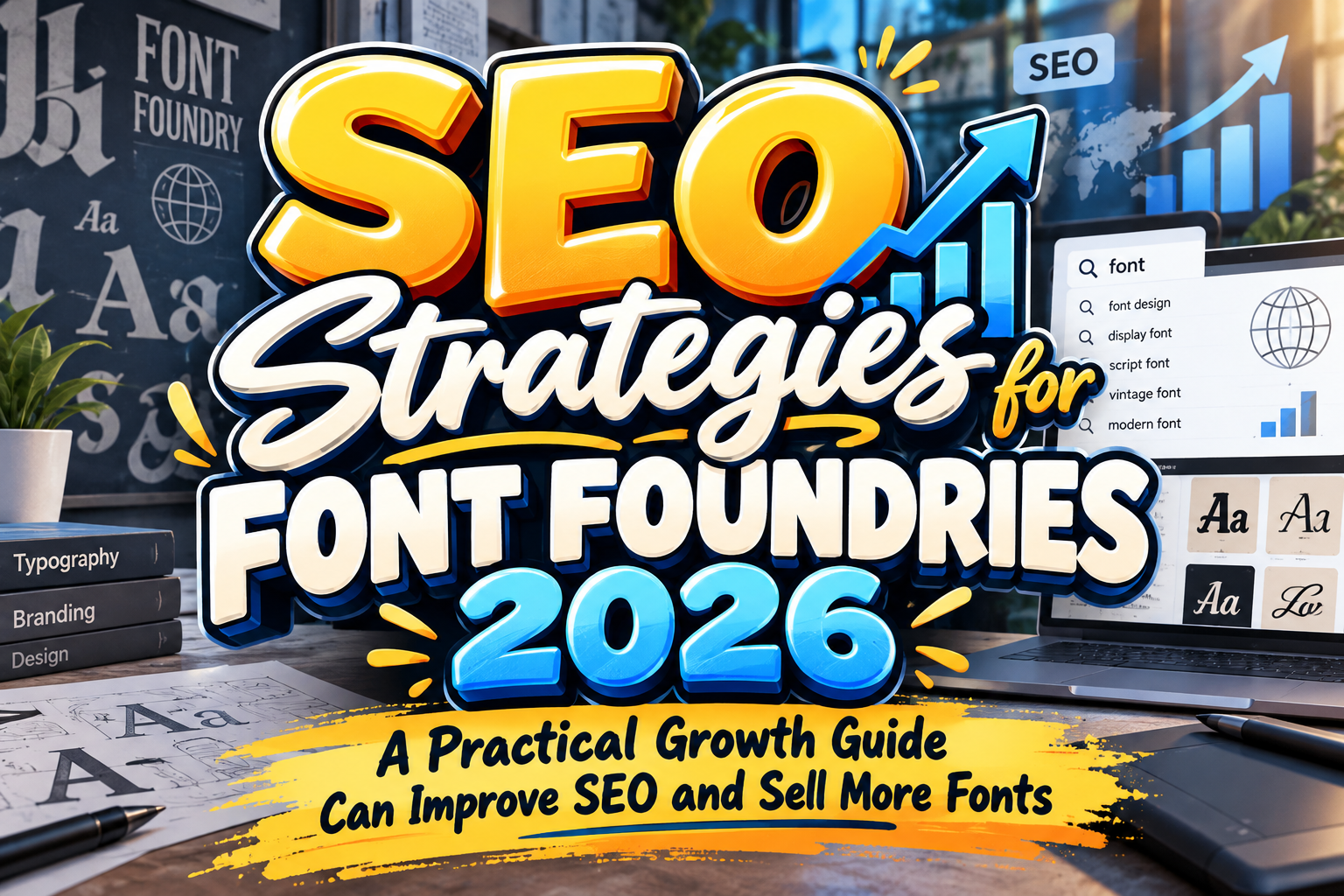
SEO Strategies for Font Foundries 2026: How to Build Visibility and Trust
A beautiful typeface can still remain invisible if potential buyers cannot discover it. For independent type designers and growing font foundries, search visibility has become part of the product strategy itself.
The most effective SEO strategies for font foundries 2026 combine traditional search optimization with strong product presentation, useful content, technical performance, and clear licensing information. The goal is not simply to rank for broad keywords such as “fonts,” but to appear when designers search for a specific style, purpose, industry, or design problem.
Initial Suggestion: Optimize Around Search Intent
Start by thinking like a font buyer.
Someone searching for “retro baseball font” has a different intention from someone searching for “best font for luxury packaging.” The first query may lead directly to a product page, while the second is better served by an informative article containing relevant recommendations.
Create keyword groups around font style, design purpose, industry, and visual characteristics. Examples include “bold condensed display font,” “handwritten restaurant logo font,” “horror graffiti font,” and “modern serif font for branding.”
This creates a stronger connection between what people search for and what your foundry actually sells.
Build Stronger Font Product Pages
Every font deserves its own indexable product page with original content. Avoid relying only on the font name and a gallery of preview images.
Explain the font’s visual personality, construction, ideal applications, supported features, and intended audience. A product description for a playful food font, for example, could mention restaurant logos, snack packaging, menu headlines, café branding, and social media campaigns naturally.
Product pages should also have descriptive page titles, headings, clean URLs, useful metadata, and internal links to related categories or articles.
For ecommerce websites, Google recommends structured data such as Product, Offer, BreadcrumbList, and Organization because machine-readable information can help search systems understand products and site structure more accurately.
Treat Font Preview Images as Search Assets
Font foundries are unusually visual businesses, which makes image SEO particularly valuable.
Instead of uploading files called preview01.jpg, use descriptive filenames such as retro-sport-display-font-preview.jpg. Add meaningful alt text describing what the preview demonstrates without stuffing keywords.
Google recommends descriptive filenames and useful alt text, and notes that images should appear near relevant page content. Standard HTML image elements also make images easier for search engines to discover.
A foundry can therefore optimize not only its product page, but also character-set previews, logo examples, packaging mockups, alphabet specimens, and typography demonstrations.
Strengthen Internal Linking and Topical Authority
Do not let hundreds of fonts exist as isolated product pages.
Build clear relationships between homepage → category → subcategory → product → supporting article.
For example, an article titled “Best Retro Fonts for Sports Branding” could naturally link to relevant retro typefaces. A product page could link back to Retro Fonts, Display Fonts, and an educational article about vintage typography.
Google specifically explains that internal links help it understand ecommerce site structure and the relative importance of individual pages.
For a foundry such as PutraCetol Studio, this approach can connect informational content with font products without turning every article into an aggressive sales page.
Make Speed and Usability Part of Font SEO
Font websites often contain large preview images, webfonts, galleries, and interactive typography tools. These elements can become performance problems if they are not optimized.
Compress preview assets, lazy-load noncritical images, limit unnecessary scripts, and carefully manage custom webfont loading.
Google’s current Core Web Vitals guidance recommends targeting an LCP within 2.5 seconds, INP below 200 milliseconds, and CLS below 0.1 for a good user experience.
This matters beyond rankings. A designer comparing several fonts is more likely to continue browsing when specimens load quickly and product information remains stable on screen.
Create Content for Search and AI Discovery
SEO in 2026 also includes visibility inside AI-assisted search experiences.
The useful part is that font foundries do not need a completely separate “AI SEO” system. Google states that its existing SEO fundamentals remain applicable to AI Overviews and AI Mode, with no special schema or AI-specific markup required simply to become eligible.
Instead, publish content that provides information beyond generic definitions.
A type designer can explain how font width affects packaging, how to pair display fonts with body typography, what licenses different businesses need, or how certain letterforms influence brand personality. Original expertise gives both users and search systems more context than mass-produced keyword articles.
Build Trust Around Licensing and the Foundry
For digital font businesses, trust can influence purchasing decisions as much as visual quality.
Make licensing conditions, supported formats, usage rights, contact information, refund policies where applicable, and business identity easy to locate. Avoid hiding important commercial terms behind vague wording.
A customer landing on an unfamiliar foundry should quickly understand what they are purchasing, where they may use it, and who created it.
Comparison: Where Should a Font Foundry Focus?
| SEO Area | Main Objective | Best Page Type |
|---|---|---|
| Product SEO | Capture buying intent | Font product pages |
| Image SEO | Increase visual discovery | Font previews |
| Content SEO | Capture research queries | Blog articles |
| Internal linking | Build topical relationships | Entire website |
| Technical SEO | Improve crawling and UX | Entire website |
| Structured data | Clarify product information | Ecommerce pages |
| Trust content | Support purchasing confidence | License, FAQ, About |
A healthy font SEO strategy uses these areas together rather than depending on one traffic source.
Common Mistakes
One common mistake is creating dozens of product pages with nearly identical descriptions. Changing only the font name while repeating the same phrases gives visitors little useful information and makes it harder to establish meaningful topical relevance. Each typeface should have its own vocabulary based on its form, personality, applications, and audience. Likewise, category pages should contain enough context to explain what distinguishes categories such as script, serif, graffiti, retro, or display fonts.
Another mistake is chasing keywords while neglecting usability. Huge previews, intrusive popups, unclear licensing, weak mobile layouts, and complicated navigation can undermine otherwise strong SEO work. Avoid creating artificial pages merely to target every possible keyword variation. Build fewer pages with clearer purposes, better examples, thoughtful internal links, and information that genuinely helps designers select and use typography.
Conclusion
The strongest SEO strategies for font foundries 2026 connect discoverability with the experience of buying typography. Optimize individual font pages, make preview images searchable, strengthen internal linking, publish expert content, improve performance, and provide transparent licensing information.
Most importantly, treat SEO as part of your foundry’s branding rather than a separate marketing trick. A website that communicates expertise clearly is easier for search engines to understand and more useful to designers. Font creators looking for inspiration can also explore PutraCetol Studio and see how distinctive typography can be presented for branding, digital content, packaging, and creative projects.
Explore these fonts and many more at PutraCetol.com to build a business identity that looks professional, trustworthy, and memorable.
Additionally, if you want to explore some free typography options, you can check out Putracetol Studio on Dafont. Happy reading and designing!