
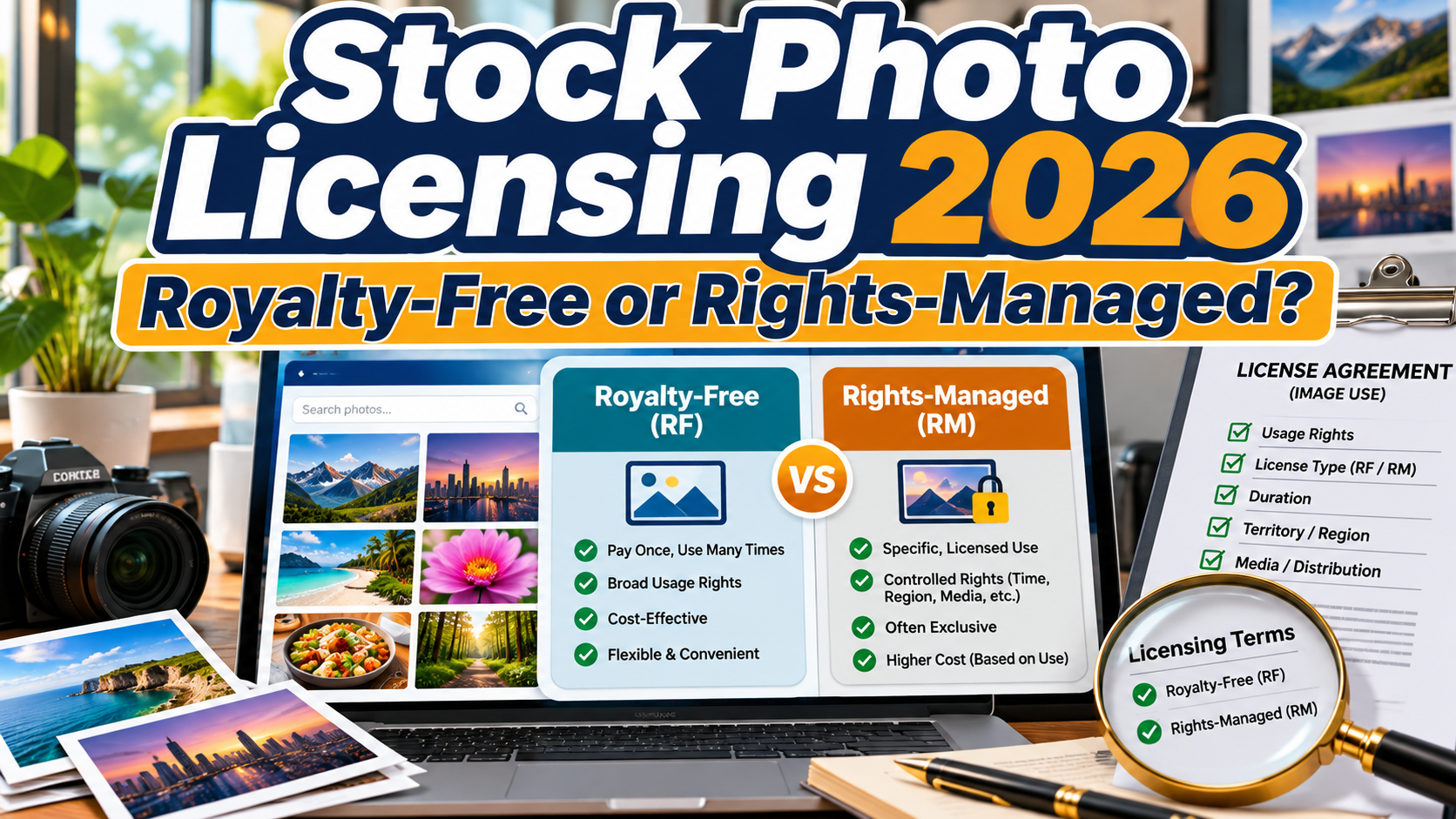
Royalty Free vs Rights Managed Stock Photos 2026: Which License Should You Choose?
Stock photography plays an essential role in modern marketing, branding, publishing, and digital content creation. However, choosing an attractive image is only part of the process. Understanding how you can legally use that image is equally important.
The royalty free vs rights managed stock photos 2026 comparison explains two important licensing models that determine how images can be used in commercial and editorial projects.
Both offer access to professional photography, but they differ in pricing structures, usage permissions, restrictions, and potential exclusivity.
Whether you’re designing advertisements, managing websites, or producing editorial content, selecting an appropriate license helps protect your projects and creative investments.
What Is Royalty-Free Stock Photography?
Royalty-Free (RF) licensing allows customers to use licensed photographs without paying additional royalties for every permitted use.
Despite its name, royalty-free does not necessarily mean free of charge. Customers generally pay a licensing fee or access images through a subscription.
RF images typically provide broad usage permissions covering websites, presentations, advertisements, and other digital or printed materials.
However, specific restrictions may still apply to merchandise, print quantities, redistribution, and commercial applications.
What Is Rights-Managed Stock Photography?
Rights-Managed (RM) licensing provides permissions based on specific usage requirements.
Licensing terms may define the publication medium, geographic territory, campaign duration, image placement, and distribution volume.
For example, a publisher might license an editorial photograph for a particular magazine edition and distribution region.
Additional uses may require another license.
RM licenses do not automatically provide exclusivity, although exclusive arrangements may sometimes be negotiated.
Identify Your Image Usage Requirements
Before purchasing stock photography, outline how the image will support your project.
Determine whether it will appear on a website, advertising campaign, printed publication, product packaging, or merchandise.
Consider the intended audience, distribution territory, campaign duration, and whether competitors might use the same photograph.
For recurring marketing activities, RF licensing often offers convenient flexibility. Projects with narrowly defined usage requirements may benefit from RM agreements when available.
Always review the actual license rather than relying exclusively on its category.
5 Key Differences Between Royalty-Free and Rights-Managed Stock Photos
1. Licensing Costs and Payment Structure
Royalty-free photography generally uses straightforward pricing through individual purchases, download packages, or subscription plans.
Once properly licensed, an image can be reused within the agreement’s permitted scope without paying a royalty each time.
Rights-managed pricing depends on the intended use, including factors such as duration, geographic distribution, and placement.
A narrowly licensed editorial image may cost less than broader usage rights, so RM pricing is not automatically higher in every situation.
BEST FOR: RF suits recurring marketing needs, while RM suits projects with clearly defined usage requirements.
2. Usage Flexibility and Reuse
RF licensing usually allows multiple permitted applications without requiring a new license for every design.
For example, a business might use the same licensed photograph across website banners, presentations, and social media campaigns.
Rights-managed images generally require the purchaser to specify authorized applications.
Using an RM photograph in a different campaign, publication, or territory may require additional permission.
BEST FOR: RF supports flexible content production, while RM supports controlled usage planning.
3. Exclusivity and Competitive Branding
Royalty-free stock photography is generally non-exclusive, meaning other businesses can license the same image.
This can create branding challenges when competing companies use identical visual assets.
Rights-managed licensing may offer opportunities to negotiate exclusivity for particular markets, territories, or periods.
However, exclusivity is never guaranteed unless the agreement explicitly grants it.
BEST FOR: RF suits general promotional content, while negotiated exclusive rights can support distinctive brand campaigns.
4. Distribution Limits and License Restrictions
RF licenses may include limits on merchandise, resale products, reproduction quantities, or audience size.
For example, Adobe Stock’s Standard license permits many commercial applications but restricts certain high-volume reproductions and merchandise uses.
Rights-managed licenses specify usage boundaries through the individual agreement.
Businesses should examine these restrictions before launching large advertising campaigns or distributing physical products.
BEST FOR: RF suits predictable general usage, while RM can accommodate specifically negotiated distribution requirements.
5. Commercial and Editorial Permissions
Commercial and editorial permissions are separate considerations from RF and RM licensing.
Editorial-only photographs generally cannot be used to advertise products or imply endorsement without additional clearance.
Commercial images featuring recognizable individuals or protected property may also require appropriate releases.
Before publishing, verify both the license conditions and any necessary third-party permissions.
BEST FOR: Commercially cleared assets suit advertising, while editorial imagery supports newsworthy and informational content.
Comparison: Royalty-Free vs. Rights-Managed Stock Photos
The following comparison summarizes the major differences between these licensing models.
| Feature | Royalty-Free (RF) | Rights-Managed (RM) |
|---|---|---|
| Pricing | Usually fixed or subscription-based | Based on specific usage |
| Reuse | Broad permitted reuse | Limited to licensed uses |
| Duration | Often perpetual | Defined by agreement |
| Geographic coverage | Often worldwide | Specified territories |
| Exclusivity | Generally non-exclusive | May be negotiated |
| Flexibility | Generally higher | More controlled |
| Best application | Marketing and general design | Specific editorial or specialized projects |
Which License Is Better for Your Business?
Royalty-free stock photos are often practical for small businesses, bloggers, agencies, and online stores needing flexible visual resources.
Rights-managed photography remains relevant for specialized editorial licensing and projects requiring carefully negotiated permissions.
Importantly, Getty Images no longer offers new RM licenses for creative images, although rights-managed editorial photography remains available.
For branding projects, combine appropriately licensed photography with distinctive typography. Explore premium fonts at PutraCetol Studio to create memorable visual identities and professional marketing materials.
Common Mistakes When Licensing Stock Photos
One common mistake is assuming that royalty-free images are completely free or unrestricted. Although RF licensing eliminates recurring royalties for permitted reuse, customers must still follow the provider’s specific conditions. Some licenses restrict redistribution, merchandise production, or the transfer of rights between clients. Designers should also remember that purchasing a license does not transfer copyright ownership. Maintaining accurate purchase records and reviewing permitted usage helps prevent unnecessary licensing disputes.
Another mistake is assuming rights-managed photographs automatically include exclusive commercial rights. Exclusivity, geographic coverage, and campaign duration must be explicitly defined when applicable. Businesses also frequently overlook editorial restrictions, model releases, and property permissions when selecting photographs for advertising. An image appearing on a professional stock website does not guarantee permission for every commercial application. Before publication, verify the license agreement, identify the correct licensee, and confirm that all intended uses are covered.
Conclusion
Understanding royalty free vs rights managed stock photos 2026 helps designers, marketers, and businesses select images with greater confidence.
Royalty-free licensing typically provides flexible, convenient usage for everyday creative projects, while rights-managed licensing offers specifically defined permissions for selected applications.
Neither model automatically guarantees exclusivity, unlimited commercial rights, or freedom from third-party restrictions.
The best choice depends on your project’s purpose, distribution requirements, budget, and licensing conditions.
For businesses combining professional stock photography with distinctive branding, explore creative typography at PutraCetol Studio and build visual identities that communicate originality and professionalism.
Explore these fonts and many more at PutraCetol.com to build a business identity that looks professional, trustworthy, and memorable.
Additionally, if you want to explore some free typography options, you can check out Putracetol Studio on Dafont. Happy reading and designing!