Free vs Paid Online Communities Growth 2026: Reach or Commitment?
Online communities are becoming increasingly important as social feeds grow crowded with algorithmically selected and AI-generated content.
For creators, startups, educators, SaaS companies, and brands, the important question is no longer simply whether to build a community. It is how access should work.
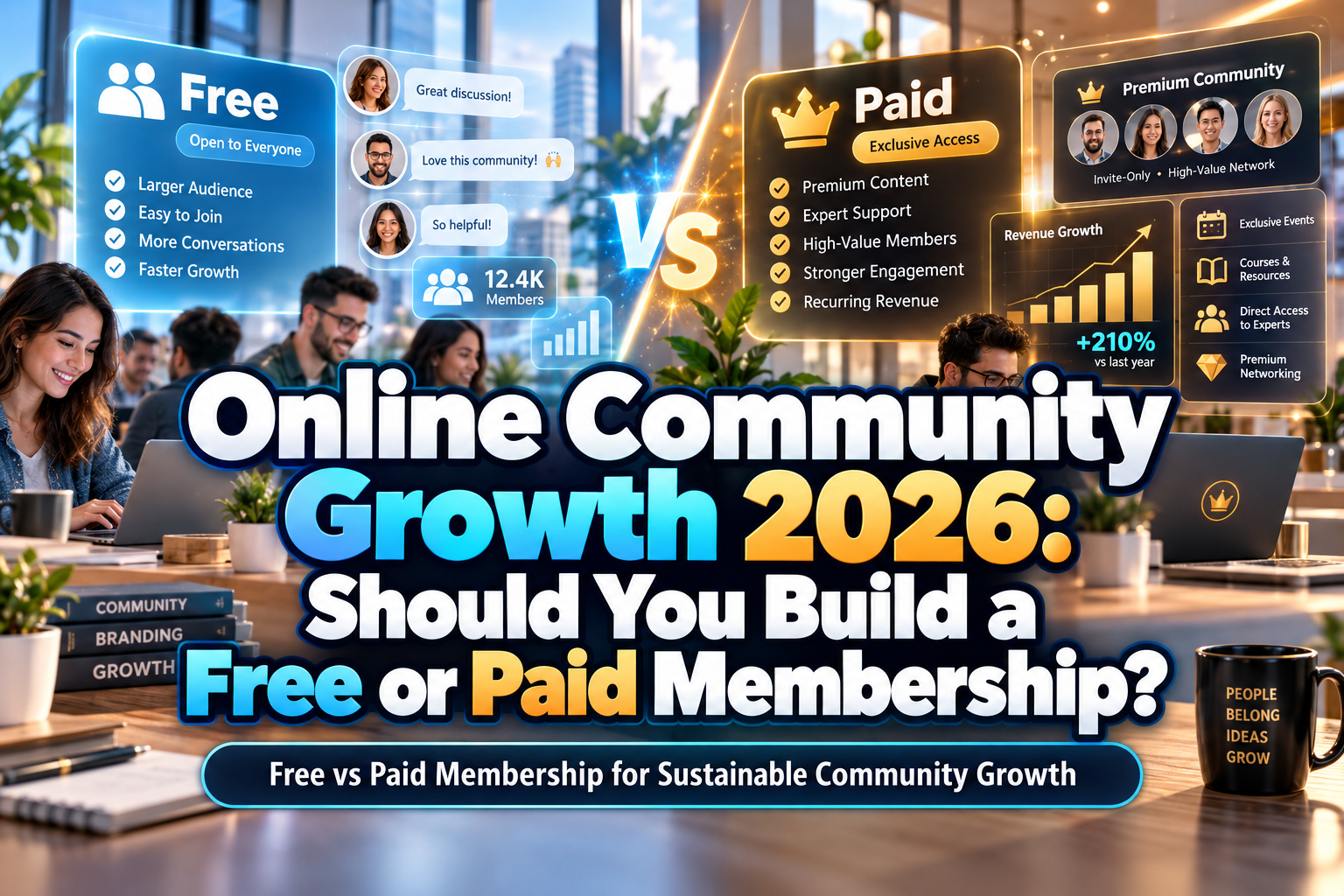
The debate around free vs paid online communities growth 2026 comes down to two very different advantages. Free communities make joining easy and can grow quickly. Paid communities introduce friction, but that same friction can create stronger intent, clearer expectations, and recurring revenue.
Neither model automatically produces better engagement.
The strongest choice depends on what the community promises its members and how that value is delivered.
Circle’s 2026 research, based on more than 750 community builders and data from thousands of communities, highlights a broader move toward focused, intentional spaces as audiences experience fatigue from always-on digital environments. Circle
Initial Suggestion: Measure Active Value, Not Member Count
A community with 50,000 registered users can look successful while only a small percentage regularly participate.
A smaller group of 500 members who attend events, answer questions, share work, renew subscriptions, and help one another may produce significantly greater value.
Instead of measuring only total membership, track meaningful indicators such as active-member rate, posts and replies, event attendance, onboarding completion, retention, referrals, free-to-paid conversion, and member outcomes.
This distinction is particularly important in 2026. Circle reports that 69% of surveyed community builders consider helping members achieve meaningful transformation one of their leading strategies for growth and retention. Circle
How Free Online Communities Grow
Free communities have one obvious advantage: low friction.
Someone interested in your topic can join without deciding whether the experience is worth paying for. This works especially well for brands trying to maximize reach, early-stage communities testing demand, open-source projects, customer communities, and creators building an audience.
The larger top of funnel also creates more opportunities for discovery and word-of-mouth growth.
Patreon’s current free-membership model demonstrates this principle. Patreon says creators offering free membership have seen nearly three times the community growth without reducing new paid-member growth. It also reports that 80% of paid members who cancel choose to remain connected as free members. Patreon Help Center
The challenge is participation.
When joining costs nothing, leaving or ignoring the community also costs nothing. A free group can therefore accumulate thousands of inactive accounts unless onboarding, programming, moderation, and recurring value encourage members to return.
Why Paid Communities Can Create Stronger Commitment
Paid communities reverse the equation.
Growth is usually slower because every potential member must make a purchasing decision. But members who pay have already demonstrated a degree of intent.
They are often joining for a specific outcome: improving a professional skill, receiving expert access, expanding a network, completing a course, getting accountability, or reaching a business objective.
Payment can also finance better community operations.
Recurring membership revenue can support moderators, events, educational resources, software, expert sessions, and customer support instead of requiring the founder to maintain everything as unpaid work.
Paid membership is becoming increasingly central to community-led businesses. Circle’s 2026 creator data says 88% of surveyed creators monetize through paid memberships, up from 54% in its previous-year data. Circle
However, charging money does not automatically create engagement. A quiet community behind a paywall is still a quiet community.
Free Communities Are Better for Discovery
Free access is particularly effective at the beginning of the relationship.
Imagine a graphic-design educator building a community around branding.
A free tier could offer discussions, selected tutorials, monthly challenges, and public resources. Thousands of designers can discover the community, observe its culture, and determine whether it is relevant to them.
The organization gains reach and a larger audience for future programs.
Free membership therefore works particularly well as a discovery and trust layer.
This is also why social channels remain important. Circle reports that 67% of creators in its 2026 survey say new members discover their communities through social platforms, even as monetization increasingly happens inside owned membership environments. Circle
Paid Communities Need a Clear Transformation
People rarely continue paying merely for access to another feed.
A paid community needs a reason to remain valuable month after month.
That value might come from expert feedback, exclusive workshops, professional networking, accountability groups, templates, structured learning, office hours, industry opportunities, or direct access to specialists.
The key concept is transformation.
Members should be able to explain what becomes easier, faster, better, or more achievable because they belong.
Without that answer, recurring subscriptions become difficult to retain regardless of how attractive the community platform looks.
The Hybrid Model Can Combine Both Advantages
For many businesses, the strongest answer to free versus paid is not choosing only one.
A hybrid community can use free membership for acquisition and paid membership for deeper value.
For example:
Free members might access general discussions, announcements, selected resources, and community updates.
Paid members could receive courses, specialist groups, live workshops, downloadable resources, mentoring, or private events.
Patreon now explicitly supports free members upgrading into paid memberships and provides creators with analytics for monitoring those conversions. Patreon Help Center
This model creates a natural customer journey:
discover → join → participate → trust → upgrade → retain.
It also keeps former paid members connected rather than losing the relationship completely after cancellation.
Branding Still Influences Community Growth
Community building is primarily about relationships, but presentation affects perception.
A consistent visual identity across the landing page, onboarding materials, event graphics, social posts, downloadable resources, and member areas makes the community feel intentional rather than improvised.
Typography is a particularly useful part of that system. Brands can use distinctive fonts from PutraCetol Studio across community banners, campaign graphics, educational materials, and promotional assets while maintaining highly readable typography inside discussion-heavy interfaces.
The goal is recognition rather than decoration.
Comparison: Free vs Paid Online Communities
| Area | Free Community | Paid Community |
|---|---|---|
| Joining friction | Very low | Higher |
| Growth potential | Faster | Usually slower |
| Member intent | Mixed | Typically stronger |
| Revenue | Indirect or optional | Recurring potential |
| Inactive members | More common | Often lower |
| Content expectations | Moderate | Higher |
| Retention pressure | Lower | Much higher |
| Best role | Discovery and reach | Transformation and depth |
A hybrid structure can connect these advantages rather than forcing one model to perform every role.
Common Mistakes
One major mistake is believing free communities should give away unlimited content until members eventually decide to pay. If the free tier already provides every benefit, there is little reason to upgrade. Free membership should be genuinely useful while leaving a clear distinction between broad access and the deeper outcomes delivered by paid membership.
The opposite mistake is putting a paywall in front of a community before proving its value. Charging for access cannot compensate for weak positioning, empty discussions, inconsistent leadership, or unclear benefits. Early founders may need to establish trust, seed conversations, and create repeatable programming before paid acquisition can scale effectively.
Finally, avoid exhausting members with constant notifications, events, challenges, and content. Circle’s 2026 research found that 45% of community builders reported signs of member burnout, while half were using bite-sized or micro-learning formats to reduce overwhelm. Circle Engagement is not the same as demanding attention every day.
Conclusion
The free vs paid online communities growth 2026 debate does not have one universal winner.
Free communities excel at reach, discovery, audience building, and low-friction participation. Paid communities can create clearer commitment, stronger economic sustainability, and resources for delivering deeper member outcomes.
For many creators and businesses, the most resilient model is hybrid: build trust through valuable free access, then offer a paid experience centered on meaningful transformation.
Ultimately, community growth is not about collecting the largest possible number of profiles. It is about creating a space people consider useful enough to return to, contribute to, recommend, and, when the value justifies it, pay to remain part of.
Explore these fonts and many more at PutraCetol.com to build a business identity that looks professional, trustworthy, and memorable.
Additionally, if you want to explore some free typography options, you can check out Putracetol Studio on Dafont. Happy reading and designing!