
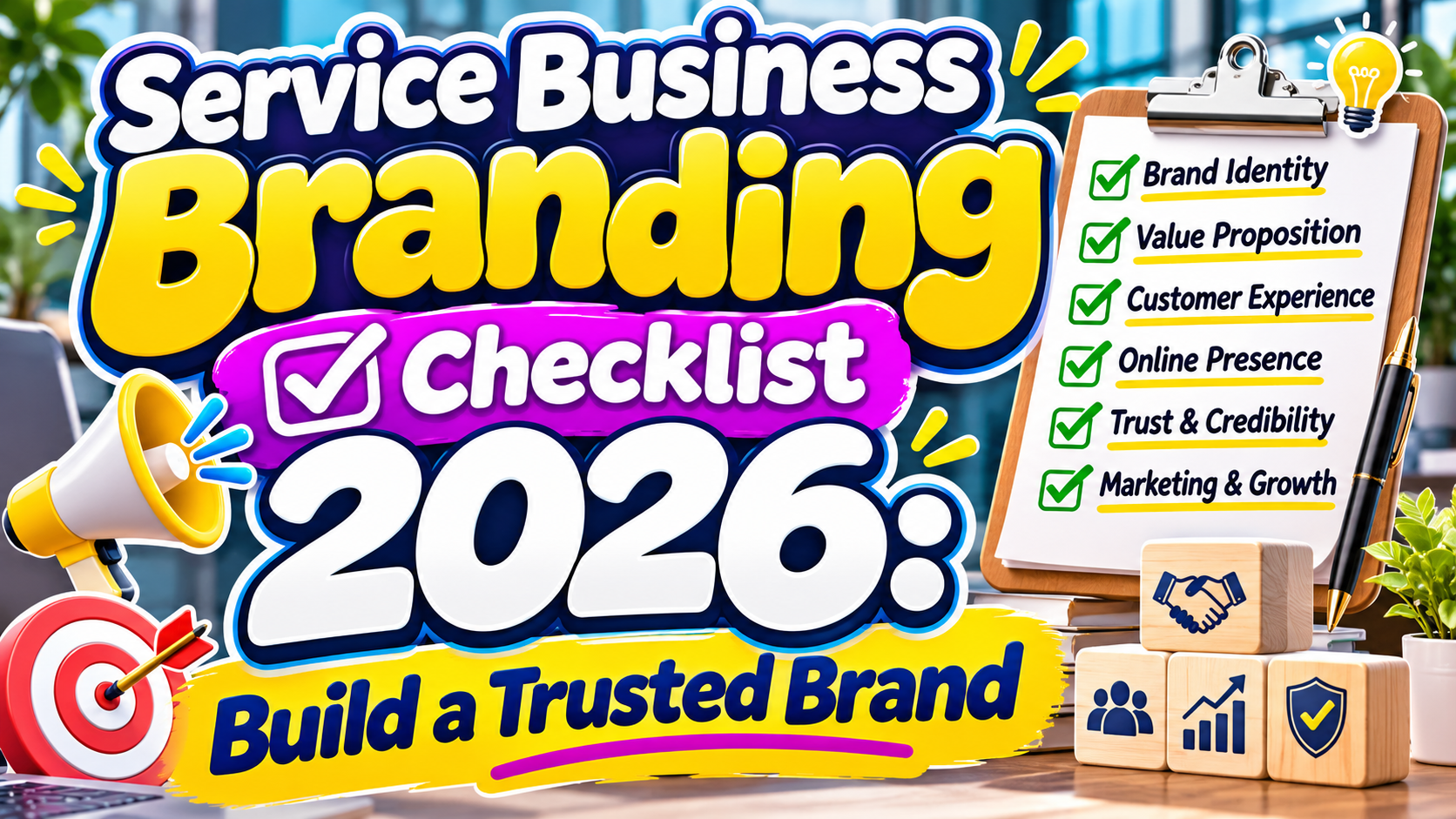
Service Business Branding Checklist 2026: Build a Professional and Trusted Brand
A successful service business needs more than excellent skills and competitive pricing. Customers want to work with companies they recognize, understand, and trust. That’s why building a professional brand has become essential for consultants, agencies, healthcare providers, freelancers, and other service-based businesses.
This service business branding checklist 2026 covers the essential elements of creating a recognizable brand identity, communicating value, and developing lasting customer relationships.
Unlike product-based companies, service businesses sell experiences, expertise, and promises. Their branding must communicate reliability before customers even make contact.
Start With Trust, Not Just a Logo
Before investing in visual design, identify what makes your service valuable.
A consulting firm might emphasize expertise and measurable results, while a cleaning company could highlight reliability, convenience, and attention to detail.
Your brand should answer three fundamental questions: What services do you provide? Who benefits from them? Why should customers choose you?
Once these answers are clear, your logo, typography, website, messaging, and customer experience can work together to communicate a consistent professional identity.
Essential Service Business Branding Checklist for 2026
1. Define Your Brand Positioning
Successful service branding begins with a clear position in the market. Identify your target audience, competitors, service strengths, and unique selling proposition.
Avoid generic claims such as “best quality service.” Instead, communicate specific advantages, including specialized expertise, personalized support, or faster response times.
Strong positioning helps customers understand your value immediately.
2. Create a Professional Visual Identity
Your visual identity should make your business recognizable across digital and physical platforms.
Essential elements include a distinctive logo, coordinated brand colors, consistent typography, and recognizable graphic elements.
Typography deserves particular attention because fonts influence how customers perceive professionalism and personality. Modern sans-serif fonts often communicate clarity, while elegant serif fonts can suggest tradition and authority.
Explore professional branding typefaces at PutraCetol Studio to develop a visual identity that matches your business personality.
3. Build a Consistent Brand Voice
Your brand voice determines how your business communicates with potential customers.
A law firm might use precise, reassuring language, while a creative agency could adopt a friendly, energetic tone.
Keep your messaging consistent across website copy, social media captions, proposals, emails, and customer support conversations.
4. Develop a Trustworthy Website
A professional website is often the first meaningful interaction between a service provider and a potential customer.
Your website should clearly explain your services, introduce your team, showcase relevant experience, and make inquiries easy.
Include intuitive navigation, mobile-friendly layouts, accessible typography, secure connections, and visible contact information.
5. Showcase Reviews and Real Results
Customer testimonials, verified reviews, case studies, and project portfolios provide evidence of your capabilities.
Instead of relying exclusively on promotional language, demonstrate how your services solve real problems.
For example, a marketing agency could publish a case study explaining how its campaign improved qualified leads for a client.
Always obtain permission before sharing identifiable customer information.
6. Optimize Your Local and Digital Presence
Service businesses should maintain accurate information across relevant digital platforms.
For local providers, an updated Google Business Profile can help customers discover services, locations, and contact details.
Maintain consistent business information, respond professionally to reviews, and use relevant service keywords naturally throughout your website.
7. Create Professional Brand Materials
Consistent business materials reinforce credibility throughout the customer journey.
Develop branded proposals, presentations, invoices, email signatures, business cards, and social media templates.
A coordinated typography system helps these materials feel connected, even when different employees create them.
8. Establish a Memorable Customer Experience
Branding continues after the customer makes a purchase.
Clear communication, transparent pricing, punctual delivery, and responsive support shape how people remember your business.
Document your service standards and ensure your team understands the experience your brand promises.
9. Strengthen Your Personal and Team Branding
In service industries, people often represent the business as much as its visual identity.
Professional team photographs, detailed biographies, relevant qualifications, and consistent employee communication help establish credibility.
For consultants and freelancers, personal expertise can become a valuable brand differentiator.
10. Measure and Improve Brand Performance
Brand development requires ongoing evaluation.
Track relevant indicators such as branded search traffic, website inquiries, qualified leads, customer retention, repeat bookings, and referral sources.
Collect customer feedback regularly and use the findings to refine your messaging, service delivery, and visual communication.
Comparison: Strong vs. Weak Service Business Branding
The following comparison illustrates how branding decisions influence customer perceptions.
| Branding Element | Weak Branding | Strong Branding |
|---|---|---|
| Brand identity | Inconsistent visuals | Recognizable design system |
| Messaging | Generic promises | Clear service benefits |
| Website | Confusing navigation | Professional user experience |
| Credibility | Unsupported claims | Reviews and case studies |
| Customer experience | Unpredictable service | Consistent service standards |
| Marketing | Disconnected campaigns | Unified brand communication |
Which Branding Elements Should Come First?
New service businesses should prioritize brand positioning, clear messaging, professional typography, and a functional website.
Established companies may benefit more from improving customer experience, strengthening social proof, and standardizing their visual identity.
The ideal approach depends on business maturity, available resources, and customer expectations.
Common Mistakes in Service Business Branding
One common mistake is focusing entirely on appearance while ignoring customer experience. A sophisticated logo and beautifully designed website cannot compensate for unreliable service or confusing communication. Service businesses should ensure their brand promises match what customers actually experience. Authenticity and consistency are particularly important because customers often evaluate intangible services through reputation, responsiveness, and demonstrated expertise.
Another mistake is frequently changing brand colors, fonts, messaging, and visual styles without a clear strategy. Inconsistent branding makes recognition more difficult and can weaken the impression of professionalism. Businesses should establish simple brand guidelines covering typography, logo usage, visual hierarchy, color combinations, and communication standards. They should also avoid copying competitors too closely, since differentiation helps customers understand why a particular provider deserves their attention.
Finally, many businesses overlook ongoing brand measurement. Branding should not be treated as a one-time design project. Customer preferences, service expectations, and market conditions evolve, making regular brand reviews essential. Evaluating customer feedback, referral patterns, and conversion performance helps businesses maintain relevance without unnecessarily abandoning their established identity.
Conclusion
Following a practical service business branding checklist in 2026 helps businesses create stronger identities, build customer confidence, and differentiate themselves in competitive markets.
Successful branding combines clear positioning, professional visual design, consistent communication, credible proof, and dependable service experiences.
Whether you’re launching a consulting firm, building a digital agency, or growing a local service company, start with a foundation that reflects your expertise and values.
For typography that supports a polished and memorable identity, explore the font collections at PutraCetol Studio and find a style that complements your business personality.
Explore these fonts and many more at PutraCetol.com to build a business identity that looks professional, trustworthy, and memorable.
Additionally, if you want to explore some free typography options, you can check out Putracetol Studio on Dafont. Happy reading and designing!