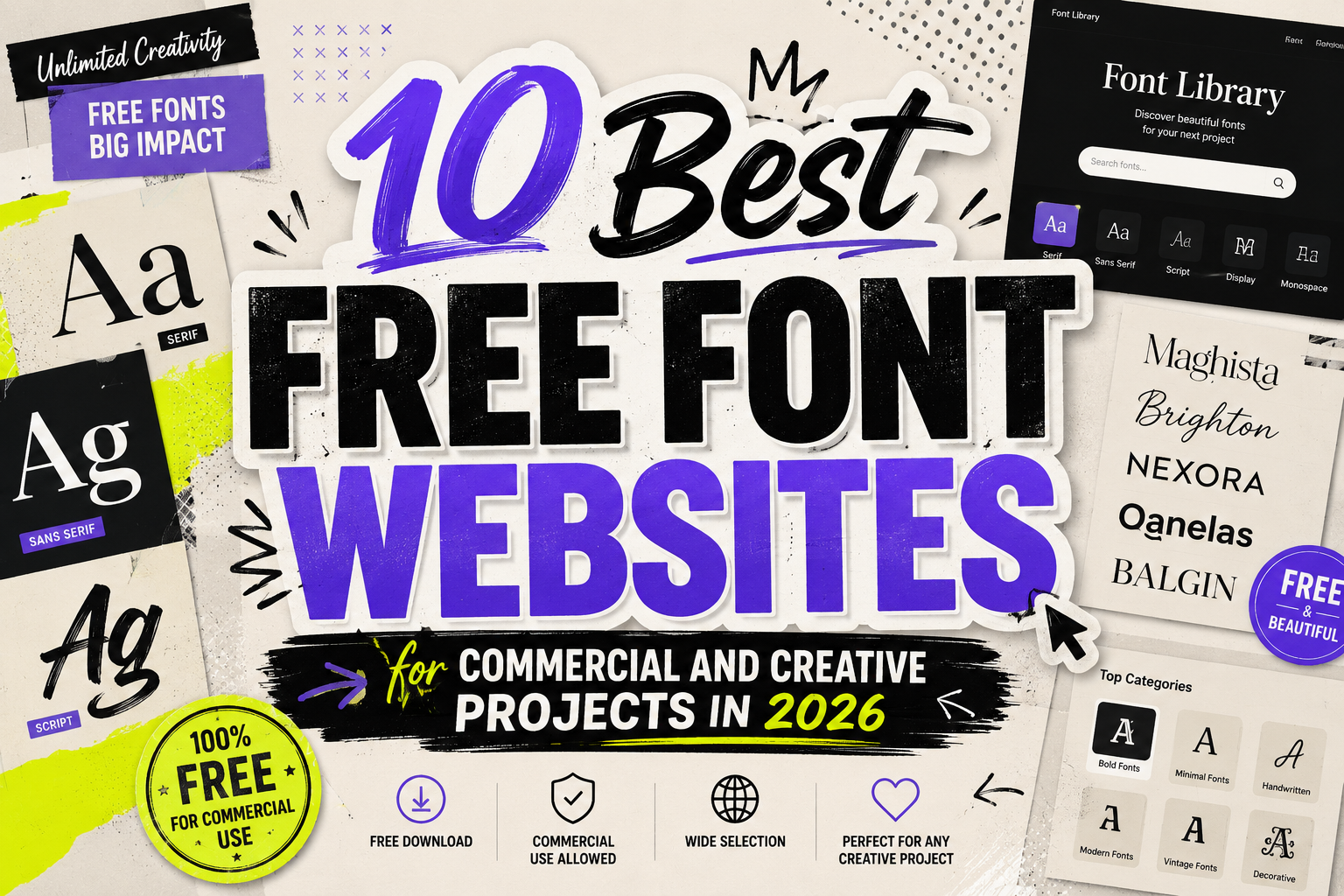
Finding a beautiful typeface is easy. Finding one that is beautiful, technically reliable, suitable for your project, and legally usable is much more important.
The best websites for free fonts in 2026 are therefore not simply the websites with the largest download buttons or the biggest libraries. Good font resources help designers understand who created a typeface, how it may be used, whether commercial projects are permitted, and what restrictions apply to web embedding, modification, redistribution, logos, apps, or merchandise.
This matters whether you are a graphic designer building a visual identity, a student experimenting with typography, a content creator designing thumbnails, or a small business trying to reduce branding costs.
A good free font can absolutely support professional work.
The important word, however, is licensed.
Check the License Before You Fall in Love With the Font
Before downloading anything, learn to separate three phrases that are often incorrectly treated as interchangeable:
Free to download does not automatically mean free for commercial use.
Free for commercial use does not necessarily mean unrestricted use in every application.
And open source does not mean that the font has no license.
For example, Google states that every font distributed through Google Fonts uses an open-source license and may be used in both commercial and non-commercial projects. Fontshare likewise states that its fonts are free for personal and commercial use, although its library contains both its own Free Font License and open-source fonts governed by the SIL Open Font License.
Other libraries work differently. Fontesk contains both commercial-use and personal-use fonts and explicitly tells users to inspect the license included with each font before using it commercially.
The safest habit is simple:
Choose the font, read its license, save a copy of that license with the project, and only then begin commercial production.
What Makes a Good Free Font Website?
A strong free-font platform should ideally provide several of these characteristics:
- Clear designer attribution
- Visible licensing information
- Font previews
- Commercial-use filters
- Character or glyph previews
- Multiple weights
- Variable font support
- Multilingual information
- Webfont options
- Reliable downloads
- Regular catalog maintenance
- Links to the original designer or foundry
A library containing 100 carefully documented families may be more useful professionally than a site containing 100,000 poorly documented downloads.
Free Font vs. Open-Source Font
These terms overlap, but they are not identical.
Free Font
A free font costs nothing to download under specified conditions.
Its license may allow:
- Personal use only
- Commercial design
- Limited commercial production
- Desktop use
- Web use
- Selected distribution
You must read the individual terms.
Open-Source Font
An open-source font is distributed under an open license such as the SIL Open Font License.
Depending on the license, users may generally be able to use, embed, study, modify, and redistribute the font under defined conditions.
For example, Google Fonts distributes open-source fonts, while Collletttivo states that its typefaces are released under the SIL Open Font License and can be used for personal and commercial work.
Open source is particularly useful for:
- Websites
- Apps
- Global brands
- Open projects
- Developers
- Design systems
- Multilingual products
But the license still needs to be followed.
1. Google Fonts: Best Overall Free Font Resource
Google Fonts remains one of the strongest starting points for anyone searching for free professional typography.
Google confirms that all fonts available through the service are released under open-source licenses and may be used in commercial or non-commercial projects. It also provides an API that allows fonts to be served directly on websites.
Why Google Fonts Is Useful
Its library includes:
- Sans serif
- Serif
- Display
- Handwriting
- Monospace
- Variable fonts
- Multiple writing systems
- Extensive language support
It is particularly valuable when the same typeface needs to work across both design files and websites.
Designers can download the font files, while developers can integrate supported families directly through the Google Fonts API. Google also allows developers to request specific families, weights, styles, and subsets.
Best For
- Website design
- UI/UX
- Startup branding
- Editorial layouts
- Presentations
- Apps
- Multilingual projects
- Long-form typography
Main Advantage
Licensing is considerably easier to understand than on mixed-source download websites.
Main Limitation
Because many Google Fonts families are extremely popular, using one without customization may make a brand feel familiar rather than distinctive.
Strong art direction, font pairing, spacing, and custom wordmark treatment can help differentiate the result.
2. Fontshare: Best for Premium-Looking Free Font Families
Fontshare is operated by Indian Type Foundry and focuses on professionally produced free fonts.
The service states that all Fontshare fonts are 100% free for personal and commercial use. Its collection contains both proprietary Fontshare releases under ITF’s Free Font License and open-source families distributed under the SIL Open Font License.
This distinction is important because the usage and modification rules differ.
For example, Fontshare’s own FFL permits extensive commercial use across print, web, mobile, apps, broadcasting, OEM, and logos but places restrictions on modifying and redistributing the font software itself.
Why Fontshare Is Useful
The collection feels more like a carefully art-directed type foundry than a mass free-font directory.
It is particularly strong for:
- Contemporary sans serif
- Editorial serif
- Display typography
- Corporate branding
- Fashion
- Modern identities
Best For
- Logo exploration
- Startups
- Agencies
- Editorial design
- Packaging
- Websites
- Brand systems
Main Advantage
Professional family depth and comparatively clear licensing.
Main Limitation
Do not assume that an open-source Fontshare font and an ITF Free Font License family have identical modification or redistribution rights. Read the license attached to the family.
3. Font Squirrel: Best for Commercial-Use Font Discovery
Font Squirrel has long positioned itself as a curated resource for free, high-quality, commercially usable fonts. Its current site still describes itself as a resource for hand-picked commercial-use fonts.
Its categories cover:
- Serif
- Sans serif
- Display
- Script
- Slab
- Handwritten
- Monospace
- Decorative styles
One particularly useful feature is the Matcherator, which can help identify fonts from an uploaded image and includes an option to limit results to free fonts.
Best For
- Commercial design exploration
- Font identification
- Webfonts
- Branding
- Posters
- Editorial design
Main Advantage
Licenses are often displayed directly on individual font pages.
Main Limitation
Do not blindly rely on the site’s commercial-use categorization. Some older entries have unusual or incomplete licensing histories, and Font Squirrel itself sometimes notes uncertainty on individual font pages.
For serious client work, prefer fonts with an explicit and traceable license.
4. UNCUT.wtf: Best for Contemporary Free Typography
UNCUT.wtf is an excellent resource for designers who find conventional free-font libraries too predictable.
As of 2026, the site describes itself as a free typeface catalog focusing on contemporary typography and lists 163 typefaces across sans serif, serif, monospace, and display categories.
Individual pages display the font’s license in simplified language and link users toward the actual licensing terms.
For example, several listed typefaces use the SIL Open Font License and explicitly allow personal and commercial use, modification, and redistribution subject to the terms of that license.
Best For
- Experimental branding
- Fashion
- Posters
- Independent magazines
- Cultural projects
- Design portfolios
- Creative studios
Main Advantage
The collection feels significantly more contemporary than many traditional free-font archives.
Main Limitation
Some families are intentionally experimental, so not every option is suitable for body copy or highly functional interfaces.
5. Collletttivo: Best Open-Source Type Foundry for Experimental Branding
Collletttivo is an open-source type foundry and collaborative network focused on type-design experimentation.
Its current catalog contains 16 open-source typefaces, including serif, sans serif, display, variable, monospace, geometric, and more experimental directions.
All Collletttivo typefaces are released under the SIL Open Font License. The foundry states that the fonts can be used for personal and commercial work on printed and digital media, while also permitting study, modification, and redistribution under the license conditions.
Why Designers Should Explore It
The collection includes typography that is unlikely to look like the default choice from a typical corporate template.
Recent releases continue to explore unusual concepts. Borges, released in March 2026, deliberately sacrifices conventional readability to create a labyrinth-like visual texture, illustrating how experimental this catalog can become.
Best For
- Experimental branding
- Art direction
- Fashion
- Editorial projects
- Cultural identities
- Posters
- Independent publishing
Main Advantage
Strong personality combined with open-source licensing.
Main Limitation
Many families are display-oriented. Pair them with quieter text typography when usability is important.
6. Velvetyne Type Foundry: Best for Avant-Garde Libre Fonts
Explore Velvetyne Type Foundry
Velvetyne is one of the most interesting resources for designers who want typography that challenges conventional commercial trends.
Its catalog includes unusual families such as:
- Pilowlava
- BianZhiDai
- Fungal
- PicNic
- Outward
- Karrik
- CirrusCumulus
- Typefesse
- Terminal Grotesque
The foundry describes its output as libre and open-source typography.
On individual download pages, Velvetyne explains that its fonts may be used for personal and commercial projects across media such as posters, logos, websites, apps, apparel, and video. It also permits modification and redistribution according to the font’s license, while requiring appropriate creator and foundry credits in applicable cases.
Best For
- Art-school aesthetics
- Experimental identities
- Cultural projects
- Fashion
- Music
- Posters
- Independent publishing
- Unusual web design
Main Advantage
Some of the most distinctive free typography available online.
Main Limitation
This is not the first place to look when you need a conservative corporate body font.
Always read the license for the specific family because licensing details can differ.
7. The League of Moveable Type: Best Classic Open-Source Foundry
Explore The League of Moveable Type
The League of Moveable Type has been an important part of the open-source typography movement for many years.
Its current collection includes recognizable families such as:
- League Spartan
- Raleway
- League Mono
- Sniglet
- Ostrich Sans
- Fanwood
- League Script
The foundry states that all fonts in its catalog are free and open source, commercially usable, and subject to the Open Font License.
Many font pages also provide useful details about:
- Designers
- Styles
- Language coverage
- Character sets
- Source-code downloads
- Licensing
For example, Raleway currently shows support for numerous character sets and more than 100 languages.
Best For
- Editorial design
- Websites
- Brand systems
- Posters
- Open-source projects
- Developers
- Designers studying type
Main Advantage
Clear connection between typography, open licensing, and type-design education.
Main Limitation
The catalog is more selective than massive font directories, which is actually an advantage for quality but provides fewer options.
8. Fontesk: Best for Discovering New Independent Free Fonts
Fontesk is a large curated catalog containing both commercial-use and personal-use fonts.
Its home page clearly labels listings with categories such as:
- Free for commercial use
- Free for personal use
- OFL
and offers styles ranging from sans serif and serif to handwritten, display, pixel, futuristic, retro, Gothic, playful, and variable fonts.
This makes it useful for trend exploration.
However, Fontesk’s licensing page explicitly states that commercial users must inspect the font archive for the relevant license. If no commercial permission is supplied, commercial use should not be assumed.
Best For
- Trend research
- Display typography
- Student projects
- Posters
- Social graphics
- Experimental branding
- Independent font discovery
Main Advantage
Frequent exposure to less familiar independent typefaces.
Main Limitation
Licensing varies considerably between fonts.
Use the site’s licensing labels as a starting point, not the final legal record.
9. Free Faces: Best for Visual Font Browsing
Free Faces is designed more like a visual gallery than a conventional download directory.
Its current collection organizes free typefaces into categories such as:
- Display
- Sans serif
- Serif
- Slab
- Monospace
- Cursive
The gallery includes recognizable free families such as Space Grotesk, Clash Display, Martian Mono, Comico, Karrik, and others.
Its display section is particularly useful when designers want to browse based on visual impression rather than typing several search filters.
Best For
- Visual inspiration
- Moodboards
- Editorial work
- Display-font discovery
- Branding research
- Poster design
Main Advantage
Excellent visual browsing experience.
Main Limitation
Free Faces explicitly notes that the fonts it features are available under a variety of free licenses. That means you need to follow through to the source and inspect the actual terms before using a font commercially.
10. PutraCetol Studio Freebies: Best for Distinctive Free Display Fonts
Explore PutraCetol Studio Freebies
For designers who want something more expressive than a standard open-source sans serif, the PutraCetol Studio Freebies catalog provides a useful alternative.
As of August 2026, the Freebies category lists 36 fonts, covering styles such as:
- Experimental display
- Retro
- Horror and blackletter
- Neon
- Brush
- Futuristic
- Script
- Foreign-look display
- Decorative
- Craft
- Serif
Current free selections include designs such as Velant, Retrocube, Black Grove, Glowmara, Grader Shave, Ravonna Touch, Nitro Nova, Carve Craft, and others.
Unlike open-source libraries such as Google Fonts or Collletttivo, PutraCetol’s free fonts use a Free License with Standard License Coverage.
Current product pages describe that coverage as allowing personal and limited commercial use, client work, static design, and finished end products. They specifically exclude unrestricted font redistribution and do not automatically include trademark, editable-template, app/game, broadcast, SaaS, or other extended rights.
Why PutraCetol Is Worth Exploring
Most large open-source catalogs are strongest in general-purpose serif and sans serif families.
PutraCetol’s Freebies collection is particularly useful when you need more visual personality for:
- Posters
- Logos
- Social media
- Packaging
- Music graphics
- Sports
- Horror
- Retro designs
- Cultural themes
- Creative campaigns
Best For
- Graphic designers
- Students
- Poster design
- Static branding concepts
- Social content
- Packaging concepts
- Client design work within the current license
Main Advantage
Distinctive display typography that can help creative work look less generic.
Main Limitation
A free download does not provide unlimited usage rights. Projects involving a trademarked logo, font embedding, SaaS, editable templates, apps, games, broadcast, or other extended applications require the appropriate license rather than assuming the Free License covers everything.
Which Free Font Website Should You Choose?
Your best source depends on the project.
For Websites and UI
Start with:
Google Fonts
Its open-source structure and direct web integration make it particularly convenient.
For Professional Brand Families
Try:
Fontshare
Its polished catalog often feels closer to a commercial type foundry.
For Commercial Font Discovery
Explore:
Font Squirrel
but verify the exact license attached to the font.
For Contemporary Design
Use:
UNCUT.wtf
It is especially useful when common open-source typography feels too familiar.
For Experimental Branding
Explore:
Collletttivo and Velvetyne.
These collections push much further into expressive type design.
For Less Common Independent Fonts
Browse:
Fontesk and Free Faces.
Both are excellent discovery tools, but license verification remains essential.
For Distinctive Display Typography
Explore:
PutraCetol Studio Freebies.
It is particularly relevant when your project needs strong themes such as retro, horror, futuristic, craft, display, foreign-look, or experimental typography rather than another neutral sans serif.
How to Evaluate a Free Font Before Using It
Test the Complete Character Set
Do not judge the typeface from the word shown in its promotional preview.
Test:
- Uppercase
- Lowercase
- Numbers
- Currency
- Punctuation
- Accented characters
- Symbols
- Local-language characters
A beautiful display font may be perfect for an English logo but unsuitable for multilingual packaging.
Check the Number of Styles
One free regular style may work for a poster but become restrictive in a website or editorial system.
For complex projects, look for:
- Regular
- Medium
- Semibold
- Bold
- Italic
- Variable weights
A deeper family creates more flexible hierarchy without requiring several unrelated fonts.
Inspect Kerning and Spacing
Type combinations such as:
AV, WA, TA, LY, To, Fo
and the actual brand name.
Poor spacing becomes extremely visible in large logos and headlines.
Test Small Sizes
A typeface that works at 72 px may fail completely at 14 px.
Check:
- Open counters
- Character distinction
- Stroke thickness
- Spacing
- Screen rendering
Use display fonts for display roles when necessary.
Test the Real Brand Name
A specimen image may use words deliberately selected to showcase the strongest characters.
Your brand may contain difficult combinations.
Always test the actual:
- Company name
- Product name
- Headline
- URL
- Model number
- Tagline
before committing.
Understanding Common Free Font Licenses
SIL Open Font License
The SIL Open Font License is widely used for open-source typefaces.
It generally supports commercial use, embedding, modification, and redistribution under defined conditions. Fontshare’s OFL page, for example, states that licensed fonts may be used, studied, copied, embedded, modified, redistributed, and included in commercial works subject to the OFL conditions.
Google Fonts, Collletttivo, The League of Moveable Type, and many fonts indexed through other libraries use OFL-based licensing.
Freeware License
Freeware licensing depends on the creator.
One freeware font may permit unrestricted commercial design, while another may restrict modification, embedding, or redistribution.
Never assume all freeware licenses are equivalent.
Free for Personal Use
This usually means you should not use the font in:
- Client work
- Paid advertising
- Commercial logos
- Product packaging
- Monetized content
- Merchandise
- Business marketing
unless you purchase or obtain a commercial license.
Limited Commercial License
Some free fonts allow defined commercial outputs while excluding higher-risk or embedded use.
PutraCetol Studio’s current Free License is an example: static design, client work, and finished end products receive coverage, while trademark, editable template, app/game, broadcast, SaaS, and extended rights are excluded.
Paid Subscription Font Libraries Are Different
Adobe Fonts is sometimes described as a free-font resource because fonts do not have to be purchased individually, but it is technically part of a Creative Cloud subscription.
Adobe currently provides thousands of fonts from more than 150 foundries to subscribers, with personal and commercial design use included under Adobe’s license.
That makes it valuable, but it does not belong in the same category as genuinely zero-cost resources such as Google Fonts or Fontshare.
Can Free Fonts Be Used for Logos?
Sometimes.
The answer depends entirely on the license.
Open-source fonts such as those distributed through Google Fonts generally permit commercial design use. Other free licenses may permit static logos but restrict modification or trademark registration.
PutraCetol Studio’s current free-font terms, for example, do not include trademark rights in the Free License.
Before creating a permanent commercial identity, verify:
- Commercial logo use
- Trademark use
- Font modification
- Number of users
- Client transfer
- Font redistribution
Do this before presenting the identity as final.
Can Free Fonts Be Used on Websites?
Again, check the license.
Google Fonts is specifically designed for web use and provides a hosted font API.
OFL fonts can generally be self-hosted according to their license.
However, a desktop or static-design license from another foundry may not automatically include the right to upload the font files to a public server.
Webfont use exposes the actual font software, so it is frequently licensed differently from an exported JPEG or PDF.
Free Fonts for Packaging and Merchandise
Packaging and merchandise are commercial uses.
Before production, check:
- Commercial permission
- Production limits
- Merchandise rights
- Print quantities
- Logo or trademark rights
- Customer customization
- Editable-product restrictions
This becomes particularly important for print-on-demand products and templates because the font may form a central part of something customers can customize or reproduce.
Create a Free Font Library Without Creating Chaos
Do not download every free font you discover.
Build a curated personal library.
Possible folders include:
Functional Fonts
- Serif text
- Sans serif
- UI
- Monospace
Display Fonts
- Bold
- Condensed
- Expanded
- Experimental
Mood-Based Fonts
- Retro
- Futuristic
- Luxury
- Playful
- Horror
- Handmade
Project-Based Fonts
- Food
- Sport
- Kids
- Fashion
- Technology
- Editorial
Store the license next to the font files.
For example:
FontName/FontName-Regular.otfFontName-Bold.otfLICENSE.txtSOURCE.txt
Add the download date and original source when possible.
That simple habit can save hours when a client asks six months later:
“Are we legally allowed to use this font commercially?”
Comparison
| Website | Best For | Commercial Use | Main Strength | License Difficulty |
|---|---|---|---|---|
| Google Fonts | Web, UI, branding, text | Yes, open source | Huge reliable ecosystem | Very low |
| Fontshare | Branding and editorial | Yes | Premium-quality families | Low |
| Font Squirrel | Commercial-use discovery | Usually, verify per font | Large curated selection | Medium |
| UNCUT.wtf | Contemporary design | Commercial-use focused | Modern and unusual catalog | Low to medium |
| Collletttivo | Experimental branding | Yes, OFL | Open-source creative typography | Low |
| Velvetyne | Avant-garde design | Commercial use available under font terms | Extremely distinctive fonts | Medium |
| League of Moveable Type | Open-source classics | Yes | Curated and educational | Low |
| Fontesk | Independent free-font discovery | Varies | Huge stylistic variety | High |
| Free Faces | Visual inspiration | Varies | Excellent gallery browsing | Medium to high |
| PutraCetol Freebies | Distinctive display typography | Limited commercial coverage | Strong themed display fonts | Medium |
Best Overall
Google Fonts wins when licensing simplicity, variety, language support, and web integration matter most.
Best Premium-Feeling Free Library
Fontshare is particularly strong for professional branding and editorial typography.
Best for Experimental Design
Collletttivo, Velvetyne, and UNCUT.wtf provide more adventurous choices.
Best for Discovery
Fontesk, Font Squirrel, and Free Faces make it easier to explore a wide range of independent typography, although individual licenses require more attention.
Best for Distinctive Free Display Fonts
PutraCetol Studio Freebies is especially useful when designers need a stronger visual theme for logos, posters, social media, packaging concepts, sports, retro, horror, futuristic, or creative branding rather than a general-purpose text family.
Common Mistakes
The biggest mistake when searching the best websites for free fonts is assuming that the word “free” defines the license. It does not. A font may be free only for personal projects, free for ordinary commercial artwork but not trademark use, or open source with broad rights but specific redistribution conditions. Never rely solely on a search-result headline or a “Free Download” button. Open the actual license, identify the designer or foundry, and keep a copy of the terms that applied when you downloaded the files.
Another common mistake is choosing free typography based entirely on appearance while ignoring technical quality. A beautiful headline font may contain poor kerning, missing punctuation, incomplete multilingual support, or only one weight. These limitations become expensive when the project expands into packaging, websites, international campaigns, or long editorial content. Test the real words and required characters before building an identity around the font, and distinguish between a display face designed for impact and a text family designed for continuous reading.
The final mistake is collecting hundreds of free fonts without knowing where they came from. When every file is stored in one download folder, designers eventually forget which fonts permit commercial work and which were downloaded only for experimentation. Maintain a curated library with the font name, original source, license file, download date, and intended usage notes. A smaller font collection with clear licensing is more valuable professionally than thousands of anonymous files.
Conclusion
The best websites for free fonts in 2026 make good typography more accessible, but the strongest platforms do more than provide free downloads.
Google Fonts offers one of the safest and most versatile open-source ecosystems for branding, websites, applications, and multilingual typography. Fontshare brings a more foundry-like level of polish to free commercial families, while The League of Moveable Type continues to provide dependable open-source classics.
For designers seeking more personality, UNCUT.wtf, Collletttivo, and Velvetyne offer contemporary and experimental directions that can make an identity feel significantly less generic. Font Squirrel, Fontesk, and Free Faces are valuable discovery tools when their individual licensing information is reviewed carefully.
PutraCetol Studio Freebies provides another useful direction for designers who want expressive display typography rather than only neutral general-purpose families. Its 2026 Freebies catalog includes dozens of free options across experimental, retro, futuristic, horror, script, decorative, and other visual categories.
The important distinction is that PutraCetol’s free typography uses defined Free License coverage rather than an unrestricted open-source model. For ordinary static designs and covered client projects, this creates an accessible way to experiment with distinctive fonts. For trademark, apps, SaaS, broadcast, editable templates, and broader usage, designers should select the appropriate license instead.
Free typography can absolutely produce professional results.
The real skill is not finding the biggest library.
It is knowing how to choose a strong font, understand its license, test it properly, and turn it into a visual identity that does not look free simply because the font was.
Explore these fonts and many more at PutraCetol.com to build a business identity that looks professional, trustworthy, and memorable.
Additionally, if you want to explore some free typography options, you can check out Putracetol Studio on Dafont. Happy reading and designing!