
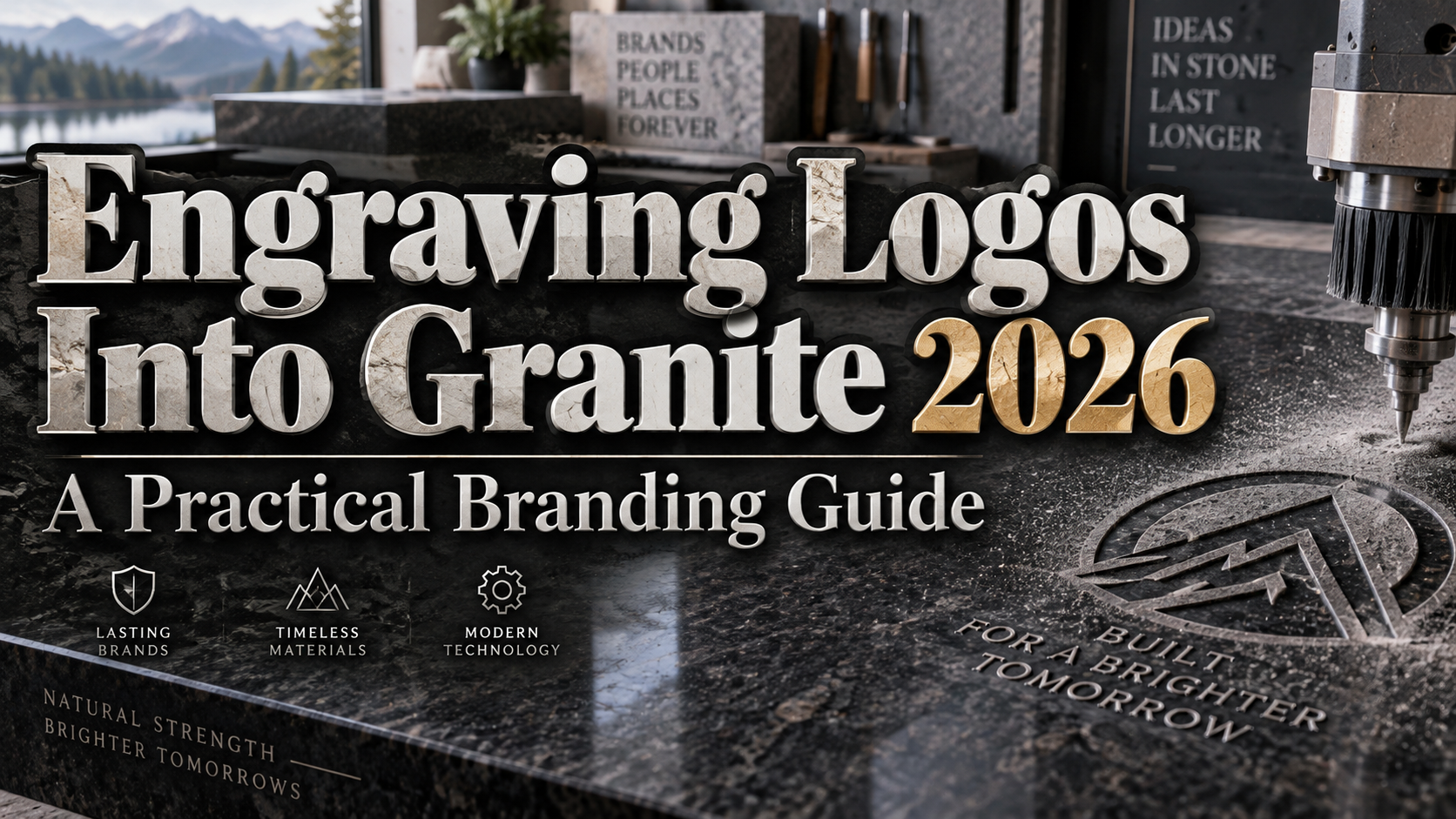
Engraving Logos Into Granite 2026: Turn Brand Identity Into a Physical Presence
Choose the Finish Before the Machine
Start your engraving logos into granite 2026 project by defining the location, viewing distance, and desired appearance. A reception plaque, outdoor entrance sign, and commemorative award require different decisions.
Surface marking and deep carving are not interchangeable. Ask fabricators for physical examples, then approve the method and material together. Specify whether the goal is a contrasting surface image, recessed lettering, or dimensional relief rather than requesting “premium engraving” without further detail.
Which Granite Engraving Method Fits Your Project?
CNC Routing and Milling
Computer Numerical Control guides cutting tools along programmed paths to remove material. CNC-STEP documents granite engraving, V-carved lettering, and relief work, while emphasizing that deep stone machining requires a suitably rigid machine.
Discuss cutter access, achievable detail, and the proposed depth with a stone specialist. Do not assume a router designed for wood can reproduce the same artwork in granite.
CO₂ Laser Engraving
Laser engraving creates a shallow, matte surface effect rather than the recessed profile of deep milling. Trotec identifies dark, uniform stone as particularly suitable and describes CO₂ processing for granite logos, lettering, and images.
Consider this approach for detailed plaques where surface contrast matters more than sculptural depth. Approve the result on your selected stone instead of relying on a photograph of another granite variety.
Sandblasting Through a Stencil
Sandcarving uses abrasive blasting through a protective mask to create the design. Rayzist supplies photoresist films for granite, including deep-carving applications and optional paint filling.
Ask the fabricator to compare stencil detail, recessed finish, and color-fill options. For a bold entrance wordmark, this method deserves consideration alongside CNC milling.
Prepare the Logo for Manufacturing
Supply a clean vector master in the fabricator’s accepted format. Rayzist’s mask service specifies black-and-white vector artwork and outlined lettering for relevant file types.
Keep an editable original and prepare a separate production copy. Remove unnecessary shadows and gradients, identify engraved areas clearly, and request approval for any simplified details.
Review the actual brand name, spacing, open letter interiors, and smallest strokes. Agree minimum dimensions with the fabricator rather than applying a universal font-size rule.
Explore PutraCetol Studio’s serif and bold display collections when developing a distinctive wordmark. Treat them as design candidates, not automatically engraving-ready fonts, and test the selected lettering in stone.
Approve a Sample in Real Conditions
Produce a representative section using the intended granite and finish. Include the smallest lettering, tightest gaps, and any decorative detail.
Inspect it at the intended viewing distance under realistic lighting. For an outdoor sign, review the appearance both dry and wet. Check whether natural patterning or reflections interfere with recognition before manufacturing the complete piece.
For a hypothetical boutique showroom, compare a restrained unfilled wordmark with a filled version. Choose the sample that communicates clearly, not simply the one that photographs dramatically.
Plan Safety, Installation, and Care
Granite processing can expose workers to respirable crystalline silica. NIOSH recommends appropriate dust controls, including wet methods, local exhaust ventilation, and enclosures, with respiratory protection when required. Avoid dry sweeping and compressed-air cleaning. Use a qualified fabrication workshop.
Have a qualified installer assess the panel, support, anchoring, and handling requirements. Ask for a maintenance plan covering the stone and any applied finish.
The Natural Stone Institute recommends suitable neutral cleaning products and notes that not every stone requires sealing. A sealer can improve stain resistance; it does not make stone stain-proof.
Comparison
These are starting points for supplier discussions, not guaranteed specifications.
| Method | Typical Result | Main Question |
|---|---|---|
| CNC milling | Recessed lettering or relief | Can the tooling reach the required details? |
| CO₂ laser | Shallow matte surface image | Does the selected stone provide enough contrast? |
| Sandblasting | Stencil-defined carving | Will the mask preserve the intended shapes? |
Common Mistakes
The first mistake is approving a digital mockup instead of a physical proof. Test the actual stone, lettering, and finish together. Treat machine specifications as only one part of quality control, and document acceptable detail and appearance before production.
Another mistake is confusing permanence with maintenance-free branding. Ask about cleaning, finish renewal, and future replacement. Keep frequently changing information, such as promotional offers or contact details, on replaceable components rather than carving it into the main identity.
The final mistake is comparing engraving prices alone. Request itemized quotations covering artwork preparation, samples, stone, machining, finishing, delivery, installation, and maintenance. Confirm authorization for the logo and fonts before manufacturing.
Conclusion
Successful engraving logos into granite in 2026 starts with clear artwork and realistic production choices. Match CNC, laser, or sandblasting to the intended result, approve a physical sample, and plan safe fabrication and installation.
Use thoughtful PutraCetol Studio typography to strengthen the identity, then let material testing guide the final details. Premium branding should remain recognizable in the real setting, not only in a presentation.
Explore these fonts and many more at PutraCetol.com to build a business identity that looks professional, trustworthy, and memorable.
Additionally, if you want to explore some free typography options, you can check out Putracetol Studio on Dafont. Happy reading and designing!