
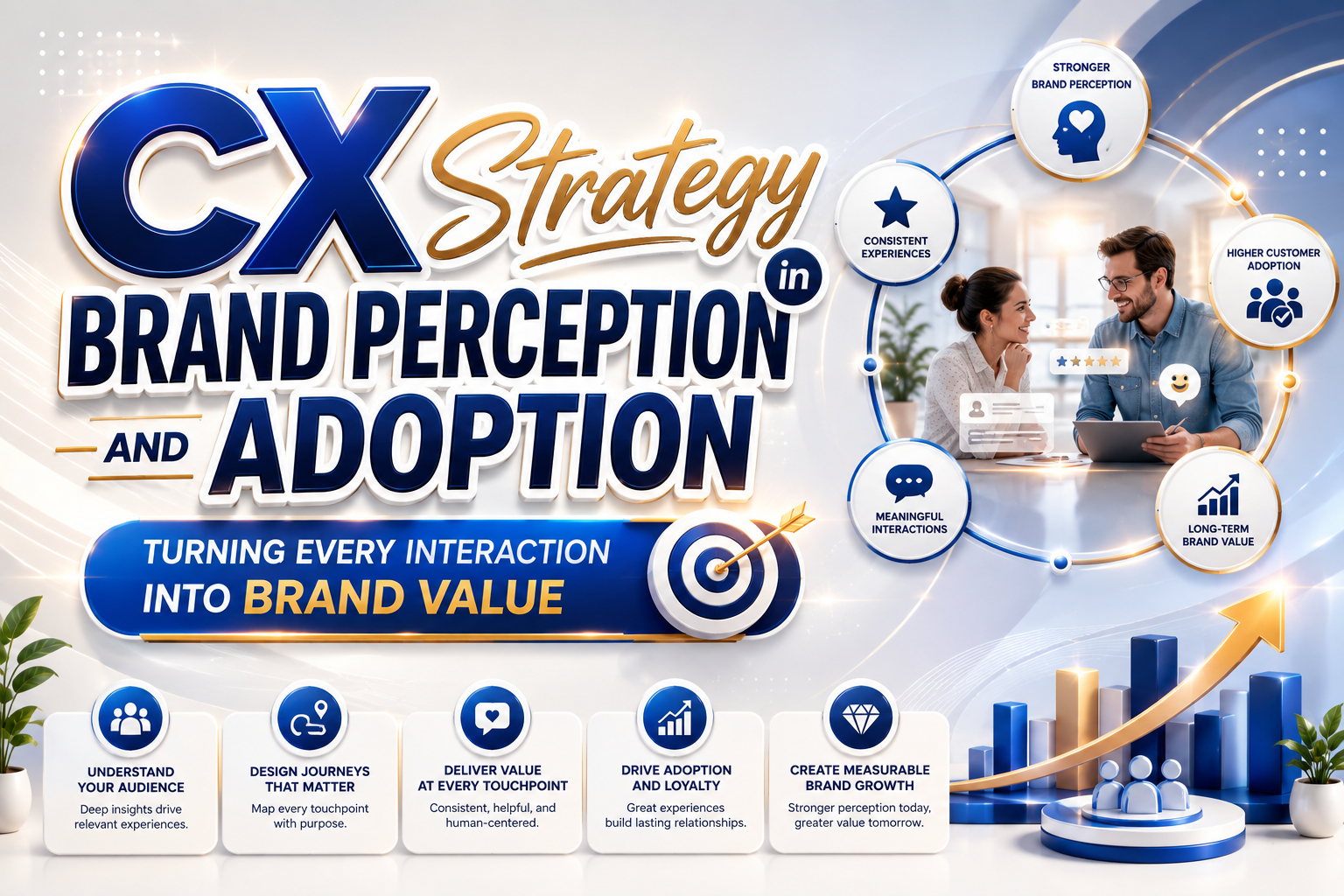
The most effective CX strategy in brand perception and adoption does not begin with a new campaign, interface redesign, or customer survey. It begins by identifying the journey that has the greatest influence on whether customers trust, adopt, and continue using the offer.
For a SaaS business, that journey may run from registration to the first completed workflow. For a financial platform, it could begin with account creation and end with the customer’s first successful transaction. A healthcare provider may need to examine appointment booking, consultation, and follow-up, while a retailer might focus on product discovery, checkout, delivery, and returns.
Define the customer’s desired outcome, not only the company’s conversion goal. Then document what users expect, what information they need, where they hesitate, which departments they encounter, and what counts as a successful first result.
Customer experience is broader than customer service. It is the perception created across interactions with the company, including its advertising, website, sales process, product, onboarding, support, and post-purchase communication. Each touchpoint becomes evidence that either supports or contradicts the brand promise.
What Is CX Strategy?
Customer experience strategy is the coordinated plan for designing, delivering, measuring, and improving how customers interact with a business throughout their relationship.
It connects four areas that organizations often manage separately:
- Brand strategy, which defines the promise and desired perception
- Product and service design, which delivers functional value
- Marketing and sales, which establish expectations
- Operations and support, which prove whether those expectations were credible
A successful CX strategy turns an abstract brand value into observable customer evidence. A company cannot credibly claim to be simple if account setup requires several unexplained steps. It cannot present itself as transparent if fees appear only at checkout. It cannot promise personal care while making customers repeat the same information to every department.
The experience becomes the practical expression of the brand.
How CX Shapes Brand Perception
Brand Perception Is Built Through Accumulated Evidence
Customers form brand perceptions by comparing what a company says with what it repeatedly does. Visual identity and advertising may create the first expectation, but the wider experience determines whether that expectation becomes believable.
A technology company may communicate innovation through modern branding, but customers will judge that claim through product performance, setup speed, documentation, and support. A financial brand may appear trustworthy through restrained typography and professional messaging, but confusing fees or unexplained account restrictions can quickly weaken that impression.
Every interaction contributes to a mental summary:
- Does this company understand me?
- Is it competent?
- Can I trust it?
- Is the product worth the effort?
- Will the company help when something goes wrong?
- Does the experience match the price and positioning?
Strong brand perception emerges when the answers remain consistent across channels and over time.
The Experience Changes the Meaning of the Brand
The same logo, color palette, and campaign message can produce different perceptions depending on the experience surrounding them.
Consider two healthcare applications using similarly calm visual systems. The first provides understandable appointment information, accessible navigation, accurate reminders, and clear next steps. The second uses the same reassuring colors but presents technical language, inaccessible forms, and uncertain confirmation messages.
The visual identities may appear similar, but the experienced brands are fundamentally different. One feels supportive and dependable. The other feels confusing and risky.
This is why brand management cannot stop at communication. Brand meaning is continuously renegotiated through the customer journey.
Cross-Industry Experiences Raise Expectations
Customers do not limit their expectations to direct competitors. Someone who experiences effortless checkout in retail may expect similar clarity when purchasing software. A patient accustomed to real-time delivery updates may also want better visibility into appointment status.
Current connected-customer research emphasizes rising expectations, trust, personalization, and responsible technology use as central challenges for organizations. It also shows that customer comfort with AI depends heavily on context. People are more open to AI that accelerates service than to autonomous systems making sensitive decisions, particularly financial ones.
Businesses therefore compete against the clearest, fastest, and most trustworthy experiences customers encounter anywhere, not only within one industry.
How CX Influences Product and Service Adoption
Adoption Is More Than Registration or Purchase
Acquisition records that someone entered the customer relationship. Adoption shows that the customer has incorporated the product or service into a meaningful activity.
A downloaded application has not necessarily been adopted. A paid software subscription may remain unused. A loyalty-program member may never redeem a benefit, and a patient may create an account without successfully booking an appointment.
Meaningful adoption normally progresses through several stages:
| Stage | Customer Question | Primary CX Responsibility |
|---|---|---|
| Awareness | Is this relevant to me? | Communicate a clear and credible promise |
| Evaluation | Can I trust this option? | Provide evidence, transparent terms, and useful comparisons |
| Onboarding | Can I get started without unnecessary effort? | Reduce setup friction and explain each step |
| First value | Did this solve the problem I came for? | Guide the customer toward a meaningful outcome |
| Routine use | Does this fit naturally into my behavior? | Support consistency, speed, and confidence |
| Support | Will the company help when something fails? | Provide contextual, accessible assistance |
| Renewal or repeat purchase | Is the value still worth the cost? | Reinforce outcomes and remove recurring friction |
| Advocacy | Would I recommend this experience? | Create confidence strong enough to share |
Perceived Usefulness and Ease Influence Acceptance
A foundational technology-adoption model identifies perceived usefulness and perceived ease of use as major influences on whether people accept information technology. The principle remains highly practical: customers are more likely to adopt a product when they understand its value and believe they can use it without unreasonable effort.
A product may offer powerful features but struggle with adoption if users cannot discover them, understand their purpose, or complete the required setup. Conversely, an easy interface may generate initial activity but weak retention if it does not produce meaningful value.
CX strategy must protect both sides of the equation:
- Value: Does the product improve an outcome the customer cares about?
- Usability: Can the customer reach that outcome confidently?
- Trust: Does the customer feel safe relying on the product?
- Fit: Can the experience become part of an existing routine?
- Reinforcement: Does the company help customers recognize the value they achieved?
Time to Value Shapes Early Perception
The period between purchase and the first meaningful result is one of the most influential parts of adoption. During this stage, customers compare the effort they are investing with the value they expect to receive.
A strong onboarding experience does not provide a tour of every available feature. It helps the customer complete the smallest action that proves the product can deliver its promise.
For example, a project-management platform might guide a new customer to create one project, assign a task, and receive a status update. A banking application may prioritize secure account verification and the first successful transfer. A retailer can make the initial value visible through accurate delivery expectations and an uncomplicated returns process.
The earlier customers experience credible value, the less the product depends on promises alone.
A Practical CX Strategy Framework
1. Align the Brand Promise With an Observable Experience
Translate every major brand claim into a behavior that customers can experience.
| Brand Promise | Observable CX Evidence |
|---|---|
| Simple | Short processes, understandable language, and clear next steps |
| Transparent | Visible pricing, data use, limitations, and account status |
| Personal | Relevant guidance based on known needs and preferences |
| Innovative | Useful improvements rather than unnecessary novelty |
| Premium | Careful details, dependable service, and thoughtful recovery |
| Accessible | Multiple usable paths for people with different needs |
| Fast | Reduced waiting, immediate feedback, and realistic time estimates |
This exercise prevents the brand strategy from remaining a collection of attractive but unprovable words.
2. Map the End-to-End Journey
Journey mapping provides a holistic view of what customers do, think, and feel as they work toward a goal. A useful map connects customer actions and expectations with channels, touchpoints, emotional states, obstacles, and organizational ownership.
Do not map only the interface. Include advertising, sales discussions, contracts, email, documentation, delivery, physical locations, support, billing, renewal, and cancellation.
Several common problems become easier to identify when the whole journey is visible:
- Marketing promises that onboarding cannot support
- Information collected repeatedly by different departments
- Different terminology for the same service
- Delays that customers cannot see or understand
- Digital processes that end with an unexpected manual step
- Support agents who lack access to earlier interactions
- Cancellation experiences that contradict the brand’s stated values
The map should lead to ownership and action, not remain an attractive workshop artifact.
3. Identify the Moments That Change Perception
Not every interaction carries equal emotional weight. Prioritize moments where uncertainty, risk, effort, or expectation is particularly high.
These may include:
- The first product demonstration
- Pricing and contract review
- Registration or identity verification
- The first transaction
- A failed payment
- Delivery of a high-value order
- A medical result
- A security alert
- A support escalation
- Renewal or cancellation
A customer may forgive a minor visual inconsistency but remember an unexplained charge, inaccessible form, or poorly handled complaint for years. The CX roadmap should therefore prioritize moments that can significantly strengthen or damage trust.
4. Design Onboarding Around Customer Progress
Replace feature-centered onboarding with outcome-centered guidance.
Ask what the customer must understand, prepare, connect, or complete to reach initial value. Remove fields that are not immediately necessary, explain why sensitive information is requested, and allow customers to resume interrupted work.
Progress indicators should communicate what has been completed, what remains, and why the next step matters. Empty states should guide action rather than merely report that no data exists.
Customers should also be able to skip optional education and return to it later. A guided path can support new users without becoming an obstacle for experienced ones.
5. Make Trust a Designed Experience
Trust is produced through clarity, control, consistency, security, and responsible recovery.
Explain what data is collected, why it is needed, and what benefit it provides. Allow customers to manage relevant permissions and preferences. Security messages should be understandable without creating unnecessary fear.
The FTC advises businesses to collect and retain only the customer information they genuinely need, limit access, protect the information they keep, and honor the privacy promises they make. These practices are not only technical obligations. They influence whether customers feel comfortable adopting and continuing to use a digital service.
When an error occurs, acknowledge it clearly. Explain what happened, what the customer should do, and what the organization is doing next. A well-handled problem can strengthen perception more effectively than an impersonal claim about customer care.
6. Create Connected, Not Merely Consistent, Channels
Consistency means maintaining the same brand identity and service principles. Connection means allowing information and progress to move with the customer.
A customer who begins an application on mobile should not need to restart on desktop. Someone who explains a problem to a chatbot should not repeat the entire story to a human agent. A retail customer should receive the same product and return information across the website, store, marketplace listing, and support channel.
A connected experience requires shared data definitions, operational integration, and clear ownership behind the interface. Visual consistency alone cannot solve fragmented processes.
7. Design Accessibility Into the Customer Journey
A CX strategy cannot claim to be customer-centered while excluding people from essential tasks. Websites, tools, and digital services should allow people with disabilities to perceive, understand, navigate, interact with, and contribute to digital experiences.
Accessibility should influence:
- Research and journey mapping
- Typography and color contrast
- Keyboard and assistive-technology support
- Form design and error handling
- Captions and transcripts
- Authentication
- Customer support
- Documents and transactional communication
- Third-party tools
An accessible experience also improves resilience. Clear labels, visible focus, understandable instructions, and flexible interaction methods help customers using small screens, temporary impairments, noisy environments, slow connections, or unfamiliar language.
8. Use Personalization With Control
Personalization should reduce effort or increase relevance. It should not create uncertainty about how the company obtained its information.
Useful personalization may include remembered preferences, relevant help, appropriate product recommendations, local information, and progress-based onboarding. Customers should be able to understand and adjust important personalization settings.
Avoid changing navigation, prices, eligibility, or significant recommendations without sufficient explanation. In finance, healthcare, and other high-trust environments, human review and clear alternatives remain important when automated systems influence consequential decisions.
9. Connect Customer Feedback With Operational Data
Survey responses describe how customers feel, but behavioral and operational data can reveal what happened.
A customer may report that onboarding was difficult. Product data can show where setup stopped. Support logs may reveal the recurring question, while technical monitoring identifies the underlying error.
Combine several types of evidence:
- Interviews and usability studies
- Customer complaints and support conversations
- Surveys and open-text feedback
- Product analytics
- Search behavior
- Abandonment and error data
- Delivery and operational performance
- Retention and repeat-purchase patterns
The goal is not to collect more dashboards. It is to establish enough evidence to decide what should change.
Applying CX Strategy Across Major Industries
Technology and SaaS
Technology businesses should connect acquisition messaging with activation. The landing page promise, sales demonstration, trial experience, onboarding, help documentation, and in-product guidance should lead toward the same outcome.
Useful improvements may include role-based setup, sample data, contextual education, migration assistance, progress saving, and clear feature discovery. Track whether customers reach first value and adopt the workflows connected to retention, not only whether they log in.
Financial Services
Financial CX depends heavily on trust, accuracy, and understandable control. Customers need clear fees, transaction status, verification instructions, security alerts, and explanations of automated decisions.
A visually polished dashboard cannot compensate for unexplained holds or ambiguous account information. Design for confidence by making state, risk, and next steps visible.
Healthcare
Healthcare experiences should reduce anxiety without hiding important information. Appointment booking, intake, consent, results, payment, and follow-up need understandable language and accessible interaction.
Patients should know whether a request was submitted, when a response is expected, and what to do if their condition changes. Human support should remain available when the digital journey cannot safely address the situation.
Retail and Ecommerce
Retail CX connects discovery, inventory, pricing, checkout, fulfillment, delivery, returns, loyalty, and support. Customers should receive consistent product information and realistic availability across channels.
Convenient checkout may win the first order, but accurate fulfillment and fair recovery influence whether the customer returns. Packaging, typography, unboxing, and post-purchase communication should reinforce the same market position established before purchase.
Measuring Brand Perception and Adoption Together
A mature CX measurement system connects perception, behavior, operational performance, and commercial outcomes.
Google’s HEART framework demonstrates how product teams can map goals to user-centered signals and metrics across happiness, engagement, adoption, retention, and task success. The same principle can help CX teams avoid choosing metrics simply because they are easy to collect.
| Measurement Area | Example Metrics | Strategic Question |
|---|---|---|
| Brand perception | Trust, attribute association, message comprehension, consideration | Do customers perceive the brand as intended? |
| Acquisition quality | Qualified conversion, trial relevance, expectation fit | Are we attracting customers whose needs match the offer? |
| Activation | Onboarding completion, activation rate, first-value completion | Are new customers reaching a meaningful result? |
| Effort and usability | Task success, error rate, customer effort, setup abandonment | How difficult is it to make progress? |
| Adoption | Feature use, workflow frequency, depth of use | Is the product becoming useful in regular behavior? |
| Service | First-response time, resolution, repeat contact, escalation | Does support restore progress and confidence? |
| Retention | Renewal, churn, repeat purchase, active cohorts | Is the experience producing durable value? |
| Advocacy | Referrals, reviews, recommendations, customer stories | Is the relationship strong enough to share? |
| Business impact | Expansion, cost to serve, margin, customer lifetime value | Is improved CX supporting sustainable growth? |
Avoid reducing CX to one score. A high satisfaction rating can coexist with weak adoption, and frequent usage can hide customer frustration when people have no practical alternative.
Review the metrics as a connected narrative: what customers expected, what they experienced, what they did afterward, and what business result followed.
Jump to Recommended Fonts
Vexorium Modern Experimental Font | Elarion Elegant Serif Font | Nomza Modern Bold Display Font | Strong Punch Sport Font | Veloria Palace Classic Serif Font
Typography is part of the customer experience because it influences recognition, emotional tone, hierarchy, and readability across every touchpoint. Use distinctive display fonts for brand names, campaign headlines, presentation covers, onboarding moments, and major section titles, then pair them with a highly readable functional font for interfaces, forms, instructions, and long content.
1. Vexorium Modern Experimental Font

Vexorium combines architectural precision with tall proportions, consistent strokes, rounded corners, and carefully controlled geometric curves. Unconventional structural details add a progressive personality while preserving enough clarity for professional brand systems. It is particularly valuable for companies that want their CX communications to feel organized, innovative, and future-focused across product launches, strategy decks, reports, and digital campaigns.
PROS: Clean geometry, distinctive construction, professional experimentation, and strong innovation positioning.
BEST FOR: SaaS companies, fintech platforms, technology startups, architecture, digital products, and innovation consultancies.
2. Elarion Elegant Serif Font

Elarion uses tall letterforms, refined stroke contrast, graceful curves, soft terminals, and balanced proportions. Its uppercase characters provide confident logo presence, while the lowercase creates a calmer editorial voice for supporting headlines. This combination can help high-trust or premium organizations communicate authority without making the customer experience feel cold.
PROS: Refined hierarchy, calm authority, polished readability, and versatile premium character.
BEST FOR: Healthcare, finance, hospitality, consulting, beauty, premium retail, and executive CX reports.
3. Nomza Modern Bold Display Font

Nomza uses chunky, rounded, and experimental letterforms with thick weight, soft corners, and playful negative spaces. Its bold silhouette feels futuristic and energetic, yet the rounded construction prevents it from appearing excessively aggressive. It can give adoption campaigns, product announcements, retail promotions, and customer-community programs a highly visible and approachable personality.
PROS: Strong visibility, playful geometry, distinctive negative space, and memorable campaign energy.
BEST FOR: Consumer technology, ecommerce, entertainment, retail launches, youth products, and adoption campaigns.
4. Strong Punch Sport Font

Strong Punch carries a heavy athletic voice through wide letters, sharp cuts, angled details, and a clear sense of forward motion. Its substantial structure makes short messages feel competitive, active, and results-oriented, which is useful for high-energy customer programs and performance-focused brands. Use it for major campaign statements rather than detailed interface content.
PROS: Powerful silhouette, visible momentum, bold headline performance, and competitive personality.
BEST FOR: Fitness platforms, sports retail, loyalty challenges, performance campaigns, events, and energetic consumer brands.
5. Veloria Palace Classic Serif Font

Veloria Palace presents a tall, condensed serif structure with a slim vertical rhythm, sharp contrast, and softened curves. The letterforms feel classic and luxurious while retaining clean visual organization, allowing longer names to maintain presence without overcrowding a layout. It can add refinement to premium customer journeys, especially where elegance, personal care, and editorial storytelling shape brand perception.
PROS: Elegant condensed form, premium contrast, space-efficient wordmarks, and graceful editorial personality.
BEST FOR: Beauty, wellness, luxury retail, boutique healthcare, hospitality, fashion, and premium customer communications.
Comparison
| Font | Visual Personality | Strongest CX Branding Role | Ideal Industry |
|---|---|---|---|
| Vexorium | Progressive and architectural | Innovation-led product identity | Technology, SaaS, and fintech |
| Elarion | Elegant and authoritative | Trust-building communication | Healthcare, finance, and consulting |
| Nomza | Bold and playful | Adoption and launch campaigns | Ecommerce and consumer technology |
| Strong Punch | Competitive and energetic | Performance and engagement programs | Fitness, sports, and active retail |
| Veloria Palace | Classic and luxurious | Premium relationship storytelling | Beauty, wellness, and hospitality |
Common Mistakes in CX Strategy
The first mistake is treating CX as a visual redesign or customer-service initiative. A company may refresh its interface, create new brand guidelines, and train support agents while leaving pricing, onboarding, delivery, and internal handoffs unchanged. The result looks different without feeling substantially better. CX must connect the brand promise with product, policy, process, data, and employee behavior. Begin with customer outcomes and moments of friction, then determine which organizational systems must change to support the intended experience.
The second mistake is optimizing individual touchpoints while ignoring the complete journey. Marketing may improve conversion while attracting customers whose expectations the product cannot meet. Product teams may simplify onboarding while billing and support continue using different terminology. Local improvements can therefore increase fragmentation rather than reduce it. Journey management requires shared definitions, connected customer information, cross-functional ownership, and metrics that follow customers from expectation through adoption and retention.
The final mistake is confusing personalization, automation, or visual sophistication with customer understanding. An AI recommendation is not helpful when customers cannot see why it was made, and a premium interface does not build trust when essential terms are hidden or inaccessible. Use customer data only for clear purposes, provide meaningful control, retain human support for sensitive situations, and ensure functional typography remains readable. Distinctive fonts can strengthen recognition and emotion, but the customer’s ability to understand and complete the task must remain the priority.
Conclusion
An effective CX strategy in brand perception and adoption connects what a company promises with what customers can repeatedly experience.
Brand perception begins with communication, but it is confirmed through usability, transparency, service, delivery, and recovery. Product adoption begins with acquisition, but it becomes meaningful only when customers reach value, establish confidence, and integrate the offer into their behavior.
The strongest organizations manage this relationship across the complete journey. They clarify the brand promise, identify moments that influence trust, reduce time to value, connect channels, build accessibility into essential tasks, and combine customer feedback with behavioral and operational evidence.
Typography helps give that strategy a recognizable visual voice. Vexorium can communicate innovation, Elarion can reinforce trust, Nomza can energize adoption campaigns, Strong Punch can express performance, and Veloria Palace can elevate premium customer relationships.
Fonts from PutraCetol Studio can support logos, campaigns, customer communications, websites, presentations, and other branded touchpoints. When typography aligns with the experience customers actually receive, it becomes more than a decorative choice. It becomes part of the evidence that makes a brand credible, memorable, and easier to adopt.
Explore these fonts and many more at PutraCetol.com to build a business identity that looks professional, trustworthy, and memorable.
Additionally, if you want to explore some free typography options, you can check out Putracetol Studio on Dafont. Happy reading and designing!