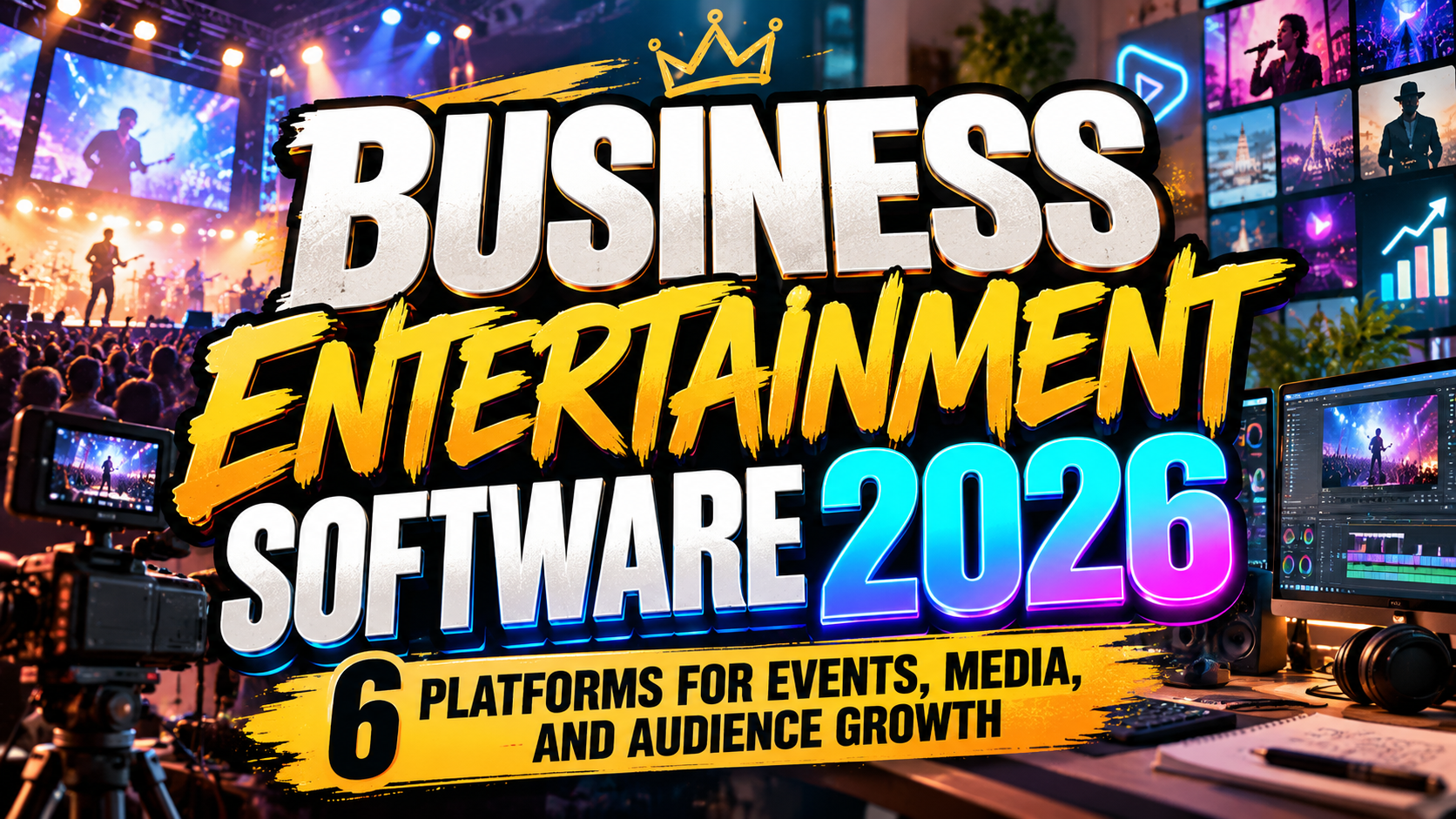
Business Entertainment Software 2026: 6 Platforms Powering Modern Entertainment
Entertainment businesses are becoming technology businesses.
A concert promoter must sell tickets, market events, check in guests, understand audience behavior, and measure revenue. A media company needs production workflows and distribution systems. Streaming businesses require subscription management, while attractions must connect ticketing, food, retail, mobile experiences, and visitor flow.
This makes business entertainment software 2026 less about finding one universal application and more about building the right operational stack.
The strongest platforms increasingly connect customer data, transactions, content, marketing, analytics, and audience engagement. Used correctly, that technology can reduce administrative work while creating more opportunities to monetize every audience relationship.
Start With Your Revenue Model
Before choosing software, identify how the entertainment business makes money.
A festival may rely primarily on ticket sales, sponsorships, merchandise, and food. A streaming company depends on subscriptions or transactional video purchases. Museums and performing arts organizations may combine tickets with memberships and donations, while theme parks need admissions, retail, food, and attraction capacity management.
Map the complete customer journey from discovery to purchase, attendance, follow-up, and repeat engagement.
Then select software that supports those stages without creating unnecessary data silos.
Recommended Business Entertainment Software for 2026
1. Eventbrite: Best for Independent Events and Ticket Sales
Eventbrite is a practical starting point for concerts, workshops, festivals, nightlife, community events, and independent promoters.
Its organizer platform combines customizable event pages, ticketing, registration, attendee check-in, payments, marketing tools, and real-time analytics. Organizers can offer reserved seating, timed entry, promo codes, group tickets, merchandise add-ons, and embedded checkout. Eventbrite also provides integrations for platforms including Facebook, LinkedIn, TikTok, and Zoom.
Its marketplace can also help events gain exposure beyond an organizer’s existing audience.
PROS: Straightforward ticketing, built-in discovery, marketing tools, check-in app, useful sales analytics.
BEST FOR: Concerts, workshops, festivals, independent promoters, small entertainment businesses.
2. Cvent: Best for Large and Complex Events
Cvent addresses a broader enterprise event-management problem.
The platform covers registration, venue sourcing, attendee engagement, onsite check-in, badges, networking, lead capture, virtual and hybrid events, surveys, and analytics. Its current platform also connects event data with systems such as Salesforce, Marketo, and HubSpot, helping organizations connect attendance with broader marketing and revenue performance.
Cvent is therefore more appropriate when an event program involves multiple stakeholders, venues, sponsors, exhibitors, or recurring programs.
PROS: Comprehensive event operations, analytics, integrations, onsite tools, large-scale management.
BEST FOR: Major conferences, corporate entertainment, trade shows, hybrid events, large event portfolios.
3. Tessitura: Best for Arts, Culture, and Audience CRM
Tessitura is specifically designed around arts and cultural organizations.
Rather than separating ticketing from customer management, its platform combines admissions, tickets, subscriptions, memberships, donations, customer preferences, communications, and other interactions within unified constituent records. It can support everything from general admission and timed entry to seated venues and multi-venue packages.
That unified approach becomes particularly valuable when an organization wants to understand the audience beyond a single ticket purchase.
PROS: Unified CRM, ticketing, memberships, donations, detailed audience relationships.
BEST FOR: Theaters, museums, performing arts, cultural venues, zoos, attractions.
4. monday.com: Best for Media and Entertainment Production Operations
Entertainment management is not only customer-facing.
Movies, videos, campaigns, social content, advertisements, and branded entertainment all move through complex internal production pipelines.
monday.com’s dedicated media and entertainment workflows can manage content planning, production schedules, resources, budgets, creative assets, marketing campaigns, content sales, and distribution. Teams can track work from ideation and pre-production through post-production while monitoring owners, deadlines, status, and budget changes.
PROS: Flexible workflows, production tracking, resource management, campaign coordination, dashboards.
BEST FOR: Production houses, creative agencies, media companies, video teams, entertainment marketing departments.
5. Vimeo OTT: Best for Direct-to-Audience Video Monetization
For entertainment companies monetizing video directly, Vimeo OTT provides a different kind of business infrastructure.
Its Starter offering supports subscription video and transactional purchases through a web-based service, while Enterprise expands into branded applications, advertising-supported models, free registration, live pay-per-view, and 24/7 linear channels. Vimeo OTT also provides subscriber management, checkout, analytics, and content delivery capabilities.
This is particularly timely because Vimeo On Demand is being discontinued on November 20, 2026, with Vimeo directing sellers interested in video monetization toward Vimeo OTT instead.
PROS: Subscription monetization, transactional video, branded apps at enterprise level, audience management.
BEST FOR: Filmmakers, fitness media, educational entertainment, niche streaming brands, digital video businesses.
6. accesso: Best for Theme Parks and Visitor Attractions
accesso is designed around destination and attraction operations.
Its ecosystem includes ticketing, ecommerce, point of sale, virtual queuing, distribution, mobile applications, and guest-experience tools. Its virtual queuing technology helps visitors spend less time physically waiting, while operators can connect ticketing and commercial touchpoints across the visitor journey.
That makes the platform significantly different from conventional event-ticketing applications.
PROS: Ticketing, POS, virtual queues, mobile experiences, attraction-focused operations.
BEST FOR: Theme parks, water parks, attractions, resorts, entertainment destinations.
Comparison: Business Entertainment Software 2026
| Platform | Main Strength | Best For |
|---|---|---|
| Eventbrite | Ticket sales and promotion | Independent events |
| Cvent | Full event operations | Large event programs |
| Tessitura | Unified audience CRM | Arts and culture |
| monday.com | Production workflow | Media teams |
| Vimeo OTT | Video monetization | Streaming businesses |
| accesso | Guest experience operations | Attractions |
The important point is that these platforms are not direct substitutes. Eventbrite manages events differently from Vimeo OTT, while accesso solves physical destination challenges that monday.com does not attempt to address.
Branding Still Matters Across Entertainment Technology
Software can optimize operations, but audiences experience the brand rather than the database behind it.
Event posters, streaming thumbnails, ticket pages, stage graphics, merchandise, social campaigns, video titles, and venue signage should share a recognizable visual language.
Entertainment companies can explore fonts from PutraCetol Studio for campaign headlines, show branding, promotional graphics, merchandise, and entertainment-focused digital assets. Strong typography is especially useful where audiences must recognize an event or property immediately across multiple channels.
Common Mistakes
A common mistake is buying one oversized platform and expecting it to solve every operational problem. Entertainment companies often need specialized systems connected through integrations. Ticketing, production management, CRM, streaming, and onsite visitor operations involve fundamentally different workflows.
Another mistake is collecting audience data without using it strategically. Ticket history, memberships, content viewing, campaign engagement, and visitor behavior can help identify loyal customers and future revenue opportunities, but only if teams maintain clean data and define meaningful segments.
Finally, avoid focusing exclusively on the purchase transaction. Entertainment businesses grow through repeat audiences. The technology stack should support discovery, purchase, experience, follow-up, personalization, and retention rather than treating each event or content purchase as an isolated sale.
Conclusion
The most useful business entertainment software 2026 depends on the entertainment model itself.
Eventbrite simplifies independent ticketing, Cvent manages complex events, Tessitura connects cultural organizations with audiences, monday.com organizes media production, Vimeo OTT supports direct video monetization, and accesso powers sophisticated attraction experiences.
The strongest entertainment businesses will not simply adopt more software. They will connect the right tools around one coherent audience journey, turning operations, content, branding, and customer data into a system that encourages people to return.
Explore these fonts and many more at PutraCetol.com to build a business identity that looks professional, trustworthy, and memorable.
Additionally, if you want to explore some free typography options, you can check out Putracetol Studio on Dafont. Happy reading and designing!