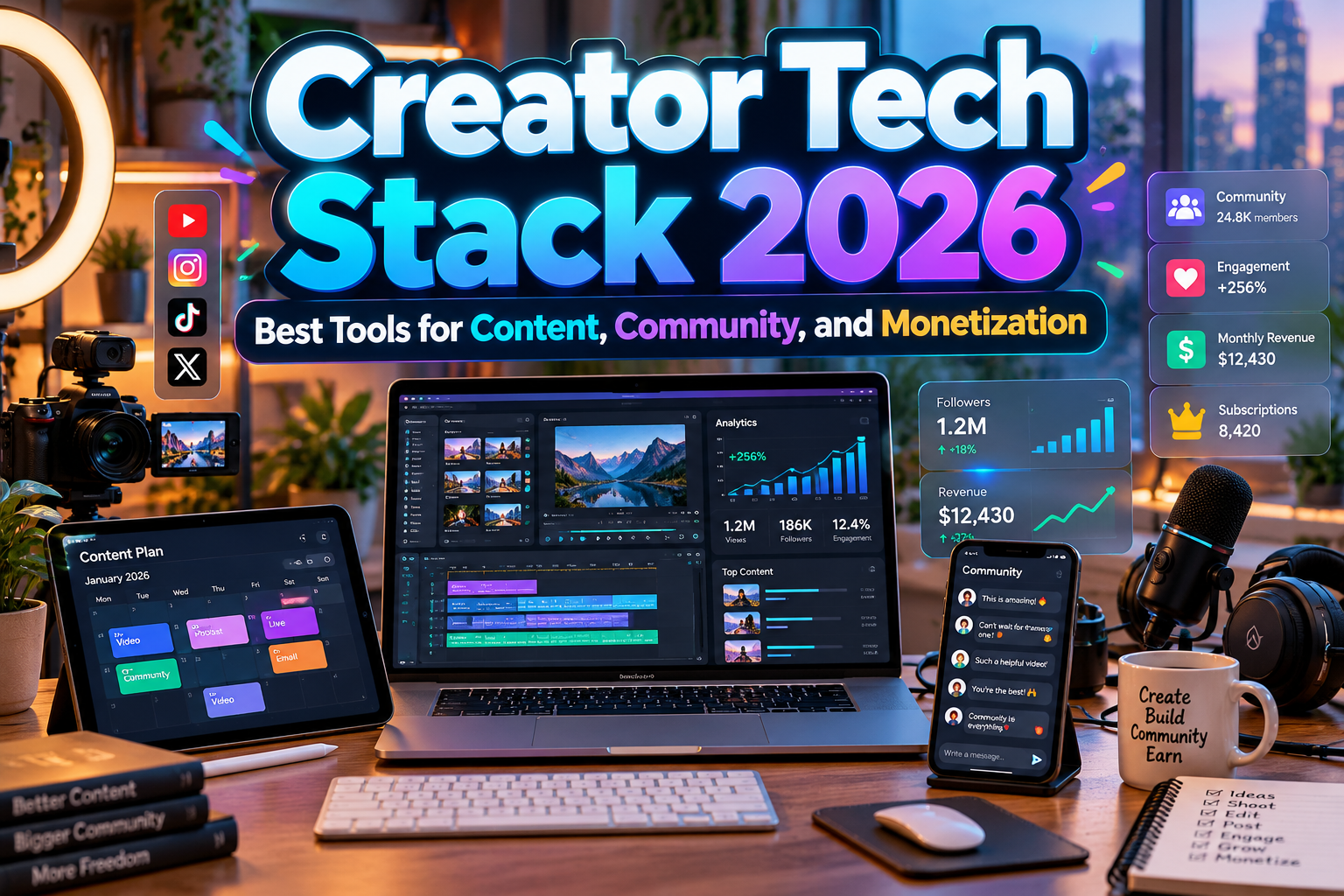
Creator Tech Stack 2026: Building a Smarter Creator Business
Being a digital creator in 2026 involves much more than publishing content.
Creators increasingly operate like small media companies. They plan editorial calendars, produce videos and graphics, manage newsletters, moderate communities, sell digital products, analyze audience behavior, and automate repetitive business tasks.
Circle’s 2026 creator-economy research reflects this shift: 48% of surveyed creators operate entirely solo, while creator responsibilities increasingly extend into marketing, revenue, community experience, technology, and retention. Circle
That makes the creator tech stack 2026 less about collecting popular apps and more about designing a connected system.
The strongest stack should help you move smoothly from idea → production → publishing → audience ownership → monetization → measurement.
Initial Suggestion: Build Around Workflows, Not Software
Before subscribing to another platform, map your actual workflow.
Imagine a YouTube creator who publishes one long-form video every week. The process might include researching ideas, writing a script, recording, editing, creating a thumbnail, publishing, repurposing clips, emailing subscribers, discussing the topic with a community, and tracking performance.
Each tool should solve a specific stage of that process.
If two applications perform almost the same job, consider consolidating them. A smaller integrated stack is usually easier to maintain than fifteen specialized apps connected through fragile workarounds.
This matters especially for solo creators. Software should reduce operational work, not become another business to manage.
Recommended Creator Tech Stack for 2026
1. Notion: Planning, Knowledge, and Creator Operations
Notion works well as the organizational center of a creator business.
Creators can manage editorial calendars, sponsorship pipelines, research databases, campaign briefs, launch checklists, content ideas, and production schedules in one workspace.
In 2026, Notion has expanded significantly into AI agents and connected context. Its current system allows AI to work directly with documents, databases, tasks, and connected tools, while Notion MCP can connect external AI applications to workspace information. Notion
BEST FOR: Content calendars, research, projects, SOPs, campaign management.
2. Canva: Fast Visual Content and Brand Consistency
Canva remains useful when creators need to produce thumbnails, social posts, presentation graphics, lead magnets, banners, and campaign assets quickly.
The Canva AI 2.0, introduced in 2026 as a research preview, moves beyond simple image generation by producing layered, editable design outputs and adding workflows including scheduling, connectors, web research, and brand intelligence. Canva
This is particularly valuable for creators who need one visual identity across several channels.
For an even more distinctive brand, creators can combine their designs with original typography from PutraCetol Studio for thumbnails, covers, merchandise, promotional graphics, and other brand-facing assets.
BEST FOR: Thumbnails, social graphics, presentations, brand templates, campaign visuals.
3. CapCut or Descript: Video and Audio Production
For social-first video, CapCut provides a fast production workflow. Its current AI tools can identify scenes, turn longer footage into short clips, generate captions, create vertical versions, and assist with automated editing. CapCut
For podcasting, interviews, tutorials, and talking-head content, Descript takes a different approach. Its 2026 Underlord assistant works from the transcript and can handle tasks such as filler-word removal, clip selection, and show notes. Descript
The choice depends on workflow rather than which platform has the longest feature list.
BEST FOR: CapCut for short-form social video; Descript for transcript-driven video and audio editing.
4. Kit: Email, Audience Ownership, and Funnels
Social followers are useful, but creators do not control the algorithms that determine whether those followers see future content.
An email list creates a more direct relationship.
Kit, formerly ConvertKit, is specifically built around creator businesses. It combines newsletters, segmentation, visual automations, landing pages, digital-product sales, paid subscriptions, analytics, sponsorship tools, and integrations. Its newer MCP capability can also connect AI tools directly to audience data and creator workflows. Kit
For example, someone downloading a free guide can automatically enter a welcome sequence and later receive a relevant paid offer.
BEST FOR: Newsletters, lead magnets, audience segmentation, automated funnels, digital sales.
5. Circle or Patreon: Community and Recurring Revenue
Content creates attention. Community can turn that attention into deeper relationships.
Circle is particularly strong for structured membership businesses combining community discussions, courses, events, and subscriptions. Its 2026 research found that 88% of surveyed community-focused creators monetize through paid memberships. Circle
Patreon remains another practical option for creators centered on fan membership. It supports free and paid communities alongside one-time digital purchases through its Shop functionality. Patreon Help Center
BEST FOR: Paid communities, memberships, exclusive content, courses, fan relationships.
6. Zapier: Connect the Stack
Automation becomes valuable when the creator business starts producing repetitive administrative work.
Zapier can connect tools through trigger-and-action workflows. Its 2026 guidance increasingly incorporates AI steps into automations alongside conventional integrations. Zapier
A new product purchase could automatically add a customer to an email segment, create a record in Notion, and trigger onboarding without manual copying.
The goal is not to automate creativity. Automate the administrative work surrounding creativity.
BEST FOR: Cross-platform automation, lead routing, customer onboarding, repetitive operations.
Comparison: Creator Tech Stack 2026
| Layer | Recommended Tool | Primary Role |
|---|---|---|
| Planning | Notion | Content and operations |
| Visual design | Canva | Brand assets |
| Video | CapCut / Descript | Production and repurposing |
| Kit | Audience ownership | |
| Community | Circle / Patreon | Membership and engagement |
| Automation | Zapier | Connect workflows |
You do not necessarily need every platform. Start with the layers currently creating the most friction.
Build Around Owned Audience and Revenue
A creator stack should not focus exclusively on producing more content.
It should also help convert temporary attention into durable relationships.
Circle’s 2026 research shows creator monetization shifting toward recurring and owned revenue models, with memberships, courses, services, and digital products playing major roles. Circle
A practical funnel might look like:
YouTube or Instagram → email newsletter → community → paid membership or digital product.
In that model, social platforms drive discovery while email and community deepen the relationship.
Common Mistakes
The first mistake is building a huge stack before the business needs it. Creators often subscribe to scheduling platforms, CRM systems, automation services, AI writers, analytics dashboards, community software, and multiple editors before establishing a repeatable publishing process. Start with the bottleneck, solve it, then add another layer only when necessary.
Another mistake is automating everything. AI can generate drafts, clips, captions, summaries, and workflows faster, but excessive automation can make every creator sound and look similar. Canva’s own 2026 trend research found strong interest in AI alongside renewed demand for human imperfection and creative control. Canva Use technology to accelerate execution while preserving the taste, expertise, personality, and visual identity that make the creator recognizable.
Finally, avoid letting your entire business depend on one social platform. Algorithms, policies, monetization programs, and reach can change. Use social media for discovery, but gradually build assets you control more directly, such as an email list, website, customer database, products, and community.
Conclusion
The ideal creator tech stack 2026 is not the stack with the most AI tools.
It is a connected system where each platform has a clear responsibility.
Notion can organize operations, Canva handles scalable visual production, CapCut or Descript accelerates editing, Kit builds an owned audience, Circle or Patreon supports community monetization, and Zapier connects repetitive workflows.
Add strong branding and distinctive typography from PutraCetol Studio, and the technology begins working behind the scenes while your creative identity remains visible in front.
The result is not simply faster content production. It is a creator business that can publish consistently, understand its audience, monetize sustainably, and grow without multiplying manual work.
Explore these fonts and many more at PutraCetol.com to build a business identity that looks professional, trustworthy, and memorable.
Additionally, if you want to explore some free typography options, you can check out Putracetol Studio on Dafont. Happy reading and designing!