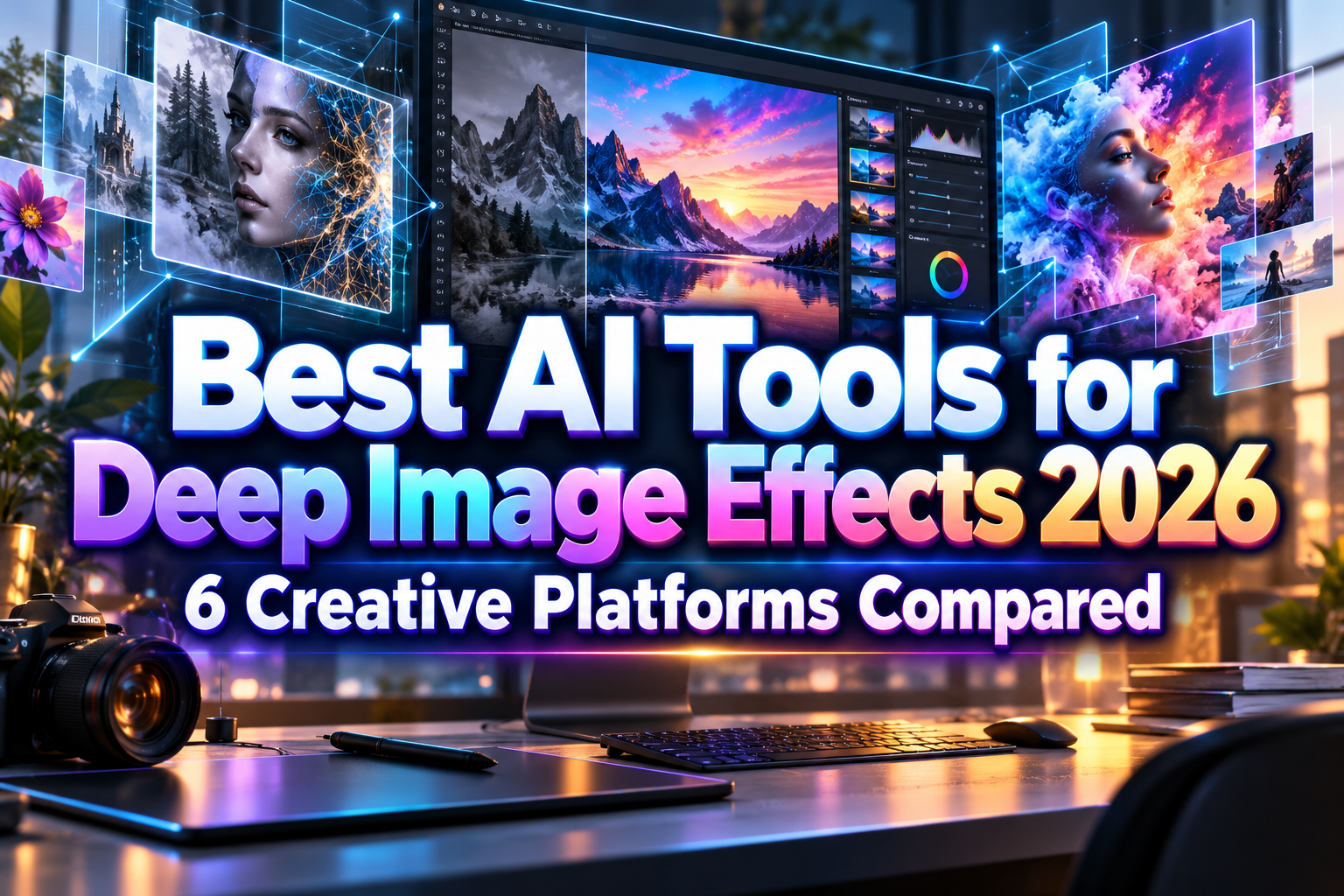
Best AI Tools for Deep Image Effects 2026: 6 Platforms for Creative Visual Editing
AI image editing has evolved far beyond automatic filters. Modern tools can rebuild missing areas, replace objects, relight photographs, recover lost detail, generate new environments, change visual styles, and transform ordinary images into campaign-ready artwork.
That makes the best AI tools for deep image effects 2026 relevant to photographers, graphic designers, marketers, digital artists, and content creators who need sophisticated results without performing every adjustment manually.
“Deep image effects” is not one formal software category. In practice, it describes advanced AI-assisted transformations that affect composition, depth, lighting, texture, atmosphere, resolution, or visual style rather than simply applying a preset.
The following recommendations are ranked editorially according to creative depth, workflow flexibility, ease of use, and usefulness for professional digital production.
Initial Suggestion: Decide Whether You Need Enhancement or Transformation
Before choosing an AI image tool, decide what kind of change you actually need.
Enhancement aims to preserve the original photograph while improving sharpness, noise, exposure, or resolution.
Transformation changes the image more substantially by generating objects, environments, lighting, textures, or entirely new visual directions.
A photographer restoring a soft portrait may benefit more from Topaz than from a generative platform. A designer creating surreal campaign artwork will probably need Photoshop, Runway, or another system that supports deeper generative editing.
Keeping these two goals separate helps prevent unnecessary AI alterations.
Recommended AI Tools for Deep Image Effects
1. Adobe Photoshop + Firefly: Best Overall for Professional Editing
Photoshop remains one of the most complete choices because generative AI exists inside a traditional layer-based editing environment. Current Photoshop features include Generative Fill for replacing or adding elements, Generative Expand for extending compositions, Generate Background, Generative Upscale, and Harmonize, which automatically adjusts lighting, color, shadows, and other details when combining objects with a scene. Adobe Help Center
This combination is particularly valuable because AI results can still be refined with masks, selections, adjustment layers, typography, and conventional retouching tools.
PROS: Deep manual control, generative editing, compositing, professional workflow.
BEST FOR: Graphic designers, photographers, advertising, campaign artwork, professional retouching.
2. Runway: Best for Experimental and Cinematic Image Effects
Runway is particularly strong when the objective is transformation rather than traditional photo correction. Gen-4 Image supports text and image inputs with stylistic control, while Gen-4 References can preserve or transfer characters, objects, environments, and visual styles across new generations. It can also combine information from multiple reference images. Runway
This makes Runway useful for surreal compositions, cinematic concepts, fashion experiments, advertising visuals, and projects that may later extend into AI video.
PROS: Strong style transformation, image references, cinematic experimentation, image-to-video ecosystem.
BEST FOR: Digital artists, filmmakers, advertising concepts, experimental campaigns.
3. Luminar Neo: Best for AI-Assisted Photography
Luminar Neo provides an easier bridge between conventional photo editing and generative AI. Its toolset includes GenSwap for replacing image elements, GenErase for removing distractions, GenExpand for extending scenes, Relight AI for correcting poorly lit photographs, and portrait-oriented AI controls. Skylum
It is particularly appealing to photographers who want advanced corrections and atmospheric effects without moving into a highly technical compositing workflow.
For example, a travel photographer could remove crowds, improve lighting, expand a landscape composition, and replace a distracting object within the same editing environment.
PROS: Photography-focused workflow, relighting, object replacement, generative editing.
BEST FOR: Photographers, travel imagery, portraits, lifestyle content.
4. Topaz Photo: Best for Image Quality Enhancement
Topaz Photo is less focused on fantasy-style manipulation and more focused on recovering image quality.
Its current tools include AI sharpening, denoising, face recovery, multiple upscaling models, Super Focus, and generative recovery systems. Topaz’s Upscale feature can enlarge suitable images by as much as 600%, while newer recovery models attempt to reconstruct realistic photographic texture rather than relying only on conventional sharpening. Topaz Labs Docs
This makes Topaz particularly useful before or after creative editing. A low-resolution photograph can be cleaned and enlarged before being incorporated into a larger design.
PROS: Strong upscaling, denoising, sharpening, face recovery.
BEST FOR: Photographers, restoration, low-resolution images, print preparation.
5. Canva Magic Studio: Best for Fast Content Creation
Canva offers a more accessible approach for creators who need AI effects without learning professional photo-editing software.
Magic Edit can add, replace, or transform portions of an image using written instructions. Magic Expand extends images beyond their original frame, while Magic Grab separates subjects so they can be repositioned and redesigned. Canva has also introduced Magic Layers, which can reconstruct flattened visuals into editable layers. Canva
Its biggest advantage is workflow speed because edited imagery can immediately become a social post, presentation, thumbnail, advertisement, or marketing design.
PROS: Easy interface, fast generative editing, integrated design workflow.
BEST FOR: Social media, marketers, educators, small businesses, content creators.
6. Photoroom: Best for Product and E-Commerce Effects
Photoroom specializes heavily in commercial product imagery.
Its current AI workflow includes background removal, product staging, realistic shadows, relighting, recoloring, AI-generated backgrounds, image expansion, batch processing, and tools that enhance low-quality product photographs. Photoroom
That makes it particularly effective for brands needing dozens or hundreds of consistent product images rather than one complex artistic composition.
PROS: Product-oriented AI, background generation, relighting, shadows, automation.
BEST FOR: E-commerce, marketplaces, product branding, online retailers.
Comparison: Best AI Image Effect Tools 2026
| Platform | Strongest Capability | Best For |
|---|---|---|
| Photoshop + Firefly | Professional generative editing | Designers |
| Runway | Creative transformation | Digital artists |
| Luminar Neo | AI photography effects | Photographers |
| Topaz Photo | Quality recovery | Enhancement |
| Canva | Fast design workflow | Content creators |
| Photoroom | Product imagery | E-commerce |
The strongest choice depends on whether you need precision, experimentation, restoration, or production speed.
Building a Strong Visual Identity Around AI Effects
AI can generate impressive visuals, but effects alone do not create recognizable branding.
A campaign should still use a consistent color palette, composition style, typography, logo treatment, and visual hierarchy. Otherwise, each AI-generated image may look like it belongs to a completely different company.
This is where typography remains important. Brands and creators can combine AI-generated imagery with distinctive fonts from PutraCetol Studio for advertising, thumbnails, packaging, posters, social content, and other visual campaigns. A consistent type system can help connect very different AI-generated scenes into one recognizable brand identity.
Common Mistakes With AI Image Effects
One common mistake is applying AI simply because the effect looks dramatic. Heavy relighting, excessive texture generation, surreal backgrounds, and extreme enhancement can easily overpower the original subject. Start by asking what the image needs to communicate, then use AI only where it strengthens that objective.
Another mistake is trusting generated detail without inspection. AI enhancement can reconstruct textures that were not truly visible in the source photograph, while generative editing can alter logos, faces, packaging, architecture, or physical proportions. Topaz itself warns that more generative enhancement settings can introduce artifacts, so important commercial details should always be checked against the original. Topaz Labs Docs
Finally, avoid depending on one-click results. The strongest AI-assisted work often combines generation with cropping, masking, color grading, typography, spacing, and manual refinement. AI should accelerate creative decisions, not replace them.
Conclusion
The best AI tools for deep image effects 2026 serve different creative priorities.
Photoshop offers the deepest professional workflow, Runway excels at experimental transformation, Luminar Neo is excellent for AI-assisted photography, Topaz specializes in image recovery, Canva prioritizes speed and accessibility, and Photoroom is highly practical for e-commerce imagery.
Choose the tool based on the type of visual change you need, not the number of AI features advertised.
When AI effects, thoughtful typography, and consistent branding work together, ordinary images can become polished visual assets that feel deliberate rather than simply generated.
Explore these fonts and many more at PutraCetol.com to build a business identity that looks professional, trustworthy, and memorable.
Additionally, if you want to explore some free typography options, you can check out Putracetol Studio on Dafont. Happy reading and designing!