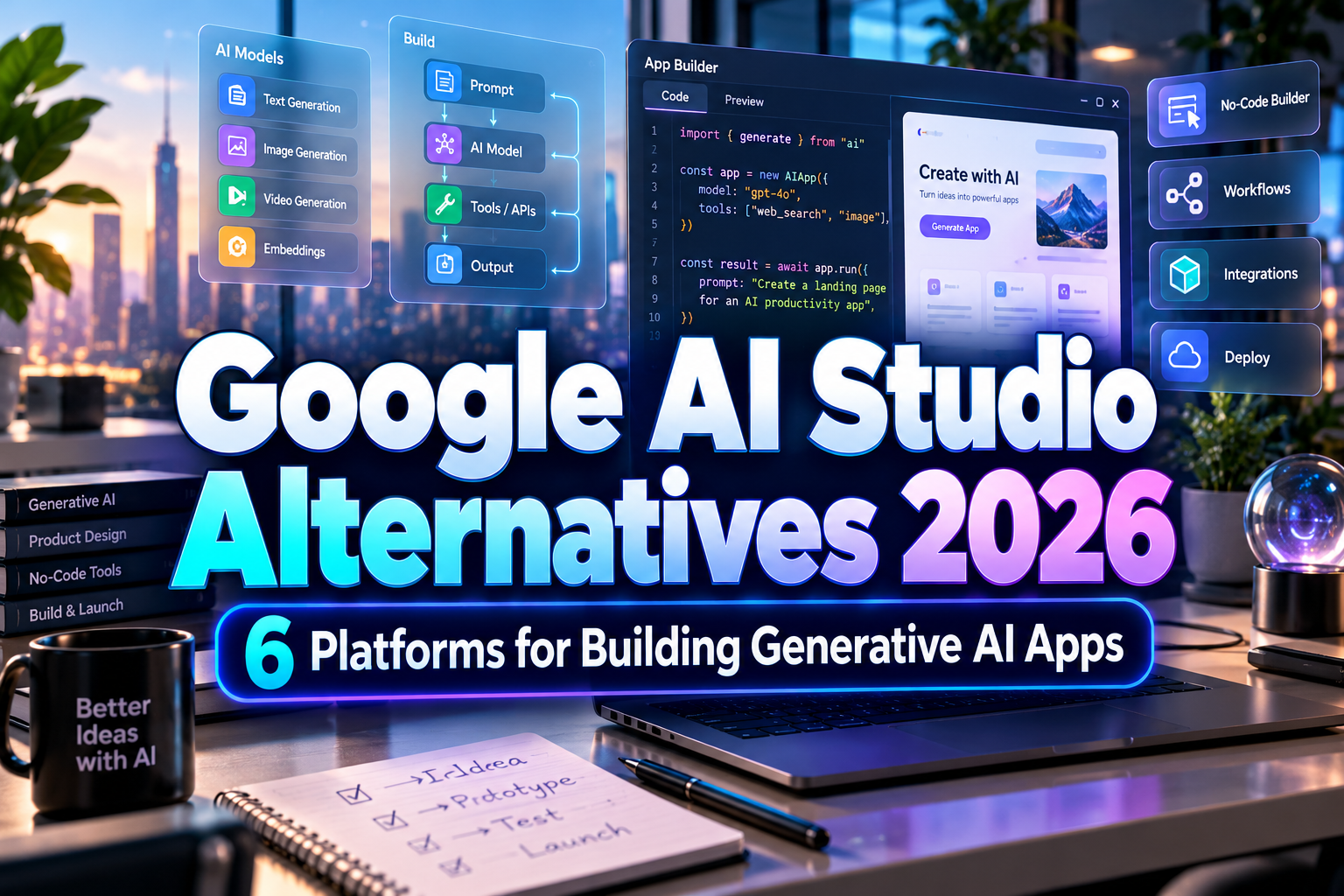
Google AI Studio Alternatives 2026: 6 Platforms for Building Generative AI Apps
Google AI Studio makes it relatively easy to experiment with Gemini models, test prompts, and move prototypes toward API integrations. However, modern AI development rarely depends on one model provider.
A startup may need rapid application deployment. An enterprise may prioritize governance and model choice. An AI engineer may want open-source models, while a no-code creator may care more about turning a natural-language idea directly into a working product.
That makes the Google AI Studio alternatives 2026 landscape increasingly diverse.
The strongest platforms now combine model experimentation with APIs, agents, tool calling, evaluation, deployment, observability, retrieval, and workflow automation. Choosing the right alternative depends on whether you need a model playground, complete cloud AI infrastructure, or an AI-powered application builder.
Initial Suggestion: Decide What You Are Replacing
Before moving away from Google AI Studio, identify which part of the workflow matters most.
If you primarily use it to experiment with prompts, OpenAI Platform or Anthropic Console may be the closest alternatives. If you need access to many model families with enterprise governance, Microsoft Foundry or Amazon Bedrock is more appropriate.
Or if your goal is to build and deploy an entire application rather than simply test model calls, Replit can reduce significantly more development work.
The key is not finding an identical interface. It is finding the platform that eliminates the most friction between idea, prototype, evaluation, and production.
Recommended Google AI Studio Alternatives for 2026
1. OpenAI Platform: Best for Tool-Using AI Applications
OpenAI Platform is a strong alternative for developers building conversational, multimodal, and agentic applications.
The current architecture centers on the Responses API, which supports capabilities such as web search, MCP connections, and computer use. OpenAI officially retired the previous Assistants API on August 26, 2026, replacing its Assistants, Threads, and Runs concepts with Prompts, Conversations, and Responses. (platform.openai.com)
This makes the platform particularly useful when an AI application needs to do more than generate text and must interact with tools or external systems.
PROS: Strong agentic APIs, tool integration, multimodal capabilities, prompt workflows.
BEST FOR: AI SaaS, assistants, automation, multimodal applications, developer-led products.
2. Anthropic Console: Best for Claude Prompt Development
Anthropic Console provides a focused environment for developers building with Claude.
Its Workbench allows teams to craft and test prompts in the browser, while the prompt generator helps turn early instructions into more structured prompts. Anthropic also provides APIs, SDKs, prompt resources, and development examples for moving tested workflows into applications. (docs.anthropic.com)
The platform is particularly attractive when Claude is the primary reasoning or coding model behind the product.
PROS: Clean prompt experimentation, Workbench, prompt-generation tools, direct Claude API workflow.
BEST FOR: Claude applications, prompt engineering, coding tools, analytical and text-heavy AI products.
3. Microsoft Foundry: Best for Enterprise Multi-Model AI
Microsoft Foundry is substantially broader than a simple AI playground.
Its model catalog includes more than 1,900 models across foundation models, reasoning models, small language models, multimodal systems, industry models, and community offerings. Providers represented in the catalog include Microsoft, OpenAI, Meta, Mistral, Cohere, NVIDIA, and Hugging Face. (learn.microsoft.com)
Foundry also provides evaluation infrastructure for testing agents on task completion, groundedness, tool selection, tool-call accuracy, safety, and other production-oriented criteria. (learn.microsoft.com)
PROS: Huge model catalog, enterprise governance, agent evaluation, Azure integration, observability.
BEST FOR: Enterprises, regulated industries, multi-model strategies, large AI engineering teams.
4. Amazon Bedrock: Best for AWS-Native Generative AI
Amazon Bedrock gives AWS customers managed access to multiple foundation-model providers through one cloud environment.
Models can be selected through the Bedrock catalog and tested in playgrounds or accessed through APIs such as InvokeModel and Converse. (docs.aws.amazon.com)
Bedrock also includes knowledge bases, Guardrails, and agent infrastructure. Importantly for 2026, Amazon Bedrock Agents is now classified as Agents Classic and is no longer open to new customers, with AWS directing new agentic development toward Amazon Bedrock AgentCore. (docs.aws.amazon.com)
PROS: Multi-model access, AWS infrastructure, Guardrails, knowledge bases, enterprise security.
BEST FOR: AWS customers, enterprise AI, secure RAG systems, large-scale agent applications.
5. Hugging Face Spaces: Best for Open Models and AI Demos
Hugging Face is the strongest option in this group for exploring the open-model ecosystem.
Its broader platform provides access to models, datasets, inference providers, and deployment infrastructure. Spaces lets developers turn machine-learning projects into hosted applications using Gradio, Docker, or static HTML, with optional GPU hardware. (huggingface.co)
Hugging Face currently exposes access to more than 200,000 models through its inference-provider ecosystem, making it particularly useful when teams want model flexibility rather than dependence on a single proprietary family. (huggingface.co)
PROS: Huge open-model ecosystem, deployable demos, GPU options, Gradio and Docker support.
BEST FOR: ML engineers, researchers, open-source AI, model experimentation, prototype demos.
6. Replit Agent: Best for No-Code-to-Production AI App Building
Replit approaches the problem from the application side rather than the model side.
The Replit Agent 4 can help create production-ready software from natural-language instructions while combining design, implementation, preview, collaboration, deployment, and ongoing app operations in one environment. (replit.com)
In 2026, Replit expanded this model with application monitoring, security agents, SEO tooling, mobile app development, and most recently a Monitoring Agent capable of investigating production failures, validating fixes, and optionally deploying them automatically. (replit.com)
PROS: Natural-language app creation, integrated hosting, deployment, databases, monitoring, low-code workflow.
BEST FOR: Founders, no-code builders, MVPs, internal tools, rapidly launched AI products.
Comparison: Google AI Studio Alternatives 2026
| Platform | Main Strength | Best For |
|---|---|---|
| OpenAI Platform | Agentic APIs and tools | AI applications |
| Anthropic Console | Prompt development | Claude-based products |
| Microsoft Foundry | Enterprise multi-model AI | Large organizations |
| Amazon Bedrock | AWS-native AI infrastructure | AWS enterprises |
| Hugging Face Spaces | Open models | Research and experimentation |
| Replit Agent | Full app creation | Founders and no-code builders |
There is no perfect one-to-one replacement. OpenAI and Anthropic are closest for model experimentation, Microsoft and AWS are stronger for governed enterprise infrastructure, Hugging Face provides maximum open-model flexibility, and Replit focuses on turning ideas into deployable software.
Common Mistakes
A common mistake is choosing an AI platform only because it provides access to the most powerful model. Production AI also depends on latency, cost, tool integration, observability, evaluation, security, data governance, and deployment reliability. Benchmark the complete application workflow rather than one impressive prompt.
Another mistake is locking the architecture too tightly to one model provider. Models improve rapidly, pricing changes, and different tasks may favor different systems. Where practical, separate application logic from model-specific implementation so models can be evaluated or replaced later.
Finally, do not confuse rapid prototyping with production readiness. A prompt that works during ten manual tests may fail across thousands of real customer interactions. Build evaluation datasets, monitor failures, test safety boundaries, and measure cost before scaling.
Conclusion
The best Google AI Studio alternatives 2026 solve different development problems.
OpenAI Platform is strong for tool-enabled applications, Anthropic Console provides a focused Claude workflow, Microsoft Foundry supports complex enterprise AI, Amazon Bedrock fits AWS-centric organizations, Hugging Face enables open-model experimentation, and Replit makes full application creation considerably more accessible.
Once an AI product is ready for users, its visual identity matters too. Teams can use distinctive typography from PutraCetol Studio for launch pages, product branding, presentations, campaign graphics, and other customer-facing assets.
The strongest AI platform is ultimately the one that lets your team move from experiment to reliable production with the least unnecessary complexity.
Explore these fonts and many more at PutraCetol.com to build a business identity that looks professional, trustworthy, and memorable.
Additionally, if you want to explore some free typography options, you can check out Putracetol Studio on Dafont. Happy reading and designing!