
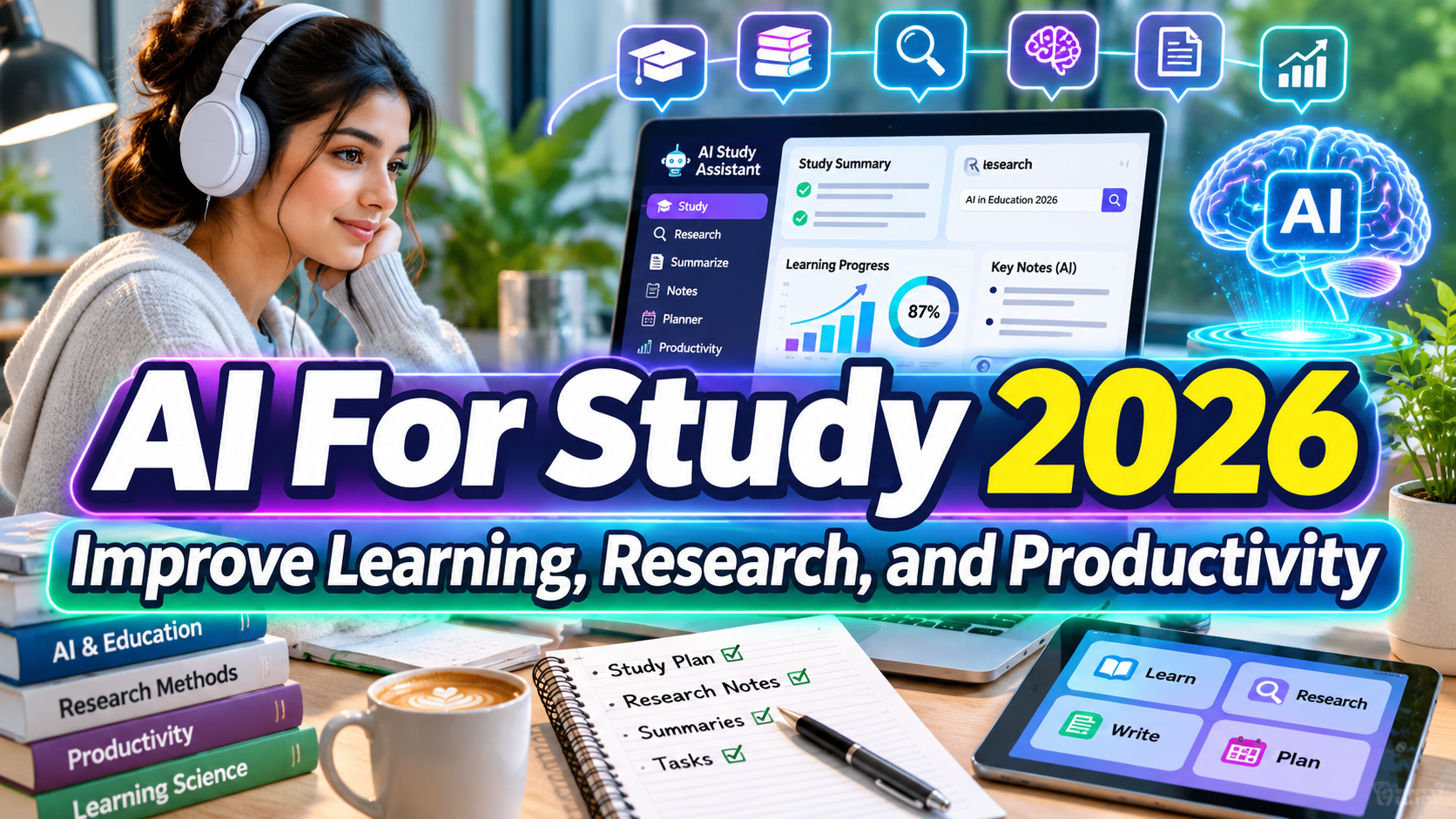
AI For Study 2026: 8 Smart Ways to Learn Faster and More Effectively
Artificial intelligence is transforming education by making learning resources more accessible, interactive, and adaptable. Students no longer need to rely exclusively on textbooks or scheduled classroom explanations to explore difficult subjects.
With AI For Study 2026, learners can receive personalized explanations, organize academic materials, practice important concepts, and develop new skills through intelligent digital assistance.
From high school assignments to university research and professional training, AI-powered study tools offer exciting possibilities. However, the greatest benefits come from using artificial intelligence to strengthen understanding rather than replace independent thinking.
Create a Smarter Learning Routine With AI
Before exploring AI learning tools, identify your biggest study challenges.
Do you struggle to understand complicated topics, remember information, organize assignments, or prepare for examinations?
Start with one specific goal and use AI to support the learning process.
For example, instead of asking an AI chatbot to solve every mathematics problem, request guided explanations and progressively challenging exercises.
A useful prompt is:
“Act as my personal study tutor. Explain this topic step by step, provide practical examples, and test my understanding before moving to the next lesson.”
This approach encourages active learning while making study sessions more productive.
8 Best Ways to Use AI for Study in 2026
1. Understand Difficult Subjects With AI Explanations
Complex academic topics often become easier when explained through familiar examples.
AI assistants can simplify scientific theories, historical events, mathematical concepts, and technical terminology based on a learner’s knowledge level.
For instance, students studying electricity could request an explanation using water flowing through pipes as an analogy.
Example Prompt: “Explain electrical circuits to a beginner using everyday examples, then ask three questions to check my understanding.”
2. Build Personalized Study Schedules
AI can help students organize academic responsibilities into manageable learning plans.
By providing examination dates, available study hours, and difficult subjects, learners can generate structured schedules with realistic daily objectives.
A university student preparing for final examinations might use AI to divide revision activities across two weeks.
Include regular breaks, practice sessions, and review periods to maintain a sustainable learning routine.
3. Generate Flashcards and Practice Tests
Active recall is an effective strategy for strengthening memory and identifying knowledge gaps.
AI study assistants can transform learning materials into flashcards, quizzes, and practice examinations.
Students studying biology, for example, might generate questions about cell structures and receive feedback after each response.
Example Prompt: “Create 15 flashcards about human anatomy, then quiz me individually without revealing the answers immediately.”
4. Improve Academic Writing and Communication
AI-powered writing assistance can help learners develop clearer arguments, improve grammar, and organize academic ideas.
Instead of generating complete assignments, students can request constructive feedback on their own drafts.
For example, an AI assistant might identify unclear sentences, weak transitions, or unsupported arguments in an essay.
This approach supports writing development while preserving the student’s original ideas and academic responsibility.
5. Research Topics and Organize Information
Finding relevant information is an important part of academic learning.
AI can assist with brainstorming research questions, identifying related concepts, organizing notes, and developing preliminary research outlines.
A student investigating climate change could use AI to explore renewable energy technologies before consulting authoritative scientific publications.
Always verify factual claims, quotations, and references against reliable sources before including them in academic work.
6. Learn Languages Through Interactive Conversations
AI language assistants provide opportunities to practice communication beyond traditional classroom exercises.
Learners can simulate conversations, explore vocabulary, receive grammar feedback, and practice realistic situations.
For example, someone learning English could simulate a job interview or practice ordering food at a restaurant.
Example Prompt: “Practice conversational English with me at an intermediate level. Correct my mistakes and explain more natural expressions.”
7. Create Visual Study Materials
Visual resources can make complicated subjects more engaging and easier to explore.
AI image generation and presentation tools can help educators develop diagrams, illustrated explanations, educational characters, and classroom activities.
For example, a teacher might create colorful solar system illustrations or illustrated vocabulary cards for younger students.
Combine visual materials with readable, expressive typography from PutraCetol Studio to create engaging educational posters, worksheets, and presentations.
8. Develop Professional Skills Independently
AI learning tools are useful beyond traditional education.
Professionals can explore programming, digital marketing, business communication, data analysis, and creative skills through guided practice.
An aspiring web designer, for instance, could request HTML exercises, identify coding mistakes, and receive explanations of unfamiliar concepts.
By combining AI guidance with hands-on projects, lifelong learners can develop practical knowledge at their preferred pace.
Comparison: Traditional Studying vs. AI-Assisted Studying
Both approaches offer valuable advantages, and combining them can create a more balanced learning experience.
| Learning Element | Traditional Studying | AI-Assisted Studying |
|---|---|---|
| Explanations | Textbooks and teachers | Personalized explanations |
| Study planning | Manual organization | AI-generated schedules |
| Practice exercises | Prepared worksheets | Custom practice questions |
| Feedback | Teacher evaluation | Immediate preliminary feedback |
| Research | Libraries and databases | Assisted topic exploration |
| Main limitation | Limited individual support | Potential inaccuracies |
Which Approach Is More Effective?
A combination of human instruction and AI assistance offers a practical approach to modern education.
The OECD Digital Education Outlook 2026 emphasizes that AI can support genuine learning when its use follows sound educational principles.
Teachers remain essential for guidance, evaluation, and critical thinking, while AI can provide additional explanations and personalized practice opportunities.
Common Mistakes When Using AI for Studying
One common mistake is relying on AI to complete assignments without understanding the underlying material. Although generated answers may appear accurate and well-structured, students can miss opportunities to develop essential problem-solving skills. Effective learning requires active participation, independent practice, and regular self-assessment. AI should help learners explore difficult concepts, recognize mistakes, and improve their reasoning rather than simply provide ready-made solutions.
Another mistake is accepting AI-generated information without verification. Artificial intelligence can produce incorrect explanations, unreliable academic references, and misleading interpretations. Students should cross-check important information using trustworthy publications and educational resources. Protecting personal information, respecting academic integrity requirements, and selecting age-appropriate tools are equally important when integrating AI into everyday learning.
Conclusion
AI For Study 2026 offers practical opportunities to make education more flexible, engaging, and personalized.
From interactive tutoring and exam preparation to academic writing and professional skill development, artificial intelligence can support learners across different educational backgrounds.
However, successful AI-assisted studying requires curiosity, critical thinking, and responsible technology use.
For teachers and educational content creators designing attractive learning materials, explore the creative font collections at PutraCetol Studio to make educational content more engaging, professional, and memorable.
Explore these fonts and many more at PutraCetol.com to build a business identity that looks professional, trustworthy, and memorable.
Additionally, if you want to explore some free typography options, you can check out Putracetol Studio on Dafont. Happy reading and designing!