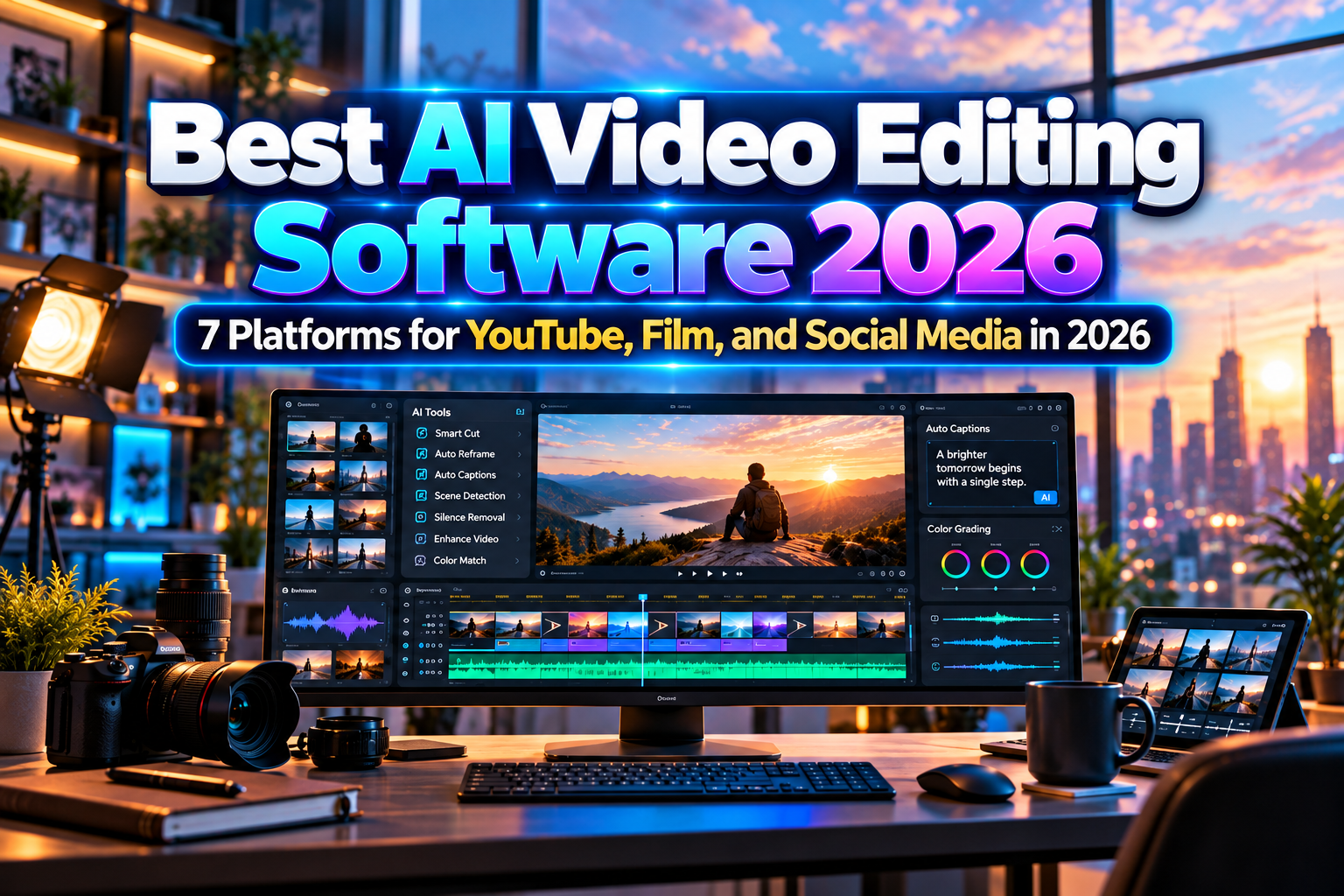
Best AI Video Editing Software 2026: 7 Platforms Worth Trying
AI has moved from being an optional video-production experiment to becoming part of everyday editing.
Today’s software can transcribe dialogue, locate footage through natural-language search, remove filler words, generate missing frames, animate subtitles, clean audio, detect speakers, reframe content for social platforms, and even generate entirely new shots.
For creators comparing the best AI video editing software 2026, however, the most important question is not which platform has the longest AI feature list. The better question is which one removes repetitive work while still giving you enough control over the final edit.
The following order is an editorial shortlist based on current AI feature depth, usability, editing flexibility, and relevance to modern production workflows rather than a laboratory benchmark.
Initial Suggestion: Match AI Features to Your Production Style
Start with the videos you produce most often.
A filmmaker managing hundreds of clips needs different AI from a YouTuber editing interviews. Social media teams may value automatic captions and vertical formatting, while corporate teams may prioritize transcription, audio cleanup, and fast revisions.
AI should ideally eliminate repetitive tasks without taking creative decisions away from the editor. Use automation for searching footage, rough cuts, transcription, masking, cleanup, and repetitive formatting, then spend your time refining pacing, story, typography, color, and sound.
Recommended AI Video Editing Platforms
1. Adobe Premiere Pro
Premiere Pro remains one of the strongest choices for professional editors who want AI integrated into a traditional timeline workflow. Adobe’s Media Intelligence can search footage by visual descriptions, while Generative Extend can create additional video and audio frames when a shot ends slightly too early. Automatic caption translation also supports multilingual workflows. Adobe Newsroom
Generative Extend now supports footage up to 4K, although Adobe documents several limitations depending on the source media and workflow. Adobe Help Center
PROS: Professional timeline, powerful media search, generative extension, multilingual captions.
BEST FOR: Professional editors, YouTubers, agencies, commercial productions.
2. DaVinci Resolve 20
DaVinci Resolve combines editing, professional color grading, visual effects, and Fairlight audio inside one application. Resolve 20 introduced AI IntelliScript for assembling timelines from scripts, AI Multicam SmartSwitch for choosing camera angles through speaker detection, AI Animated Subtitles, and AI Audio Assistant for creating an automated mix. Blackmagic Design
Some advanced Neural Engine features require Resolve Studio, so users should check the specific feature tier they need. Blackmagic Design Documents
PROS: Advanced editing, industry-level color, AI multicam and audio tools.
BEST FOR: Filmmakers, professional post-production, documentaries, multicamera work.
3. CapCut
CapCut is particularly strong for creators who need speed rather than a complex post-production environment. Its current AI workflow covers editing, captions, audio, generated imagery, avatars, AI video creation, and quick finishing for social-first content. CapCut also continues adding generative video models and automated editing workflows. CapCut
Its accessible interface makes it especially practical when a video needs to move from raw clips to TikTok, Reels, or Shorts quickly.
PROS: Easy to learn, strong social workflow, captions, generative tools.
BEST FOR: TikTok, Instagram Reels, Shorts, creators, marketing teams.
4. Descript
Descript approaches video editing differently: it turns recorded speech into text and lets you edit the video by editing the transcript.
Its Underlord AI assistant can tighten recordings, remove filler words and silences, select clips, improve audio, and help create visual elements or captions. Descript’s latest Underlord workflow also allows users to direct edits conversationally rather than manually performing every operation. Descript
This can be dramatically faster for dialogue-heavy productions.
PROS: Transcript-based editing, AI audio cleanup, automatic rough editing.
BEST FOR: Podcasts, interviews, tutorials, webinars, talking-head YouTube videos.
5. Runway
Runway is the strongest option on this list when generative visuals are central to the project.
The Runway Agent can analyze project inputs, generate imagery and video, plan creative tasks, and work with a built-in timeline for cutting and arranging generated material. The platform also provides multiple video generation, editing, extension, and enhancement models. Runway
Rather than replacing Premiere or Resolve for every long-form workflow, Runway is particularly useful for generating shots that would otherwise require complex VFX or production.
PROS: Generative video, AI visual experimentation, video transformation.
BEST FOR: Advertising, concept films, AI filmmaking, creative campaigns.
6. Wondershare Filmora
Filmora sits between beginner editors and more advanced desktop software. Its current AI toolkit includes eye-contact correction, AI video extension, generative video, image-to-prompt features, beauty enhancement, and prompt-driven editing that can add, replace, or remove elements. Filmora
The interface is generally less intimidating than professional post-production suites, making it attractive for users who want substantial AI assistance without a steep learning curve.
PROS: Beginner-friendly, broad AI toolkit, traditional timeline editing.
BEST FOR: Beginners, small businesses, educators, casual creators.
7. Final Cut Pro
Final Cut Pro remains especially relevant for creators committed to Apple’s ecosystem. Its AI-assisted capabilities include automatic object tracking and machine-learning-based Enhance Light and Color, helping editors handle motion graphics and image correction more quickly. Apple
It does not emphasize generative AI as heavily as some competitors, but its combination of performance, editing speed, and integrated intelligent tools remains compelling for Mac-based production.
PROS: Fast Apple workflow, object tracking, intelligent image correction.
BEST FOR: Mac users, professional creators, Apple-based production teams.
Comparison
| Platform | Strongest AI Advantage | Ideal User |
|---|---|---|
| Premiere Pro | Search + generative editing | Professional editor |
| DaVinci Resolve | AI post-production | Filmmaker |
| CapCut | Social automation | Content creator |
| Descript | Transcript editing | Podcast/YouTube |
| Runway | Generative video | Creative studio |
| Filmora | Easy AI editing | Beginner |
| Final Cut Pro | Intelligent Mac workflow | Apple creator |
Common Mistakes When Using AI Video Editors
The first mistake is allowing automation to determine the entire edit. AI can find pauses, choose shots, generate captions, or create a rough sequence, but it does not automatically understand the emotional rhythm, brand strategy, or storytelling priorities of every project. Treat AI-generated edits as a first pass. Review transitions, dialogue timing, caption accuracy, generated imagery, music, and visual continuity before publishing.
Another problem is choosing software only because it offers the most AI features. A sophisticated generative platform may be unnecessary for someone who mainly edits interviews, while a simple social editor may become restrictive on a long documentary. Hardware requirements, collaboration, export formats, storage, licensing, and subscription or AI-credit limits should all influence the choice.
Finally, do not forget branding. Automated templates can make many AI-edited videos look similar. Customize typography, title cards, captions, colors, transitions, and motion language. Creators looking for distinctive commercial typography can explore PutraCetol Studio for fonts suited to video titles, campaigns, social media, entertainment branding, and other creative projects.
Conclusion
The best AI video editing software 2026 depends on how you create. Premiere Pro and DaVinci Resolve provide deeper professional workflows, CapCut excels at social content, Descript transforms spoken-video editing, Runway pushes generative filmmaking, Filmora makes AI approachable, and Final Cut Pro remains a strong choice within Apple’s ecosystem.
AI can dramatically reduce repetitive editing, but the strongest videos still depend on human decisions about story, pacing, typography, sound, and visual identity.
Explore these fonts and many more at PutraCetol.com to build a business identity that looks professional, trustworthy, and memorable.
Additionally, if you want to explore some free typography options, you can check out Putracetol Studio on Dafont. Happy reading and designing!