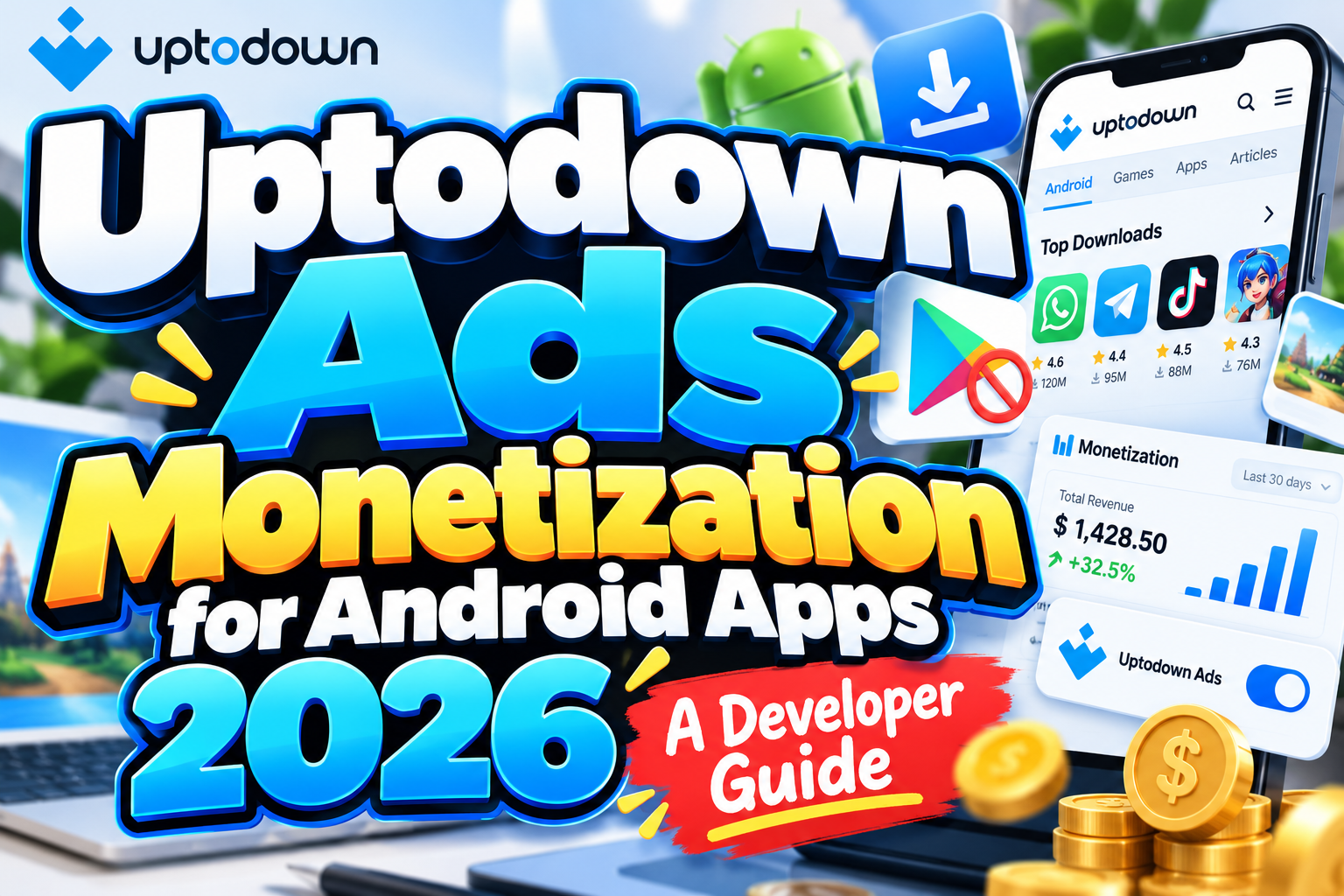
Uptodown Ads Monetization for Android Apps 2026: A New Option for Developers
Android developers have more ways to distribute software than ever, but distribution alone does not create a sustainable business.
An app still needs a monetization model.
Advertising remains attractive for free apps because users can access the product without paying upfront while developers generate revenue from usage. The challenge is that ad monetization can quickly become complicated, involving multiple SDKs, demand partners, mediation configurations, dashboards, formats, and pricing rules.
This is where Uptodown Ads monetization for Android apps 2026 becomes interesting.
Uptodown officially introduced Uptodown Ads in April 2026 as an integrated in-app advertising solution designed to simplify Android monetization. It uses a lightweight SDK, is powered by Google Ad Manager 360, and incorporates AI-based optimization for ad inventory. Blog Uptodown International
There is, however, an important detail: Uptodown Ads currently requires eligible applications to be published on both Uptodown and Google Play. It should therefore be viewed as an additional monetization and distribution strategy, not a complete replacement for Google Play. Blog Uptodown International
Initial Suggestion: Separate Distribution From Monetization
Developers should first understand the difference between publishing on Uptodown and using Uptodown Ads.
Simply publishing an Android app on Uptodown does not automatically insert advertising into the software. Uptodown allows developers to choose their own monetization systems, and registration and publishing on the marketplace are free. Its developer platform does not generally require a proprietary payment or advertising SDK. Uptodown
Uptodown Ads is a separate in-app monetization service.
Developers who choose it integrate the provided SDK into their application, while Uptodown assists with the advertising configuration.
This distinction matters when calculating whether the platform fits an existing monetization stack.
What Is Uptodown Ads?
Uptodown Ads is designed as a managed advertising layer for Android applications.
According to Uptodown, the platform provides access to globally sourced premium advertising demand across markets including the United States, Europe, Latin America, and Asia. Developers can work with formats, ad units, and pricing floors while receiving real-time reporting about performance. Blog Uptodown International
The infrastructure is built around Google Ad Manager 360, while Uptodown says AI-driven optimization is used to continuously improve ad-serving efficiency. Blog Uptodown International
This may appeal particularly to smaller development teams that want ad monetization without turning ad operations into a separate full-time discipline.
How Uptodown Ads Works
The onboarding process is relatively straightforward.
Developers first contact the Uptodown Ads team and go through eligibility and compatibility checks. The Uptodown Ads SDK is then integrated into the Android application.
Uptodown subsequently configures ad serving through Google Ad Manager 360, including the dedicated setup, ad units, formats, and initial pricing floors. Once configured, advertising can begin serving to eligible users across supported markets. Blog Uptodown International
The current technical requirements include using the latest stable Uptodown Ads SDK, keeping it updated, and passing a compatibility check. The application must also already be available on Uptodown and Google Play. Blog Uptodown International
Why the Existing-Stack Compatibility Matters
Many established Android apps already use advertising.
Replacing a monetization architecture completely can introduce technical risk, reporting disruption, and revenue instability.
Uptodown therefore positions its SDK as compatible with existing monetization stacks and mediation configurations rather than as something that must completely replace the developer’s current system. Blog Uptodown International
This approach makes testing more practical.
A developer could evaluate Uptodown Ads as another monetization layer, measure its performance, compare fill rate and effective revenue, and then decide how aggressively to expand its role.
The important metric should not simply be the highest CPM. Developers should examine revenue per active user, fill rate, retention, session length, geographic distribution, and whether advertising harms the user experience.
AI-Driven Optimization and Pricing Control
Advertising inventory changes constantly.
Demand from advertisers varies by country, device, audience, time, format, and market conditions. A pricing strategy that works well today may underperform later.
Uptodown says its system uses AI-based optimization to improve the efficiency of ad delivery automatically while still giving developers control over elements including ad formats, ad units, and pricing floors. Blog Uptodown International
That balance is important.
Automation can reduce manual tuning, but developers still need visibility into what is happening. Real-time reporting allows teams to identify whether monetization improvements are actually increasing overall value rather than simply generating more impressions.
Monetization and Distribution Can Work Together
Alternative distribution creates another opportunity beyond advertising revenue: audience diversification.
Uptodown says more than 130,000 developers use its ecosystem, while its marketplace can distribute apps through both the web and its native platform. Uptodown Help Center
For startups, this means monetization and user acquisition can be treated as related but separate strategies.
Uptodown also offers promotional advertising placements designed to increase visibility and downloads within its marketplace. These should not be confused with Uptodown Ads: one helps promote an application, while the other helps monetize users inside the application. Blog Uptodown International
That distinction is essential for building an accurate growth model.
Comparison: Uptodown Ads vs. Other Monetization Approaches
| Approach | Main Advantage | Main Challenge |
|---|---|---|
| Uptodown Ads | Managed in-app ad optimization | Eligibility and SDK integration |
| Self-managed ad stack | Maximum configuration control | Higher operational complexity |
| In-app purchases | Revenue from paying users | Conversion can be limited |
| Subscription | Predictable recurring revenue | Requires continuing user value |
| Paid download | Revenue before installation | Higher acquisition barrier |
| Hybrid model | Diversified revenue | More complex UX and analytics |
For many free Android apps, the most sustainable strategy may combine advertising with optional premium purchases or subscriptions rather than relying entirely on a single source.
Build a Brand Around the App, Not Just the Monetization
Revenue optimization matters, but users still judge the application through its brand.
App icons, screenshots, landing pages, social graphics, onboarding screens, promotional banners, and campaign assets should share a recognizable visual language.
Developers and marketing teams can use distinctive typography from PutraCetol Studio to create a stronger identity around their Android products, especially for promotional graphics, app websites, social media, and launch campaigns.
Good monetization keeps the product financially viable. Strong branding gives people a reason to recognize and return to it.
Common Mistakes
One common mistake is assuming that publishing on Uptodown automatically activates Uptodown Ads. The marketplace supports independent monetization choices, while Uptodown Ads requires its own onboarding, SDK integration, and configuration. Developers should plan these as separate technical and commercial decisions.
Another mistake is assuming that more ads always produce more revenue. Excessive interstitials, poorly timed banners, or aggressive placements may improve short-term impression counts while damaging retention. Advertising should be tested against engagement, session frequency, uninstall rates, and long-term user value.
Finally, do not assume specific revenue-share, CPM, or payout figures unless they are confirmed directly for your account. Uptodown publicly explains the infrastructure and onboarding model, but commercial performance depends on factors including audience geography, ad format, demand, app category, and usage patterns.
Conclusion
Uptodown Ads monetization for Android apps 2026 offers developers another way to diversify their mobile business strategy.
Its combination of a lightweight SDK, Google Ad Manager 360 infrastructure, global advertising demand, real-time reporting, configurable pricing controls, and AI-driven optimization is designed to reduce some of the operational complexity surrounding in-app advertising. Blog Uptodown International
It should not be viewed as a magic revenue switch or a complete departure from Google Play. Instead, it is best evaluated as another monetization layer within a broader strategy covering distribution, retention, branding, advertising, and sustainable product growth.
Explore these fonts and many more at PutraCetol.com to build a business identity that looks professional, trustworthy, and memorable.
Additionally, if you want to explore some free typography options, you can check out Putracetol Studio on Dafont. Happy reading and designing!