
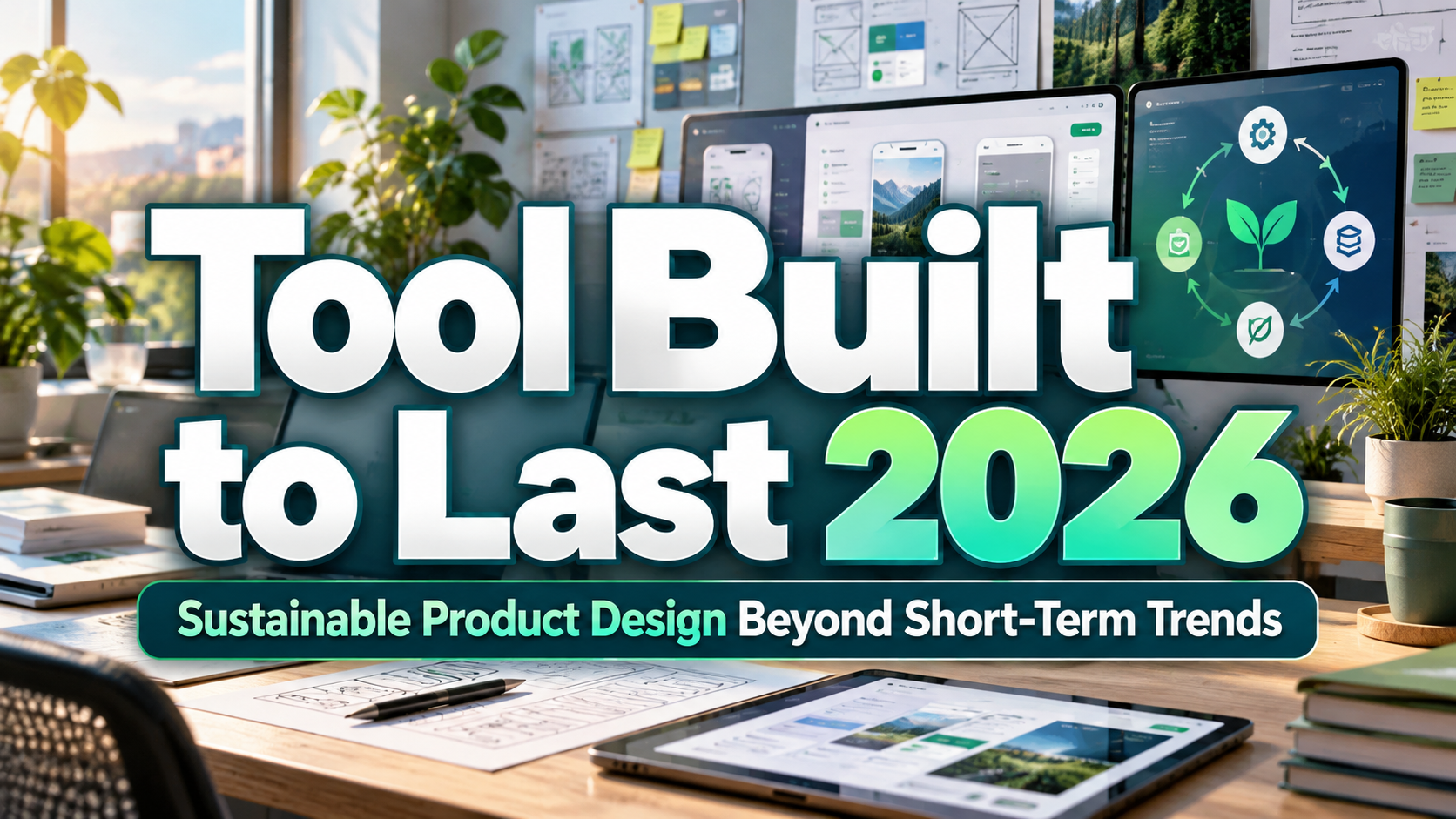
Tool Built to Last 2026: Designing Digital Products for Long-Term Value
Digital products are often built for speed.
Teams race to launch features, follow emerging design patterns, add AI capabilities, and respond to competitors. Moving quickly can be valuable, but constant expansion does not automatically create a better product.
The tool built to last 2026 philosophy asks a different question: will this product still solve an important problem several years from now?
A durable digital tool is not frozen in time. It evolves carefully without losing the qualities that made users depend on it in the first place. Its interface remains understandable, its architecture can be maintained, its data remains accessible, and its business model can support continued development.
This long-term mindset is increasingly relevant as software becomes more complex and AI makes adding new functionality easier than ever.
Start With a Durable Problem
The strongest foundation is not a fashionable technology. It is a problem that people repeatedly need solved.
GOV.UK’s long-standing design principles begin with understanding user needs and recommend doing less rather than building unnecessary functionality. Its guidance was updated in 2025 to include minimizing environmental impact as another design principle. (gov.uk)
Before adding another feature, ask whether it improves the core job users came to accomplish.
A simple invoicing tool that makes creating and tracking invoices extremely reliable may have more long-term value than a larger platform filled with features its customers rarely use.
1. Protect the Core Product Promise
Products that last usually have a clear identity.
Users understand why the product exists and what it does especially well. New capabilities strengthen that purpose instead of continuously redefining it.
This requires product teams to distinguish between core value and feature requests.
A project-management app, for example, might consider task clarity, collaboration, and reliable history fundamental. A fashionable social feed may generate temporary engagement but could distract from the original job.
Strong product roadmaps therefore include deliberate decisions about what not to build.
2. Keep the User Experience Consistent
Long-lived products change, but they should not make existing users relearn basic interactions every year.
Consistency creates accumulated familiarity.
Navigation patterns, terminology, controls, keyboard behavior, and information architecture should evolve when there is a meaningful improvement, not simply because a new visual trend has appeared.
The Office for National Statistics recommends being “consistent, not uniform” and using established patterns wherever possible, while still allowing justified improvements. (ons.gov.uk)
Visual identity follows the same principle. Typography, color, spacing, and brand assets should establish recognition without requiring constant redesign. For product websites, documentation, launch graphics, and brand materials, teams can explore distinctive typography from PutraCetol Studio while keeping functional interface typography clear and predictable.
3. Design Architecture for Change
Software does not need to predict every future requirement.
It needs to make reasonable future change possible.
Clear boundaries between components, documented APIs, automated testing, predictable data models, migration strategies, and limited unnecessary dependencies can reduce the cost of future development.
The opposite is also true. A product can launch quickly with tightly coupled systems, undocumented workarounds, and dozens of third-party dependencies, only for every later improvement to become increasingly expensive.
Technical debt cannot always be avoided, but it should be visible and intentionally managed.
4. Treat Data Portability as a Product Quality
Users increasingly depend on digital platforms for valuable information.
A durable tool should make that relationship trustworthy.
Where appropriate, customers should be able to export important data in practical formats rather than becoming permanently dependent on a proprietary interface.
Portability also protects the product team. Clear schemas, documented migrations, backups, and recovery procedures make infrastructure changes less dangerous.
The W3C’s 2026 Web Sustainability Guidelines connect sustainable digital products with qualities including openness, resilience, accessibility, privacy, security, and user-controlled data. (w3.org)
Long-term product quality therefore extends beyond what appears on the screen.
5. Build Fewer Features, but Maintain Them Better
Feature count is an attractive marketing metric because it is easy to communicate.
Maintenance quality is harder to advertise, but far more important to long-term users.
Every feature creates future responsibilities: documentation, support, testing, accessibility, security, compatibility, performance, and design consistency.
Products built to last regularly remove unnecessary complexity instead of accumulating it forever.
A mature roadmap should therefore include simplification, reliability improvements, performance work, accessibility, security, and retiring features that no longer justify their maintenance cost.
6. Make Sustainability Part of Product Quality
Sustainable software is not only about environmental efficiency.
The W3C’s current Web Sustainability Guidelines address the complete lifecycle of digital products, including UX, development, hosting, infrastructure, business strategy, privacy, security, accessibility, and long-term resilience. (w3.org)
That broader perspective is useful.
A product that requires excessive infrastructure, overwhelms users with unnecessary complexity, or depends on an unsustainable business model may technically function today but still be poorly positioned for the future.
Long-term thinking asks whether both the product and the organization behind it can continue operating responsibly.
Comparison: Short-Term Product Thinking vs. Built-to-Last Thinking
| Short-Term Thinking | Built-to-Last Thinking |
|---|---|
| Chase every new trend | Adopt technology when it adds value |
| Maximize feature count | Strengthen core capabilities |
| Frequent redesigns | Consistent, evolving UX |
| Optimize only for launch speed | Optimize for maintainability |
| Lock users into data | Support practical portability |
| Ignore technical debt | Manage it continuously |
| Measure growth alone | Measure reliability and retention |
| Build for current architecture | Prepare for controlled change |
The difference is not innovation versus conservatism. A durable product can adopt AI, new interfaces, and emerging technologies aggressively when they improve its core purpose.
The important distinction is whether change serves users or merely creates activity.
Common Mistakes
One common mistake is confusing “built to last” with refusing to change. Long-lived products survive precisely because they adapt. The goal is to preserve stable principles while allowing implementation, technology, and features to evolve. Avoid redesigning everything unnecessarily, but also avoid protecting outdated workflows simply because users are familiar with them.
Another mistake is overengineering from day one. Founders sometimes interpret long-term thinking as needing enterprise architecture before they have customers. Durability does not mean predicting ten years of requirements. Start with a simple architecture that solves today’s real problem, then preserve clear boundaries and upgrade paths as evidence appears.
Finally, do not treat sustainability as an engineering responsibility alone. A technically excellent application can still disappear if its pricing cannot fund development, onboarding is confusing, customers cannot trust the business, or the team burns out maintaining excessive complexity. Product durability is simultaneously a design, engineering, operational, and business challenge.
Conclusion
The tool built to last 2026 philosophy is ultimately about designing for continued usefulness.
Solve a durable problem. Protect the core product promise. Keep the interface understandable. Build software that can be changed without unnecessary risk. Respect user data, control complexity, and maintain the product rather than endlessly expanding it.
Technology will continue changing quickly.
The most resilient products will not be those that follow every change. They will be the ones that understand which changes improve their purpose and which ones can safely be ignored.
Explore these fonts and many more at PutraCetol.com to build a business identity that looks professional, trustworthy, and memorable.
Additionally, if you want to explore some free typography options, you can check out Putracetol Studio on Dafont. Happy reading and designing!