
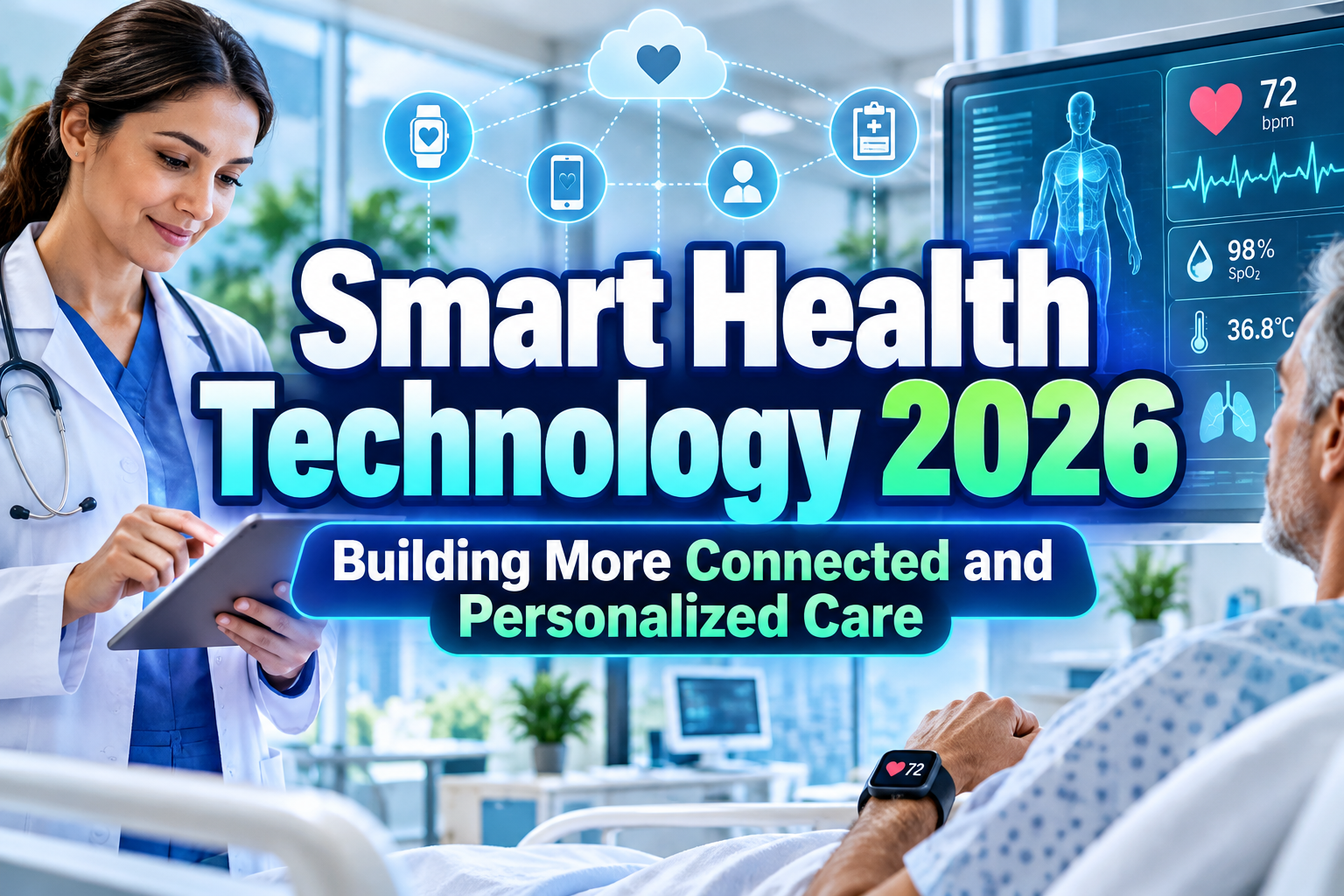
Smart Healthcare Technology 2026: How AI, IoT, and Wearables Are Transforming Care
Healthcare technology is moving beyond electronic records and telemedicine. Hospitals, clinics, technology companies, and patients are increasingly working within connected ecosystems where artificial intelligence, wearable sensors, remote monitoring, and digital platforms can continuously generate and analyze health information.
The promise of smart healthcare technology 2026 is not simply greater automation. The larger opportunity is to deliver the right information to clinicians and patients sooner, reduce repetitive work, extend care beyond hospitals, and make healthcare more responsive to individual needs.
The technology is already substantial. As of September 2026, the U.S. Food and Drug Administration says it has authorized more than 1,600 AI-enabled medical devices for marketing in the United States. Examples include systems supporting medical imaging, diabetic-retinopathy detection, heart-risk assessment, and automated insulin dosing. U.S. Food and Drug Administration
Initial Suggestion: Start With a Healthcare Problem, Not the Technology
A hospital should not implement AI simply because AI is popular. A startup should not add a wearable sensor merely to make its product appear innovative.
Begin with a clearly defined problem.
Perhaps clinicians spend too much time reviewing routine data. Maybe chronic-care patients require closer observation between appointments. A hospital might need better visibility into equipment or patient flow. A patient-facing application may need to communicate health trends more clearly.
Once the problem is established, teams can determine whether AI, connected sensors, automation, or another technology actually improves the workflow.
This approach also makes performance easier to measure. Instead of asking, “Did we deploy AI?”, ask whether the solution reduced delays, improved monitoring, decreased administrative burden, or supported better clinical decisions.
AI Is Moving Deeper Into Clinical Workflows
Artificial intelligence can analyze complex datasets at a scale that would be difficult to process manually.
In healthcare, current AI-enabled devices already support areas such as radiology, image enhancement, ophthalmology, risk assessment, and treatment-related automation. The FDA maintains a public database specifically to improve transparency around AI-enabled medical devices that have received marketing authorization. U.S. Food and Drug Administration
The important word is support.
AI can flag patterns, prioritize cases, automate measurements, or help clinicians interpret information, but healthcare organizations still need appropriate validation, oversight, and clinical judgment.
WHO’s 2026 guidance on AI-related health research highlights challenges involving ethics, human rights, fairness, oversight, and unequal impacts. The organization argues that responsible AI adoption requires governance alongside technical innovation. World Health Organization
Wearables Are Becoming Serious Health Data Sources
Smartwatches were once associated primarily with steps and fitness goals. Today’s wearable-health ecosystem includes watches, rings, patches, bands, and other sensor-based devices capable of continuous or intermittent health monitoring.
The FDA now maintains information on authorized sensor-based digital health technologies designed for use outside conventional clinical environments, including devices intended for home monitoring. U.S. Food and Drug Administration
This creates opportunities to observe health information between appointments instead of relying only on measurements taken during an occasional clinic visit.
For patients and caregivers, that may provide greater awareness of changing trends. For clinicians, it can create a richer longitudinal picture when the information is clinically meaningful and appropriately integrated.
The challenge is avoiding data overload. Collecting thousands of measurements provides little value if healthcare teams cannot distinguish actionable information from background noise.
Remote Patient Monitoring Extends Care Beyond the Clinic
Remote patient monitoring, or RPM, connects patients and healthcare professionals through medical devices that transmit health information.
CMS describes RPM as a system in which patients collect data such as blood pressure, weight, or glucose through connected devices that automatically transmit readings to healthcare providers for monitoring and management. Centers for Medicare & Medicaid Services
This model can be especially relevant to chronic-care management.
Instead of waiting for the next appointment, care teams can potentially observe patterns over time and determine when further attention may be appropriate.
The emerging direction is toward continuous care relationships, where the healthcare experience is no longer limited to the physical appointment.
IoT Is Creating More Connected Healthcare Environments
The Internet of Things adds another layer to smart healthcare.
Connected medical equipment, sensors, hospital infrastructure, and patient-monitoring systems can exchange information across healthcare environments. A connected hospital might use digital systems to track equipment availability, monitor environmental conditions, coordinate patient flows, or transmit readings from bedside devices.
The advantage is operational visibility.
The risk is complexity. Every connected endpoint becomes another asset that healthcare IT teams need to identify, update, monitor, and secure.
This is why smart healthcare infrastructure needs cybersecurity built into the architecture rather than added after deployment.
Cybersecurity Becomes Patient Safety
Healthcare data is highly sensitive, and increasingly connected systems create a larger attack surface.
The U.S. Department of Health and Human Services publishes healthcare-specific Cybersecurity Performance Goals designed to help organizations prioritize high-impact protections. Its guidance includes vulnerability management, endpoint protection, asset inventory, and stronger management of third-party risks. HHS Cyber Gateway
For healthcare organizations, cybersecurity is therefore not simply an IT issue.
A compromised system can disrupt clinical operations, prevent access to important information, affect connected equipment, and expose patient data. Security planning should cover devices, applications, cloud services, staff access, vendors, authentication, software updates, backups, and incident response.
Healthtech startups should consider these requirements from the product-design stage rather than waiting until commercialization.
Better Interfaces Matter as Much as Better Algorithms
Smart healthcare systems still need to communicate with humans.
A sophisticated monitoring system can fail operationally if clinicians cannot interpret the dashboard quickly. A patient app can create unnecessary anxiety if alerts are poorly explained. Small typography, weak contrast, complicated navigation, and excessive technical terminology can make useful technology difficult to use.
Design teams should therefore treat healthcare UX, accessibility, and information hierarchy as part of system performance.
Critical information should be visually prioritized. Alerts need meaningful severity levels. Data visualization should help interpretation rather than simply display more numbers.
Typography also contributes to clarity and brand consistency. Healthtech companies building patient-facing websites, campaigns, presentations, or digital identities can explore professionally licensed typography from PutraCetol Studio, while maintaining accessibility and readability for health-related interfaces.
Comparison: Key Smart Healthcare Technologies in 2026
| Technology | Primary Role | Key Consideration |
|---|---|---|
| AI-enabled systems | Analysis and decision support | Validation and human oversight |
| Wearable devices | Continuous or periodic sensing | Data accuracy and relevance |
| Remote monitoring | Care outside clinical settings | Workflow integration |
| Healthcare IoT | Connected devices and operations | Cybersecurity |
| Digital health platforms | Information and patient interaction | Privacy and usability |
| Automation | Reduce repetitive processes | Appropriate supervision |
These technologies become more powerful when integrated carefully rather than deployed as isolated tools.
Common Mistakes in Smart Healthcare Adoption
One common mistake is treating technology as proof of innovation. Buying an AI platform or connecting thousands of devices does not guarantee better care. Organizations need clear clinical or operational objectives, evidence that the technology performs appropriately for its intended population, integration with existing workflows, staff training, and ongoing measurement. A system that increases alerts and administrative workload can create new problems instead of solving old ones.
Another mistake is underestimating governance. Health data, AI models, connected devices, and automated recommendations raise questions about privacy, accountability, bias, consent, cybersecurity, and human oversight. WHO continues to emphasize that AI innovation in health should be accompanied by ethical governance and safeguards, particularly as the technology develops faster than many regulatory frameworks. World Health Organization
Finally, healthcare organizations should not design exclusively for technically confident users. Patients vary in age, language, ability, connectivity, and digital literacy. Smart healthcare becomes genuinely useful when innovation remains understandable and accessible to the people expected to depend on it.
Conclusion
Smart healthcare technology 2026 is bringing AI, wearable sensors, connected medical devices, remote monitoring, and digital platforms closer together.
The strongest opportunity is not replacing healthcare professionals with technology. It is giving professionals and patients better information, reducing unnecessary friction, extending monitoring beyond traditional clinical settings, and creating more responsive systems.
Success will depend on more than technical sophistication. Healthcare organizations need clinical evidence, thoughtful UX, cybersecurity, interoperability, ethical governance, and clear human accountability.
Smart healthcare becomes meaningful when technology makes care not only more connected, but safer, more understandable, and genuinely more useful.
Explore these fonts and many more at PutraCetol.com to build a business identity that looks professional, trustworthy, and memorable.
Additionally, if you want to explore some free typography options, you can check out Putracetol Studio on Dafont. Happy reading and designing!