
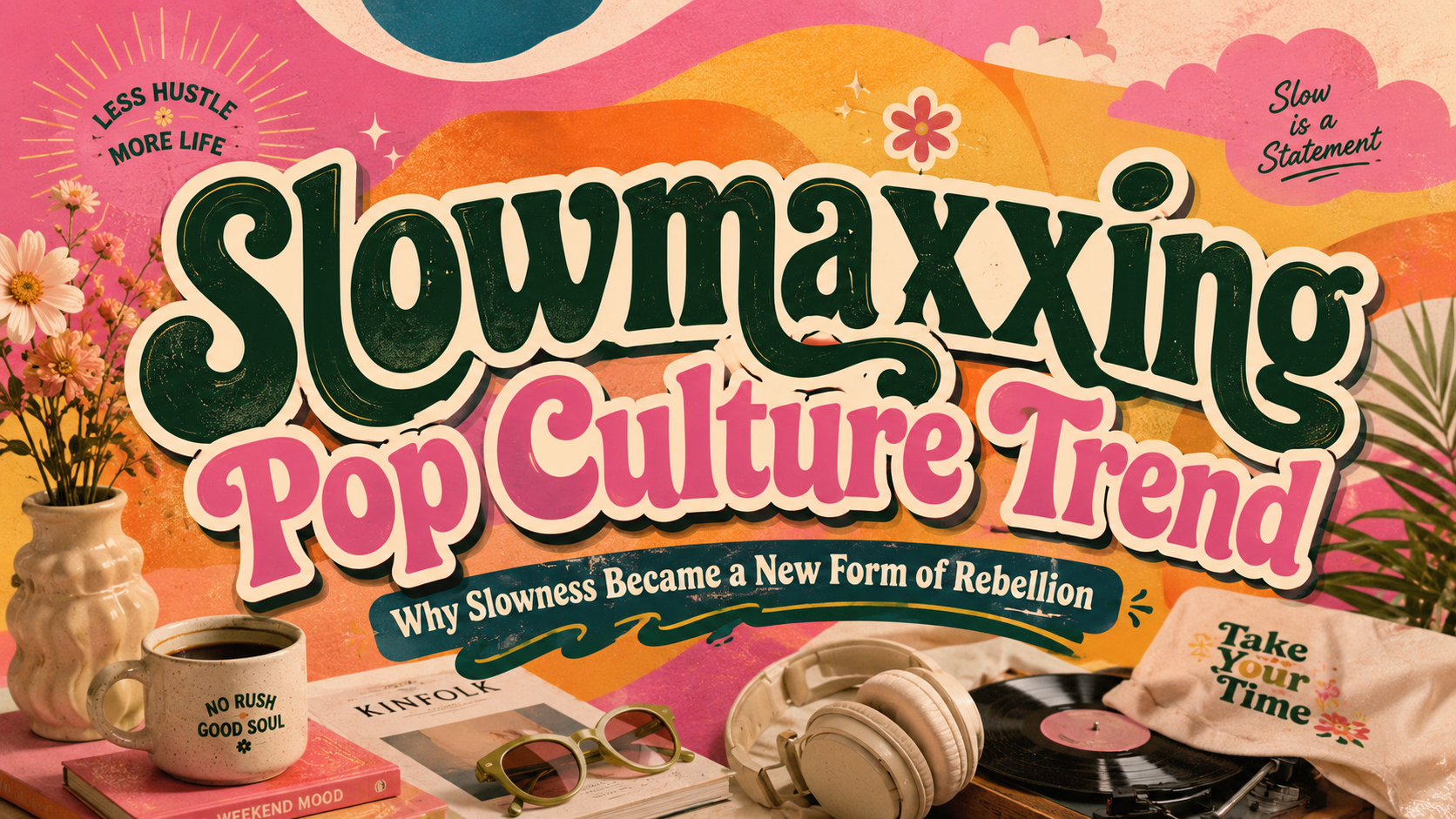
The most effective way to interpret the slowmaxxing pop culture trend is to treat slowness as an experience rather than a collection of beige colors, coffee cups, linen clothing, and film-grain photographs.
A campaign can look peaceful while still rushing the audience through jump cuts, urgent CTAs, countdowns, notifications, and constant product launches. That is a slow aesthetic applied to a fast system.
A more credible slowmaxxing direction asks:
- How quickly does the content move?
- How much information competes for attention?
- Does the audience have space to observe?
- Does the brand encourage reflection or immediate reaction?
- Are products designed for lasting use or rapid replacement?
- Does the interface respect pauses, boundaries, and user control?
- Does the campaign make ordinary moments feel meaningful?
The central design principle is simple:
A slowmaxxing identity should feel unhurried in both appearance and behavior.
This makes the trend relevant to far more than wellness content. It can influence fashion, editorial design, photography, hospitality, food, product interfaces, social campaigns, and any brand that wants to reject the visual pressure of constant optimization.
What Is Slowmaxxing?
Slowmaxxing is an internet-native expression for deliberately reducing the speed of ordinary life. It may involve preparing coffee without multitasking, cooking something over several hours, reading a long book, taking an unhurried walk, watching wildlife, crafting by hand, or completing one activity without switching constantly between screens.
The term gained broader cultural visibility during 2025 and continued appearing in mainstream lifestyle and wellness coverage during 2026. Its supporters present it as a response to rushed routines, productivity pressure, and the feeling that every part of life must be optimized.
The word contains an intentional contradiction. The suffix “-maxxing” refers to maximizing or optimizing a particular behavior, sometimes to an extreme degree. Slowmaxxing uses the language of optimization to challenge the idea that life must always become faster, more measurable, and more efficient. Merriam-Webster now defines “-maxxing” as making an activity as effective or fruitful as possible, while cultural coverage has documented how the suffix moved from niche online jargon into wider and often ironic use.
In that sense, slowmaxxing is not simply “doing nothing.” It is maximizing attention, depth, patience, or presence by refusing unnecessary speed.
Slowmaxxing Is New Language for an Older Idea
The label is contemporary, but the underlying philosophy is not.
The Slow Food movement began in Italy in 1986 as a response to fast-food culture and developed into a broader commitment to local knowledge, biological and cultural diversity, responsible production, and more thoughtful relationships with food. Modern slow living expanded similar principles into work, travel, fashion, interiors, and everyday routines.
Slowmaxxing translates that older philosophy into the language and humor of social media. It is shorter, more ironic, and easier to package into a TikTok caption or lifestyle series.
This distinction explains both its popularity and its paradox. The trend encourages people to resist digital speed, yet much of its visibility depends on fast-moving digital platforms.
A creator may film a fifteen-minute coffee ritual, compress it into a thirty-second Reel, and then ask viewers to slow down. That contradiction does not automatically make the trend meaningless. It reveals the central challenge of slowmaxxing culture: using accelerated media to communicate a different relationship with time.
Why Slowmaxxing Feels Relevant Now
Fatigue With Hustle Culture
Hustle culture turns constant activity into a moral achievement. Long hours, multiple jobs, packed schedules, side projects, and visible exhaustion can become proof that someone is ambitious enough.
Younger audiences are increasingly questioning whether that model produces the stability, fulfillment, or control it promises. Recent commentary around Gen Z and work has repeatedly highlighted a desire for better boundaries, adequate compensation, sustainable effort, and a life that is not permanently subordinated to work.
Slowmaxxing offers a culturally legible response. Instead of presenting rest as the reward earned after perfect productivity, it treats unhurried time as valuable in itself.
Exhaustion With Constant Self-Optimization
Modern lifestyle culture can turn sleep, exercise, skincare, food, reading, relationships, and leisure into systems that must be measured and improved.
The broader “maxxing” trend reflects that desire to optimize almost every area of life. Health coverage has also warned that such habits can become rigid when the pursuit of improvement turns into another form of perfectionism.
Slowmaxxing responds by using optimization language against itself.
The goal is not to create the world’s most efficient morning routine. The goal is to experience the morning without treating it as a performance metric.
Digital Fatigue and the Return of Analogue Activities
The slowmaxxing mood overlaps with renewed interest in books, print magazines, journaling, knitting, pottery, vinyl records, puzzles, cooking, and other tactile activities.
In 2025 and 2026, cultural reporting documented a rise in cosy craft communities and “analogue bags” filled with offline activities intended to give people practical alternatives to doomscrolling.
These activities appeal partly because they contain natural limits. A ceramic object takes time to shape. A long novel cannot be consumed through a three-second glance. A knitted garment records hours of visible labor.
Slowmaxxing therefore represents more than calm content. It also reflects a renewed interest in experiences that resist instant completion.
Slowmaxxing Is Not the Same as Laziness
Slowmaxxing is best understood as intentional pacing rather than permanent inactivity.
A slow activity can require significant effort. Cooking from scratch, maintaining a garden, writing by hand, repairing clothing, learning an instrument, or walking instead of driving may take more time than the convenient alternative.
The difference is that the person chooses to give the activity attention rather than treating time as something that must always be minimized.
Slowmaxxing can include:
- Completing one task at a time
- Leaving unscheduled space between commitments
- Choosing longer creative processes
- Reducing unnecessary notifications
- Spending time without documenting it
- Maintaining an item instead of replacing it
- Allowing boredom or uncertainty to exist
- Valuing depth over visible output
It should not become another rigid lifestyle competition. A person does not fail at slowmaxxing because work, caregiving, finances, disability, or location prevents them from living an idealized rural routine.
The most inclusive interpretation focuses on small moments of agency, not on buying access to a photogenic slow life.
The Visual Language of Slowmaxxing
Space That Feels Available
Slowmaxxing layouts use space to reduce competition between elements.
This can include:
- Wider margins
- Fewer elements per screen
- Longer pauses between sections
- Restrained navigation
- One dominant image
- Shorter blocks of copy
- Clear visual grouping
The objective is not emptiness. It is creating enough separation for each element to be noticed without fighting for attention.
A slowmaxxing website might place one thoughtful statement beside one image rather than filling the opening screen with a video, testimonial carousel, discount popup, newsletter prompt, and several buttons.
Typography With an Unhurried Rhythm
Typography can establish pace before the audience reads the full message.
Useful directions include:
- Elegant contemporary serifs
- Humanist sans serifs
- Soft monoline scripts
- Handwritten display fonts
- Organic letterforms
- Warm editorial type
- Calm condensed serifs with generous spacing
The lettering does not need to be thin. Extremely light type can weaken readability and make the brand feel fragile.
Slowmaxxing typography works through proportion, spacing, and rhythm. A substantial serif surrounded by generous space may feel more relaxed than a delicate script crowded into a busy composition.
Use an expressive font for:
- Brand names
- Campaign statements
- Editorial titles
- Product collections
- Short quotations
Use a more functional companion for:
- Instructions
- Product details
- Navigation
- Prices
- Captions
- Long-form copy
PutraCetol Studio offers serif, script, handwritten, organic, retro, and contemporary display collections that can support this balance between personality and clarity.
Colors That Feel Lived In
The slowmaxxing palette is often softer than the high-saturation colors associated with urgent digital content.
Possible combinations include:
- Oat, warm white, and moss
- Clay, brown, and faded blue
- Butter yellow, cream, and burgundy
- Dusty pink, olive, and parchment
- Charcoal, stone, and muted green
- Washed denim, ivory, and rust
These colors do not need to imitate nature literally. Their main role is to feel less synthetic and less visually demanding.
A stronger accent can still be used for important actions. The palette should remain calm without making text and controls disappear.
Tactile Texture
Slowmaxxing graphics often feel more convincing when they suggest physical materials.
Useful textures include:
- Paper grain
- Linen
- Natural wood
- Ceramic surfaces
- Handwritten notes
- Faded ink
- Film grain
- Worn book covers
- Uncoated packaging
- Imperfect paint
Texture helps digital content feel connected to a physical world.
Avoid applying artificial grain to every element. One tactile surface is usually more effective than several unrelated vintage effects.
Photography for the Slowmaxxing Pop Culture Trend
Show Process Instead of Only Results
Fast lifestyle content frequently presents the completed object: the outfit, meal, room, product, or perfect morning.
Slowmaxxing photography can show the time around the result.
Examples include:
- Ingredients before cooking
- Hands repairing a garment
- A half-finished sketch
- Light changing across a room
- A book with handwritten notes
- Clay before it becomes pottery
- A table after friends have eaten
- Weathered tools
- Clothing worn repeatedly
The process communicates care, repetition, and real use.
Use Natural or Observational Light
Soft daylight, shadows, overcast skies, evening warmth, and imperfect indoor light can support the trend more convincingly than highly polished studio lighting.
The image should feel observed rather than aggressively staged.
This does not mean poor technical quality. Composition, focus, color, and exposure should still be intentional.
Allow Imperfection
Slowmaxxing imagery can include:
- Motion blur
- Crooked objects
- Visible wear
- Uneven food
- Wrinkled fabrics
- Partially cropped scenes
- Unretouched surfaces
- Human traces
These details make the image feel inhabited.
Imperfection should communicate life rather than carelessness. A brand can remain refined while allowing materials and people to look real.
Use Longer Visual Sequences
Instead of compressing an entire process into one before-and-after image, create a sequence.
A fashion campaign could show:
- Selecting material
- Cutting fabric
- Sewing
- Repairing a detail
- Wearing the garment
- Storing it for future use
This creates narrative depth and gives the audience more than one visual reason to stay with the campaign.
Slowmaxxing in Fashion
The slowmaxxing mood in fashion moves attention away from constant novelty and toward repetition, care, tactility, and personal attachment.
Visual directions may include:
- Repeating outfits across content
- Visible garment repair
- Natural or reclaimed materials
- Hand-knit accessories
- Unhurried dressing videos
- Clothing diaries
- Personal wardrobe archives
- Secondhand pieces with documented histories
- Seasonal layers rather than microtrend hauls
The styling can feel relaxed without becoming shapeless. Structured tailoring, minimal silhouettes, or premium accessories can still belong to the trend when the wider message values longevity and intentional use.
Fashion Photography
Slowmaxxing fashion imagery can replace rapid pose changes with:
- Still portraits
- Long walks
- Domestic settings
- Reading
- Cooking
- Gardening
- Public transport
- Repeated daily rituals
The clothing appears inside a life rather than as an isolated object demanding immediate purchase.
Fashion Branding
A slowmaxxing fashion brand might emphasize:
- Small collections
- Repair information
- Material origins
- Care instructions
- Repeat styling
- Long-term product photography
- Customer wardrobe stories
- Fewer but more meaningful launches
The visual identity should support those practices. A calm serif logo cannot create credibility if the company still promotes constant overconsumption through daily urgency.
Slowmaxxing in Branding
Build Around a Slower Promise
A slowmaxxing brand should explain what it allows customers to do differently.
Possible promises include:
- Take better care of what you own
- Make one ritual more enjoyable
- Reduce unnecessary decisions
- Create space for deeper attention
- Buy fewer but more useful products
- Learn at a sustainable pace
- Spend time with people rather than platforms
This turns slowness into a customer benefit rather than a vague mood.
Make the Product Experience Consistent
A brand cannot credibly promote calm while creating a stressful experience.
Review:
- Website speed and clarity
- Popup frequency
- Notification settings
- Subscription cancellation
- Packaging layers
- Customer-support tone
- Shipping expectations
- Product instructions
- Social posting frequency
Slowmaxxing branding is strongest when the business model and experience support the visual identity.
Use Storytelling With Duration
Many brand stories are compressed into short claims such as “handmade,” “timeless,” or “crafted with care.”
Slowmaxxing storytelling can show the evidence behind those phrases.
For example:
- How long the product takes to make
- Who performs each stage
- Why one material was chosen
- How the product changes with use
- How customers can maintain it
- What can be repaired
- What the brand chose not to produce
Time itself becomes part of the product narrative.
Slowmaxxing in Social Media
Create Content That Does Not Rush the Viewer
Slowmaxxing social content may use:
- Longer, stable shots
- Gentle camera movement
- Quiet sound
- Natural ambient audio
- Fewer cuts
- Shorter on-screen text
- Deliberate pauses
- Longer captions
- Reflective carousels
- Process-based storytelling
The objective is not to make every video extremely long. It is to remove editing that exists only to prevent the audience from looking away.
Use Carousels as Reflective Sequences
A slowmaxxing carousel could follow this structure:
- One quiet opening statement
- A personal observation
- A visual detail
- A short reflection
- A practical prompt
- An invitation to pause
Instead of “Five Ways to Fix Your Life Today,” the opening might say:
What would change if this did not need to be finished today?
The language itself can reject urgency.
Create Offline Calls to Action
Not every CTA needs to request another click.
A slowmaxxing post might invite the audience to:
- Put the phone away for ten minutes
- Make a drink without multitasking
- Repair one small object
- Walk without tracking the route
- Read five pages
- Write one page by hand
- Contact someone without posting about it
The campaign can still support the brand while giving the audience permission to leave the platform.
Publish Less, but Build Stronger Series
A creator does not need to disappear from social media. The account can shift from constant output toward recurring, recognizable formats.
Examples include:
- Sunday reading notes
- One monthly photo diary
- Seasonal wardrobe reflections
- Slow recipe journals
- Behind-the-scenes craft sessions
- Quiet studio mornings
- Long-form creator letters
Consistency can come from rhythm rather than frequency.
A Slowmaxxing Campaign Example
Imagine a lifestyle brand launching a ceramic cup designed for everyday use.
Fast Campaign Version
- Twenty rapid video cuts
- Flash sale
- Countdown clock
- “You need this now”
- Five color variants released together
- Several influencer unboxings
- Urgent checkout CTA
Slowmaxxing Campaign Version
- One continuous video showing the cup being made
- Natural studio sound
- A short story about the clay and maker
- One carefully selected finish
- A guide to caring for the object
- Photographs showing the cup after months of use
- A calm invitation to purchase when ready
Both campaigns sell a product. Only the second makes time, care, and continued use part of the brand value.
Applying the Trend Without Rebuilding the Entire Brand
A company can introduce slowmaxxing principles gradually.
Start With Content Pace
Reduce unnecessary transitions, visual clutter, and urgent language.
Create One Slow Content Series
Build a recurring editorial or social format focused on process, reflection, or maintenance.
Add More Material Honesty
Use real textures, behind-the-scenes photography, and evidence of use.
Review Notification Behavior
Allow customers to control promotional messages and nonessential alerts.
Replace Artificial Scarcity
Use truthful availability information rather than automatic countdown timers.
Improve Care and Repair Content
Help customers keep products useful for longer.
Reconsider Typography
Introduce an expressive serif, handwritten accent, or organic display face for reflective brand moments while preserving readable functional text.
Privilege, Access, and the Slow-Life Image
Slowmaxxing can become unrealistic when it is presented only through spacious homes, expensive ingredients, countryside retreats, flexible work, and beautifully curated free time.
Not everyone controls their work schedule, home environment, health, caregiving responsibilities, transportation, or finances.
A responsible interpretation avoids presenting slowness as a luxury product available only to people with extensive time and money.
More accessible examples include:
- Eating one meal without a screen
- Sitting outside during a break
- Reusing a familiar outfit
- Borrowing a book
- Repairing something small
- Taking a slower route when practical
- Leaving one part of the day unscheduled
- Reducing one unnecessary notification
The trend becomes more useful when it supports realistic choices instead of another ideal lifestyle people are expected to purchase and perform.
Comparison
The slowmaxxing pop culture trend overlaps with several contemporary lifestyle movements, but each one emphasizes a different form of resistance. Its rise also sits alongside renewed interest in analogue hobbies, anti-hustle attitudes, underconsumption, and intentional friction.
| Trend | Central Idea | Typical Visual Language | Main Difference |
|---|---|---|---|
| Slowmaxxing | Intentionally making ordinary life less rushed | Tactile imagery, gentle pacing, rituals, reflective copy | Uses ironic internet-optimization language |
| Slow living | Building life around intentional time and values | Natural materials, local culture, seasonal rhythms | Broader philosophy with pre-social-media roots |
| Soft life | Prioritizing ease, comfort, care, and reduced struggle | Cozy interiors, beauty rituals, warm luxury | Often more aspirational and comfort-oriented |
| Digital detox | Temporarily reducing or removing screen use | Analogue objects, nature, books, offline activities | Focuses specifically on technology use |
| Underconsumption | Reusing, repairing, and buying less | Worn objects, practical storage, repeat outfits | More explicitly connected to consumption |
| Quiet luxury | Choosing restrained, high-quality, low-logo aesthetics | Neutral colors, refined materials, classic typography | Can remain consumption- and status-focused |
| Slow productivity | Producing valuable work through fewer, deeper priorities | Organized schedules, calm workspaces, long focus blocks | Concentrates primarily on work |
| Friction-maxxing | Choosing less convenient options intentionally | Analogue tools, walking, handwritten notes, manual processes | Emphasizes effort and resistance to convenience |
1. Slowmaxxing vs. Slow Living
Slow living is the broader philosophy. Slowmaxxing is the internet-era expression that packages similar practices into a memorable cultural label.
2 Slowmaxxing vs. Soft Life
Soft-life content often emphasizes comfort and freedom from unnecessary struggle. Slowmaxxing is more focused on pace and attention. An activity may be slow without being luxurious or easy.
3. Slowmaxxing vs. Digital Detox
Digital detox usually involves leaving screens for a defined period. Slowmaxxing can occur online or offline. A person may use digital tools slowly and intentionally rather than rejecting them entirely.
4. Slowmaxxing vs. Underconsumption
Underconsumption focuses on buying less and using existing possessions. Slowmaxxing may support that behavior, but it also applies to time, work, food, creativity, and social interaction.
Common Mistakes
The first mistake is reducing slowmaxxing to a predictable beige aesthetic. Linen clothing, warm coffee, books, candles, flowers, and film grain may fit the trend, but they do not automatically communicate intentional living. A brand can use bright colors, bold typography, urban photography, or experimental fashion while still creating a slower experience. Focus first on pacing, attention, product longevity, and the relationship the audience has with the content. The appearance should grow from those decisions.
The second mistake is turning slowmaxxing into another form of optimization pressure. A creator may begin measuring perfect morning routines, ideal reading targets, exact screen-free hours, and elaborate wellness habits until slowness becomes one more performance standard. The trend loses its meaning when people feel guilty for being busy, using convenient tools, or failing to maintain a photogenic ritual. Present slowmaxxing as flexible permission rather than a strict system that must be mastered.
The final mistake is using the trend to sell more products without changing the brand’s behavior. A company may release a “slow living collection” while using artificial scarcity, constant drops, excessive packaging, and urgent promotional language. Audiences will eventually notice the contradiction. Build the campaign around real practices such as durable design, repair, smaller collections, transparent production, calmer communication, and more respectful digital experiences. Typography and visual style should reinforce those commitments rather than substitute for them.
Conclusion
The slowmaxxing pop culture trend turns slowness into a contemporary form of cultural resistance.
It responds to hustle culture, digital fatigue, constant self-optimization, and the pressure to make every moment productive or publicly visible. Its appeal lies not in complete withdrawal from modern life, but in restoring a sense of choice over how time and attention are used.
For creators, the trend encourages longer visual observation, quieter storytelling, tactile photography, reflective captions, and content that does not rely on nonstop stimulation.
For fashion and lifestyle brands, it can support repeated outfits, durable products, visible craft, repair, natural materials, and campaigns that show the life of an object rather than only its launch.
And For designers, slowmaxxing creates opportunities to use space, editorial pacing, warm color, organic texture, and expressive typography with greater intention. Font collections from PutraCetol Studio can help establish that voice through contemporary serifs, handwritten scripts, organic display lettering, and modern-vintage styles that feel personal rather than automated.
The strongest slowmaxxing identity does not merely look calm.
It gives people enough space to notice, understand, choose, and experience something without being pushed immediately toward the next task.
Explore these fonts and many more at PutraCetol.com to build a business identity that looks professional, trustworthy, and memorable.
Additionally, if you want to explore some free typography options, you can check out Putracetol Studio on Dafont. Happy reading and designing!