MyFonts ChatGPT Font Discovery 2026: How AI Is Changing the Way We Find Type
Finding a font has traditionally required designers to translate a visual idea into technical filters. You might know that a brand should feel “editorial, sophisticated, slightly nostalgic, but contemporary,” yet still struggle to decide whether to search for a transitional serif, humanist typeface, or something entirely different.
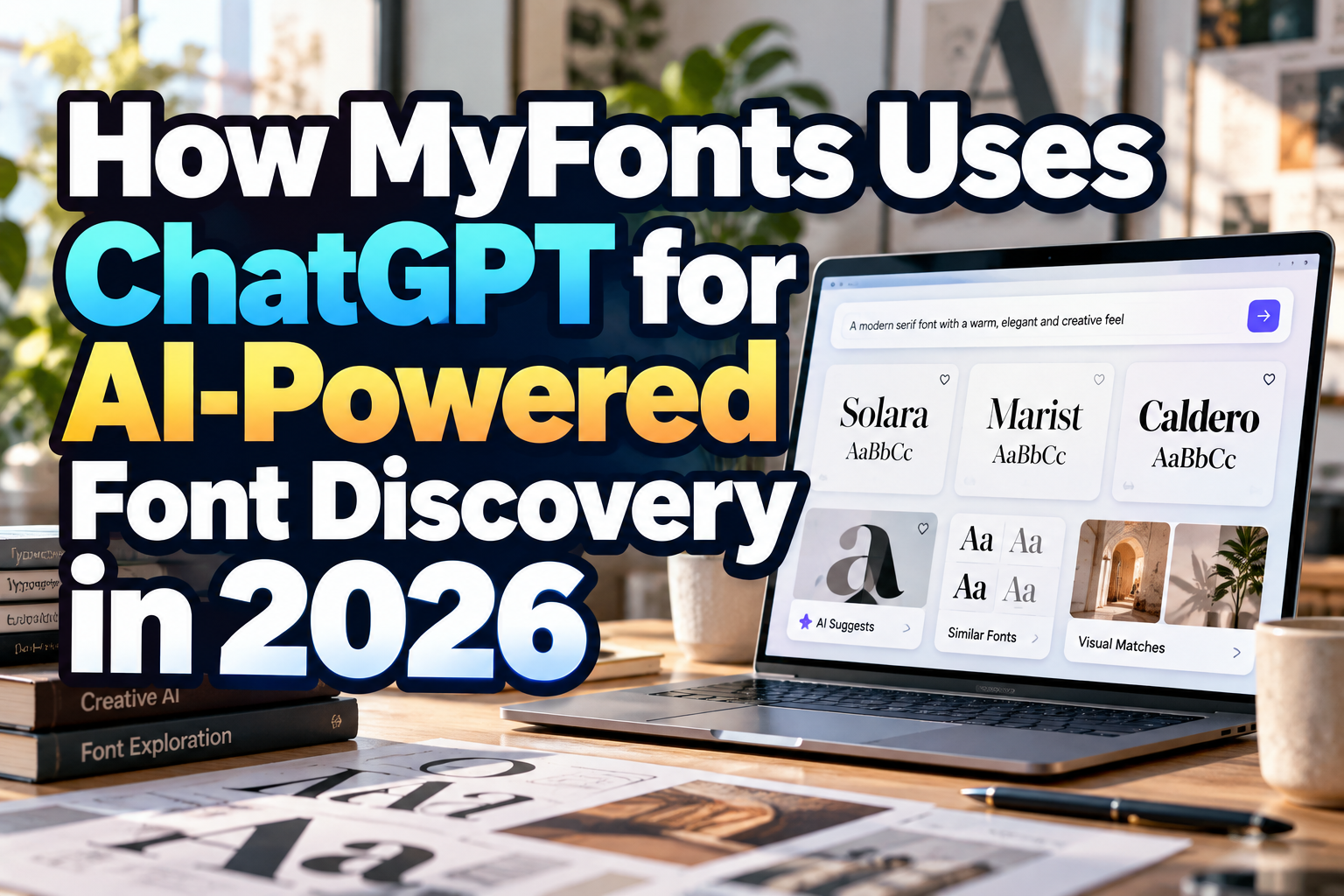
MyFonts ChatGPT font discovery 2026 represents a different approach. Instead of forcing users to begin with typographic terminology, MyFonts now lets people describe a project conversationally inside ChatGPT and receive recommendations connected to real fonts that can be explored and licensed.
Monotype launched the MyFonts app for ChatGPT in May 2026 as a Monotype Labs beta. The company says the integration draws from a library of more than 250,000 fonts and is intended to bring professional font discovery into AI-assisted creative workflows.
Initial Suggestion: Describe the Design Problem, Not Just the Font Style
The most useful way to approach AI font discovery is to describe context, emotion, audience, and application together.
Instead of prompting:
“Find me a serif font.”
Try something closer to:
“Find typography for a premium organic chocolate brand that should feel European, handcrafted, elegant, but still approachable on modern packaging.”
MyFonts says its ChatGPT integration is designed to interpret natural-language descriptions involving mood, personality, industry, use case, and creative direction. Recommendations then link to MyFonts so users can inspect the family and licensing options.
This makes AI especially useful during early concept development, when designers understand the desired atmosphere but have not yet translated it into formal typography vocabulary.
How MyFonts Works Inside ChatGPT
After connecting the MyFonts app, users can invoke it through @MyFonts within an English-language ChatGPT conversation. The advantage is contextual continuity: a designer can discuss a branding brief, define an audience, develop visual references, and then request typography without starting a separate search session.
The current MyFonts app listing also supports two major discovery routes. Users can describe the typeface they need through text prompts, or upload an image for font identification using technology connected to WhatTheFont. The app can therefore address both “What font would fit this idea?” and “What font is this image using?” scenarios.
Importantly, this is primarily a font discovery system, not a tool that invents arbitrary new font names. Its value is connecting conversational intent with existing, licensable typography.
AI Search Changes the Language of Font Discovery
MyFonts had already been developing natural-language AI Search before bringing the workflow into ChatGPT. Its AI Search began rolling out in the United States in November 2025 and expanded further during 2026. MyFonts describes the system as a way to search by mood, tone, intent, and cultural reference rather than relying entirely on traditional classification filters.
This matters because typography is often emotional before it is technical.
A creative director may ask for something that feels “like an old newspaper redesigned for a contemporary restaurant.” Traditional search fields cannot always represent that idea efficiently. Conversational discovery creates a bridge between subjective art direction and structured font catalogs.
What This Means for Type Designers and Foundries
AI-powered discovery changes how foundries should think about product metadata.
A font may no longer be discovered only through its classification as serif, script, display, condensed, or handwritten. Search systems can increasingly consider use cases, personality, industry context, visual characteristics, and semantic descriptions.
For independent type designers, that makes detailed product descriptions more valuable. A font page should explain whether the typeface feels playful, brutalist, elegant, nostalgic, experimental, corporate, handmade, futuristic, or luxurious, and where those characteristics work effectively.
For a foundry such as PutraCetol Studio, this creates an opportunity to make highly distinctive fonts easier to understand through descriptive product content, preview imagery, clear categorization, and specific branding applications. AI discovery may expand the importance of good metadata rather than eliminate it.
Benefits for Designers and Creative Teams
The most obvious benefit is speed during exploration. Designers can move from a vague concept to a more focused shortlist without manually navigating hundreds of similar fonts.
Conversational refinement is equally important. A user can begin with “modern luxury serif,” then ask for something warmer, more condensed, less traditional, or more appropriate for food packaging.
AI discovery can also lower the knowledge barrier for marketers, startup founders, and students who may recognize good typography without knowing professional classification terminology.
There is a commercial benefit too. Because MyFonts recommendations point toward actual catalog products, designers can move from inspiration toward licensing rather than discovering an attractive typeface that is unavailable or legally unclear. Monotype specifically presents real, current, licensable recommendations as one of the integration’s goals.
Comparison: AI Font Discovery vs. Traditional Methods
| Discovery Method | Strongest Use | Main Limitation |
|---|---|---|
| MyFonts in ChatGPT | Concept-driven recommendations | Availability currently varies by market |
| MyFonts AI Search | Natural-language marketplace search | Still depends on interpreting user intent |
| Traditional filters | Precise technical requirements | Requires typography knowledge |
| WhatTheFont | Identifying type from images | Depends on image and lettering quality |
| Independent foundry browsing | Discovering distinctive collections | Smaller catalog per foundry |
These methods are better viewed as complementary tools rather than replacements for one another.
Common Mistakes When Using AI for Font Discovery
The biggest mistake is treating an AI recommendation as a final design decision. A font may conceptually match “premium,” “friendly,” or “futuristic” yet perform poorly with the actual brand name, language, packaging dimensions, or interface. Always test the required words, numerals, punctuation, weights, and character coverage before committing. Evaluate spacing, readability, logo behavior, and small-size performance visually.
Another mistake is allowing conversational convenience to replace licensing checks. Recommendation systems can help users reach relevant products, but designers still need to verify whether the required license covers logos, websites, applications, advertising, editable templates, broadcasting, or other commercial uses. The recommendation and the legal permission are separate stages of the workflow.
There is also a discoverability risk for designers who depend entirely on automated suggestions. AI systems inevitably narrow a huge catalog into a small set of results. Traditional browsing, independent foundries, curated collections, and manual experimentation remain valuable because unexpected typography often emerges from exploration rather than perfectly matching the initial prompt.
Conclusion
MyFonts ChatGPT font discovery 2026 shows how typography search is moving from rigid filters toward conversational creative intent. Designers can describe a feeling, refine recommendations through dialogue, or identify fonts from visual references while remaining connected to licensable products.
AI can accelerate discovery, but typography still requires human judgment. Test the letterforms, understand the license, compare alternatives, and explore beyond automated recommendations.
For designers looking beyond major marketplaces, PutraCetol Studio offers an independent collection of distinctive fonts for branding, packaging, digital content, advertising, and creative projects, making direct foundry exploration another valuable part of the modern font-discovery workflow.
Explore these fonts and many more at PutraCetol.com to build a business identity that looks professional, trustworthy, and memorable.
Additionally, if you want to explore some free typography options, you can check out Putracetol Studio on Dafont. Happy reading and designing!