
Anticipated EVs 2026: The Electric Cars Shaping a More Competitive Market
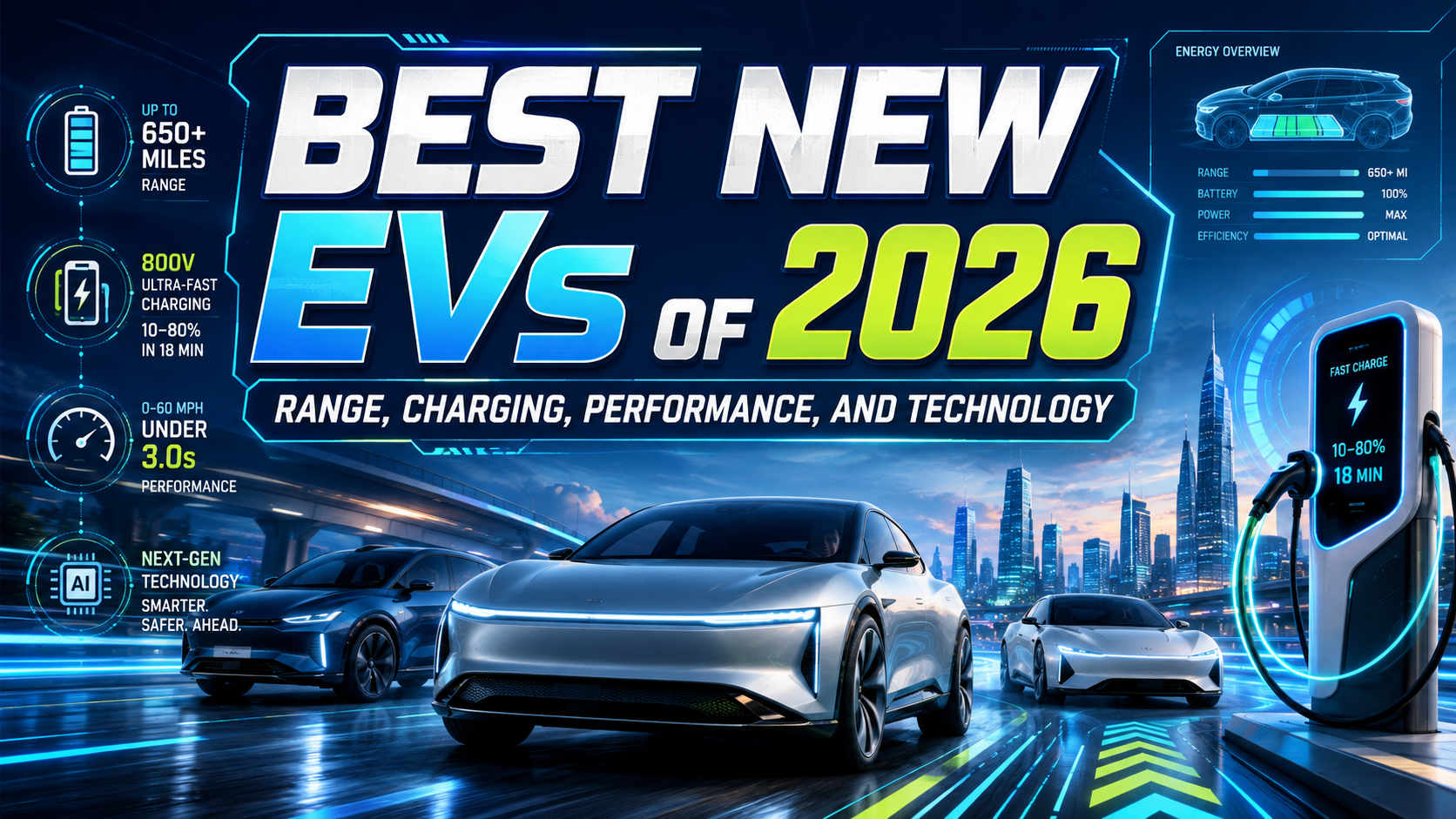
The anticipated EVs 2026 lineup shows how quickly the electric-car market is expanding beyond early adopters. This year’s major arrivals include practical midsize SUVs, long-range premium models, high-performance grand tourers, and the first fully electric Ferrari.
As of August 2026, some vehicles in this launch cycle have already entered production or customer delivery, while others are scheduled for late-year market arrival or official debut. Together, they reveal the industry’s main direction: faster charging, better efficiency, more distinctive design, and electric platforms developed around software rather than adapted from combustion vehicles.
Compare the Complete Ownership Experience
Do not evaluate a new EV through maximum range alone. Before buying, compare charging speed, local charging compatibility, battery warranty, service availability, software support, interior space, and realistic pricing.
Range figures also use different testing standards. EPA estimates are commonly quoted in the United States, while WLTP figures are widely used in Europe and other regions. They should not be compared as though they were produced under identical conditions.
Five EVs Defining the 2026 Launch Cycle
Rivian R2
Rivian began public R2 customer deliveries on June 9, 2026, starting with the Performance Launch Package. The more accessible R2 Premium is scheduled for late 2026 with a starting price of $53,990, an estimated 330-mile EPA range, 450 horsepower, and a claimed 0–60 mph time of 4.6 seconds.
The R2 matters because it brings Rivian’s adventure-focused identity into a smaller and less expensive SUV than the R1S. It also represents growing competition in the midsize electric-SUV segment, where buyers increasingly expect useful cargo space, strong range, software features, and everyday practicality in one package.
BMW iX3 Neue Klasse
The new BMW iX3 is the first series-production model based on BMW’s Neue Klasse architecture. The U.S.-market iX3 50 xDrive is scheduled to launch on September 25, 2026, with an official EPA-estimated range of up to 434 miles and a base price of $61,500 before destination charges.
BMW’s sixth-generation electric-drive technology introduces an 800-volt system, improved battery efficiency, and a new digital interface built around Panoramic iDrive. These technologies are expected to spread across dozens of new or updated BMW models by the end of 2027, making the iX3 more than another electric SUV. It is the beginning of a wider product transformation.
Porsche Cayenne Electric
The Cayenne Electric brings Porsche’s largest-volume SUV nameplate into a fully electric generation. Its 113 kWh battery supports up to 642 kilometers of WLTP range, while the 800-volt architecture enables charging at up to 400 kW under suitable conditions. Porsche says a 10–80% charge can take less than 16 minutes.
An optional 11 kW inductive charging system also allows compatible owners to begin charging by parking over a floor plate rather than connecting a cable. The feature may initially appeal to premium buyers, but it also demonstrates how EV convenience can evolve beyond faster public chargers.
Jaguar Type 01
Jaguar’s new electric four-door GT is now officially called the Type 01. The production-focused prototype uses a tri-motor all-wheel-drive system with more than 1,000 horsepower, all-wheel steering, air suspension, and torque-control technology influenced by Jaguar’s Formula E program. Its world premiere is expected later in 2026.
The Type 01 is significant because it marks a complete repositioning of Jaguar rather than a conventional model replacement. Its dramatic proportions and luxury-GT format suggest that the company is using electrification to establish a new visual and commercial identity.
Ferrari Luce
Ferrari’s first fully electric production car is called the Ferrari Luce. Official specifications include four electric motors, more than 1,000 cv in boost mode, a 122 kWh battery, more than 530 kilometers of range, a 0–100 km/h time of 2.5 seconds, and a top speed of 310 km/h.
The Luce illustrates how performance brands are approaching electrification without abandoning emotional differentiation. Ferrari is not presenting the vehicle only through efficiency or acceleration figures. Its engineering, interface, sound, and driving character must still communicate a recognizable Ferrari experience.
The Main EV Trends to Watch
The 2026 launch cycle highlights several important trends. The first is the spread of 800-volt electrical architectures, which enable high charging rates and better long-distance usability. The second is improved efficiency, with vehicles such as the BMW iX3 targeting long range without relying only on enormous batteries.
Software is also becoming part of the product identity. Interfaces, driver assistance, charging preparation, personalization, and connected services increasingly influence how buyers judge an EV.
Finally, electric design is becoming less generic. The R2 emphasizes outdoor utility, the iX3 introduces BMW’s new design language, and Jaguar and Ferrari are using electric platforms to rethink proportions and brand character.
Comparison
| EV | Main Highlight | Announced Range | Key 2026 Status |
|---|---|---|---|
| Rivian R2 Premium | Practical midsize adventure SUV | 330 miles EPA | Arriving late 2026 |
| BMW iX3 50 xDrive | Neue Klasse efficiency and software | 434 miles EPA | U.S. launch September 2026 |
| Porsche Cayenne Electric | Up to 400 kW charging | 642 km WLTP | 2026 market rollout |
| Jaguar Type 01 | Luxury GT with over 1,000 hp | Final figure pending | World premiere later in 2026 |
| Ferrari Luce | Ferrari’s first full EV | Over 530 km | Major 2026 electric debut |
Common Mistakes
The first mistake is comparing announced range numbers without checking the testing standard, wheel size, trim, climate, and driving conditions. EPA and WLTP estimates are useful reference points, but real consumption can change with speed, temperature, terrain, and charging habits. Buyers should study the exact regional specification rather than relying on the largest number used in global marketing.
Another mistake is focusing on acceleration while ignoring charging and service infrastructure. A powerful EV may still be inconvenient when local fast chargers are limited or the nearest qualified service center is far away. Charging curves, route compatibility, home-charging options, warranty coverage, and repair support can affect daily ownership more than peak horsepower.
The final mistake is assuming every announced feature will be available in all markets or on the base model. Prices, trims, charging ports, software packages, and launch dates frequently vary by country. Confirm the final local configuration before placing an order.
Conclusion
The anticipated EVs 2026 lineup demonstrates that electric vehicles are becoming more specialized and competitive.
Rivian is expanding adventure-focused EV ownership with the R2. BMW is beginning its Neue Klasse era with a long-range iX3, while Porsche is pushing charging performance through the Cayenne Electric. Jaguar is rebuilding its identity around the Type 01, and Ferrari is bringing electric propulsion into the super-luxury performance market with the Luce.
For automotive marketers and creative teams, this changing market also creates opportunities for more distinctive visual storytelling. Futuristic, automotive, techno, and bold display fonts from PutraCetol Studio can help launch campaigns communicate speed, innovation, and product character without depending on generic EV graphics.
The most important 2026 EV story is not one record-breaking specification. It is the widening range of electric vehicles designed for very different customers.
Explore these fonts and many more at PutraCetol.com to build a business identity that looks professional, trustworthy, and memorable.
Additionally, if you want to explore some free typography options, you can check out Putracetol Studio on Dafont. Happy reading and designing!