
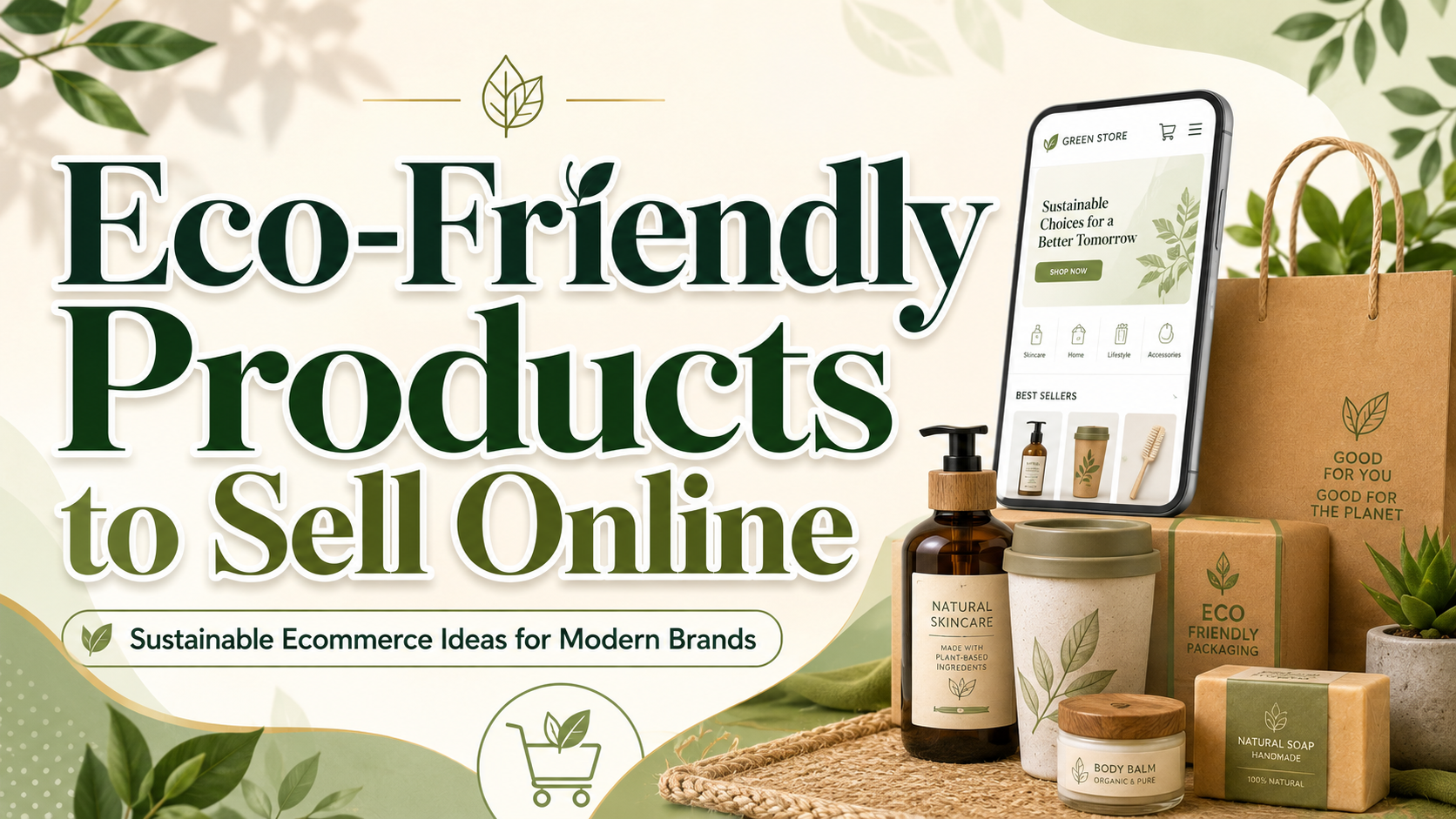
The strongest eco-friendly products to sell online solve an ordinary customer problem while reducing a meaningful environmental impact. Sustainability should be built into the product, materials, packaging, durability, sourcing, and end-of-life plan rather than added later through green colors or vague marketing language.
Before choosing a product, ask four questions:
- What conventional product does this replace?
- Which environmental impact is actually reduced?
- Can the improvement be verified?
- Will customers still choose it because it works well?
This distinction is important for both credibility and marketing. In the United States, the FTC advises marketers not to make broad, unqualified claims such as “green” or “eco-friendly” without clear substantiation. Specific claims about recycled content, compostability, recyclability, renewable materials, or other environmental benefits need appropriate evidence and qualifications.
A stronger product page says:
Bottle made with 80% post-consumer recycled plastic.
rather than:
100% eco-friendly bottle.
The first statement tells the customer exactly what has changed. The second leaves the environmental benefit undefined.
What Makes an Ecommerce Product More Sustainable?
No physical product has zero environmental impact. Raw materials must be extracted or grown, products must be manufactured and transported, and eventually they need to be reused, recycled, composted, repaired, or discarded.
A more sustainable ecommerce product may improve one or several parts of that lifecycle through:
- Reusable design
- Refillable systems
- Greater durability
- Repairability
- Recycled content
- Responsibly sourced renewable materials
- Reduced packaging
- Concentrated formulas
- Lower shipping weight
- Replaceable components
- Verified certifications
- Better end-of-life recovery
EPA materials-management guidance has long emphasized source reduction, reuse, refillability, durability, and designing products so fewer materials enter the waste stream.
For an ecommerce founder, the opportunity is therefore not simply to find “green products.” It is to identify products whose sustainability improvement can become part of a compelling functional value proposition.
15 Eco-Friendly Products to Sell Online
1. Reusable Water Bottles and Drinkware
Reusable bottles, insulated cups, travel mugs, and modular drinkware are straightforward products for sustainability-focused stores because they are designed to replace repeated single-use consumption.
The opportunity is differentiation. Instead of selling another generic metal bottle, build the product around a specific audience such as commuters, cyclists, students, travelers, children, or office workers.
Useful differentiators include replaceable lids, repair parts, dishwasher-safe construction, compact designs, or personalization.
2. Refillable Household Cleaning Products
Concentrated cleaning tablets, powders, and liquid refills can reduce the need to ship a new bottle with every purchase.
A starter kit might contain one durable bottle and several refill concentrates. Customers then purchase lightweight refills on a recurring basis.
EPA has recognized companies using concentrated formulas and refillable or reusable cleaning systems as part of safer-chemistry and sustainable-packaging initiatives.
This category also has strong subscription potential because cleaning products are repeatedly consumed.
3. Reusable Food Storage
Silicone containers, washable snack bags, reusable wraps, lunch containers, produce bags, and modular storage systems can help customers reduce disposable packaging.
Focus on durability and convenience. Products that are difficult to clean, leak easily, or require complicated maintenance will struggle regardless of their environmental positioning.
Consider selling coordinated sets rather than isolated products to increase average order value.
4. Sustainable Stationery
Notebooks, journals, greeting cards, planners, wrapping paper, and desk accessories made using recycled or responsibly sourced fiber can support a visually strong ecommerce brand.
For forest-based products, FSC certification provides a recognized system for demonstrating responsible sourcing. FSC-certified paper and packaging can support verified sustainability communication when the relevant supply-chain and trademark requirements are met.
Stationery is also well suited to limited-edition artwork, personalization, gifting, and creative collaborations.
5. Reusable Shopping and Produce Bags
Foldable shopping bags, mesh produce bags, durable totes, and storage pouches are relatively simple products that can combine utility with strong branding.
Rather than competing only on sustainability, consider better handles, pocketable construction, washable materials, reinforced seams, or attractive graphics.
These products can also work as branded merchandise for other companies, opening a B2B revenue channel.
6. Refillable Personal-Care Products
Refillable deodorant containers, soap dispensers, shampoo systems, skincare bottles, and reusable cosmetic packaging can create recurring revenue while reducing repeated packaging.
The business model is often more interesting than the initial container. The durable package attracts the first purchase, while refills can create ongoing customer relationships.
Product safety, ingredients, labeling, stability, and cosmetics regulations still need proper attention. Sustainable packaging does not reduce the need for compliant formulations.
7. Solid Shampoo and Soap Bars
Solid personal-care products can reduce packaging requirements and shipping weight because they contain less water than many conventional liquid alternatives.
They are also visually suitable for kraft boxes, paper wraps, reusable tins, and subscription bundles.
Differentiation can come through hair type, fragrance, ingredients, travel use, or specialized formulations.
Avoid assuming that “natural” automatically means safer or environmentally preferable. Ingredient and performance claims should remain specific and supportable.
8. Composting Accessories
Countertop compost containers, carbon filters, compostable collection liners where suitable, thermometers, aeration tools, and beginner composting kits can support consumers trying to manage organic waste.
A strong ecommerce offer could combine the physical product with educational content explaining what can be composted, how odor can be managed, and which disposal options exist locally.
This is particularly useful because sustainable behavior often fails when the customer does not know how to use the product correctly.
9. Repair and Maintenance Kits
One of the most overlooked sustainable product categories is maintenance.
Shoe-repair kits, garment-care tools, furniture touch-up products, zipper repair, leather-care products, electronics-cleaning kits, and replacement components can extend the usable life of existing goods.
EPA materials guidance identifies durability, reuse, repairability, and extending product life as important elements of reducing resource use.
This category can support a powerful brand message: take better care of what you already own.
10. Upcycled Fashion Accessories
Bags, wallets, pouches, jewelry, and accessories can be created from production remnants, reclaimed textiles, banners, deadstock fabric, or other usable material streams.
The advantage is storytelling. Each material can have a visible origin rather than being marketed through a generic sustainability statement.
Operational consistency can be more difficult because reclaimed materials may vary. Build those variations into the product identity instead of promising identical products that the supply chain cannot deliver.
11. Durable Everyday Textiles
Reusable kitchen towels, napkins, cleaning cloths, handkerchiefs, washable makeup-removal pads, and cloth gift wrapping can replace disposable alternatives.
These products are inexpensive enough to bundle and visually adaptable enough for strong print or pattern design.
Durability should be emphasized. A reusable item only creates meaningful value when customers actually continue using it.
12. Low-Waste Travel Kits
Travel-sized reusable bottles, cutlery sets, toiletry containers, soap tins, packing accessories, and compact shopping bags can be packaged into curated kits.
Instead of selling miscellaneous sustainable products, solve a specific situation:
The low-waste weekend travel kit
or:
The reusable office lunch kit
Use-case bundles simplify purchasing and can improve perceived value.
13. Recycled-Material Home Décor
Planters, storage organizers, trays, textile products, art objects, and small furnishings can be produced from recycled glass, recycled plastics, reclaimed wood, textile remnants, or recovered metal.
This category works especially well for design-led brands where sustainability is integrated with strong visual appeal.
Customers should be told which material is recycled and, when possible, what percentage or sourcing standard applies.
14. Responsible Paper Gift Packaging
Gift boxes, wrapping paper, paper bags, cards, tissue, and reusable rigid boxes can become an attractive B2B and B2C category.
Brands increasingly need packaging that fits their own sustainability positioning. FSC-certified materials can provide stronger sourcing evidence for forest-based packaging when supplied and labeled through the appropriate certified chain.
Offer coordinated packaging collections for weddings, boutiques, handmade businesses, holidays, and corporate gifting.
15. Refurbished or Reconditioned Products
Refurbished electronics, restored furniture, reconditioned tools, vintage goods, and professionally repaired devices can support circular-commerce models by extending product life rather than manufacturing another new item.
EPA notes that electronics reuse can extend product lifespans and reduce demand for additional raw materials.
This category requires rigorous quality control, condition grading, warranties, and clear product descriptions because customer trust is critical.
Choose Products With Ecommerce Economics in Mind
A sustainable product can still be a poor ecommerce product.
Evaluate each idea according to:
| Factor | Why It Matters |
|---|---|
| Product margin | Must cover acquisition, fulfillment, returns, and overhead |
| Shipping weight | Heavy products can destroy online margins |
| Fragility | Breakage increases cost and waste |
| Repeat purchase | Refills and consumables can improve lifetime value |
| Storage | Bulky inventory increases operating costs |
| Differentiation | Generic products compete primarily on price |
| Certification | Verification can strengthen claims but may increase sourcing complexity |
| Return rate | High returns weaken both profit and sustainability |
| Packaging | Excessive protective packaging can contradict positioning |
| Customer education | Some sustainable alternatives require behavior change |
Do not select a product only because search interest appears promising. Order samples, inspect durability, test packaging, estimate total landed cost, and calculate realistic margins.
Build a Sustainable Supply Chain
Ask Suppliers Specific Questions
Replace “Is this eco-friendly?” with measurable questions:
- What material is used?
- What percentage is recycled?
- Is it pre-consumer or post-consumer material?
- Where is the material sourced?
- Which certifications apply?
- Who issued the certification?
- Can certification numbers be verified?
- What chemicals or coatings are used?
- Can components be separated?
- How should the product be disposed of?
- How long is the expected usable life?
- Is replacement hardware available?
- What packaging is included?
- Can packaging be reduced?
The more specific the supplier’s answers, the easier it becomes to create accurate customer communication.
Verify Certifications
Do not place certification logos on packaging simply because a supplier says the underlying material is certified.
Certification programs normally have rules governing chain of custody, labeling, logo use, and promotional claims. FSC, for example, requires businesses to follow its certification and trademark requirements before using FSC labels or promotional marks in relevant contexts.
Keep supporting documents organized in case a marketplace, retailer, customer, or regulator asks for evidence.
Design Responsible Ecommerce Packaging
Sustainable positioning can be weakened immediately by an oversized shipping box filled with unnecessary plastic.
Review the complete fulfillment package:
- Primary product packaging
- Protective material
- Shipping carton
- Tape
- Labels
- Printed inserts
- Promotional samples
- Return packaging
Reduce components before replacing them with different materials.
The question should be:
Do we need this packaging element at all?
before:
Which sustainable material should replace it?
For paper-based packaging, responsibly sourced or recycled fiber can strengthen the system. Reusable packaging can also make sense when the logistics and return model support actual repeated use.
Avoid creating complex combinations of paper, plastic, foil, magnets, foam, and coatings that customers cannot easily separate.
Avoid Greenwashing in Product Marketing
The word eco-friendly is useful as a search concept, but it is risky as an unsupported product claim.
FTC Green Guides advise against broad unqualified environmental-benefit claims because consumers may interpret them as meaning that a product has no negative environmental impact. Environmental claims should instead be clear, specific, prominent, and supported by competent evidence.
Weak Claim
Our eco-friendly packaging saves the planet.
Better Claim
The shipping carton is made with 100% recycled paper fiber and contains no plastic laminate.
Weak Claim
Sustainable clothing.
Better Claim
Made with 70% recycled cotton from pre-consumer textile waste.
Specific claims are often more persuasive because customers understand exactly what makes the product different.
Build Branding Around Proof
A sustainable brand does not need to use green leaves, kraft paper, and beige typography.
Visual identity can be bold, luxurious, playful, technological, or colorful as long as the sustainability story remains credible.
Useful brand pillars might include:
Durability
Buy better. Use longer.
Reuse
Refill the product instead of replacing the container.
Responsible Materials
Know where the materials come from.
Waste Reduction
Remove unnecessary components before adding alternatives.
Repair
Replace the broken part instead of the entire product.
Circularity
Create a realistic route for materials or products to remain in use.
This gives the brand a clearer story than generic “green living.”
Build Product Pages That Educate Without Overwhelming
A strong sustainable ecommerce product page can include:
What It Is
Explain the product and its everyday benefit.
Why It Is Different
Identify the material, reuse system, durability improvement, or packaging reduction.
Evidence
List relevant certifications, recycled percentages, material sources, or testing.
How to Use It
Sustainable alternatives sometimes require new behavior. Make adoption easy.
Care Instructions
Help customers extend product life.
End of Life
Explain whether the item should be repaired, reused, recycled, composted, returned, or disposed of normally.
Packaging
Describe how the order will arrive.
Transparency strengthens customer confidence while reducing unsupported assumptions.
Develop Repeat-Purchase Models
Sustainability can support strong recurring revenue when the business model is designed carefully.
Examples include:
- Cleaning concentrates
- Personal-care refills
- Replacement filters
- Repair components
- Refill pouches
- Consumable inserts
- Subscription stationery
- Seasonal sustainable goods
The recurring product should provide genuine utility rather than deliberately making the primary product disposable.
A durable reusable container with efficient refills creates a stronger proposition than a “sustainable” product that needs complete replacement frequently.
Use Content Marketing to Build Trust
Educational content is particularly valuable for sustainability brands because customers frequently need help comparing materials and claims.
Useful topics include:
- Recycled vs. recyclable
- Reusable vs. single-use
- What FSC certification means
- How to care for reusable products
- How refill systems work
- How to identify misleading sustainability claims
- How to recycle different packaging components
- What post-consumer recycled content means
- How to extend product life
This content can attract organic search traffic while establishing the company as a transparent source rather than a brand that only sells a green image.
Comparison of Eco-Friendly Product Categories
| Product Category | Startup Difficulty | Repeat Purchase Potential | Branding Potential | Shipping Complexity |
| Reusable drinkware | Low to moderate | Low | High | Low |
| Cleaning refills | Moderate | Very high | High | Low |
| Reusable food storage | Low to moderate | Moderate | High | Low |
| Sustainable stationery | Low | Moderate | Very high | Very low |
| Personal-care refills | Moderate to high | Very high | Very high | Moderate |
| Solid shampoo and soap | Moderate | High | Very high | Low |
| Repair kits | Low to moderate | Moderate | High | Low |
| Upcycled accessories | Moderate | Low to moderate | Very high | Low |
| Sustainable textiles | Low to moderate | Moderate | High | Low |
| Recycled home décor | Moderate | Low | Very high | Moderate to high |
| Gift packaging | Low to moderate | High B2B potential | Very high | Moderate |
| Refurbished electronics | High | Low | Moderate | High |
For a new founder, sustainable stationery, reusable goods, repair products, or focused lifestyle kits can be easier to validate. Refill systems and personal care can create stronger recurring revenue but require more operational planning.
Common Mistakes
The first mistake is choosing a conventional commodity product and adding sustainability language without changing anything meaningful about the product. Customers can increasingly recognize vague claims such as “planet positive,” “green choice,” or “better for Earth” when there is no explanation behind them. Build the environmental improvement into materials, durability, refillability, sourcing, packaging, or recovery first. Then communicate the specific improvement and keep the documentation needed to support it.
Another common mistake is focusing entirely on the product material while ignoring the complete ecommerce lifecycle. A reusable glass product shipped individually across long distances in oversized protective packaging may have trade-offs that the marketing never acknowledges. Examine durability, manufacturing, shipping weight, packaging, returns, expected product life, and disposal together. You do not need to claim that the product is perfect. Customers are more likely to trust a brand that clearly explains what it has improved and what remains difficult.
The final mistake is making sustainability the only reason to buy. Customers still care about performance, appearance, convenience, price, reliability, and customer service. Build a product that is desirable even before the sustainability story is explained. Then use responsible sourcing and environmental improvements as additional reasons to choose and remain loyal to the brand. Strong design, professional typography, transparent product pages, and thoughtful packaging can make sustainable positioning feel aspirational rather than restrictive.
Conclusion
The best eco-friendly products to sell online are products that combine genuine customer value with a specific and verifiable sustainability improvement.
Reusable drinkware, refillable cleaning products, sustainable stationery, solid personal care, repair kits, upcycled accessories, durable textiles, recycled home décor, responsible packaging, and refurbished products all offer viable ecommerce directions. The strongest opportunity depends on sourcing, margins, shipping, customer behavior, and your ability to differentiate the offer.
Start with one customer problem and one measurable sustainability advantage. Verify supplier claims, reduce unnecessary packaging, document certifications, and avoid broad environmental promises that cannot be supported.
Then build the brand around proof.
An environmentally responsible ecommerce company does not need to look earthy or minimalist. It needs to make its commitments understandable and credible. Strong branding can turn sustainability from a vague marketing theme into a recognizable business position built around durability, reuse, repair, better materials, and responsible consumption.
When good design, useful products, accurate environmental claims, and thoughtful ecommerce operations work together, sustainability becomes more than a selling point. It becomes part of why customers trust the brand and return to it.
Explore these fonts and many more at PutraCetol.com to build a business identity that looks professional, trustworthy, and memorable.
Additionally, if you want to explore some free typography options, you can check out Putracetol Studio on Dafont. Happy reading and designing!