
Define What You Are Reproducing
Start by distinguishing a museum replica, a replacement architectural component, and a new heritage-inspired product. Each needs a different brief, material strategy, and approval process.
A precise copy is not automatically an appropriate restoration. The Venice Charter emphasizes respect for original material and documentary evidence, and says replacements should remain distinguishable from historic fabric.
Before planning production, involve conservators, owners, and relevant cultural custodians. Agree what should be copied, what must remain untouched, and how the result will be identified.
What Does CNC Add to Heritage Work?
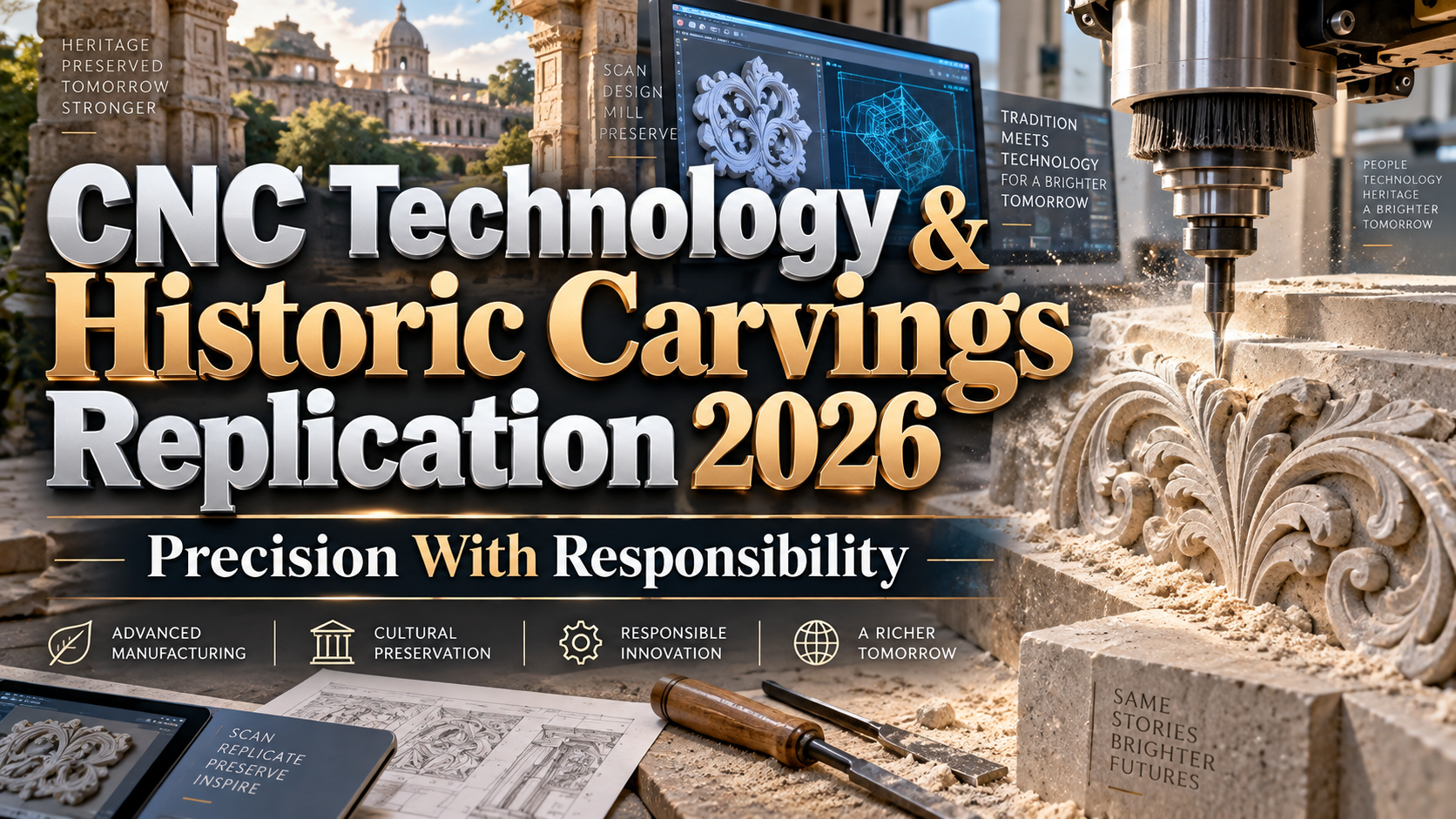
Computer Numerical Control uses programmed instructions to guide machinery. For carving, a router or milling machine removes material from new stock according to digital toolpaths. Factum Foundation documents routing in materials including wood, alabaster, plaster, and polyurethane. Its use in facsimile production demonstrates that CNC can support both direct carving and intermediate fabrication stages.
The value lies in connecting recorded geometry with repeatable production, not recreating historical authenticity automatically.
A Practical Scan-to-Carving Workflow
1. Record the Original Carefully
Use appropriately selected 3D scanning or photogrammetry, supported by photographs, measurements, and condition records. Historic England identifies these survey techniques as tools for conservation planning, monitoring, and detailed documentation.
Specify the smallest feature that matters before capture. Agree a non-invasive recording method with the conservation team, and document areas hidden from the equipment.
2. Prepare an Evidence-Based Model
Preserve the unedited survey and work on a separate production copy. Correct scale and alignment, inspect gaps, and document every alteration.
Do not automatically smooth irregularities or rebuild missing ornament. Separate measured geometry from interpretations, including AI-assisted suggestions. The Venice Charter’s restoration principles explicitly limit work based on conjecture.
3. Plan Toolpaths and Check Access
Use computer-aided manufacturing software to define cutting operations. Autodesk Fusion supports multi-axis programming, simulation, and collision checking before generating machine instructions.
Ask the machinist to assess deep recesses, fragile projections, tool diameter, and workholding. Establish which details the chosen cutters can reach before approving the production model.
4. Prototype Before Final Production
Approve a representative test section containing curves, fine lettering, and difficult recesses. Assess dimensional fit and appearance separately.
Define acceptance criteria for the complete workflow rather than relying on the machine’s advertised precision. Compare the test against verified measurements, then agree the material, finishing method, and final inspection process.
5. Finish, Verify, and Archive
Inspect the machined result before hand finishing. Record any changes to texture, edges, or surface appearance, and obtain approval before installation.
Retain photographs, scans, model versions, manufacturing files, material details, and intervention records. The Venice Charter calls for precise documentation throughout conservation and restoration work.
A Documented Application
Factum Foundation records the use of routed surfaces in recreating the eastern end of Ashurnasirpal II’s throne room. This is an established example of digital fabrication supporting heritage reproduction, not a newly invented 2026 technique.
For a hypothetical museum project, begin with a small approved relief replica for supervised handling. Evaluate interpretation, durability, and accessibility before expanding the commission.
Connect Heritage With Contemporary Design
Use PutraCetol Studio typography for project presentations, exhibition headings, or contemporary heritage-inspired branding. Pair expressive titles with readable explanations identifying the original object and reproduction method.
For an original inscription, preserve documented lettering instead of substituting a modern display font. Keep historical evidence separate from new brand expression.
Comparison
Use these questions to select a production approach.
| Approach | Planning Focus | Key Question |
|---|---|---|
| Hand carving | Craft interpretation and access | Which details require specialist judgment? |
| CNC-assisted carving | Data and machining setup | Can the tools reproduce the approved geometry? |
| Digital visualization | Documentation and interpretation | Is a physical replica actually necessary? |
| Combined workflow | Machining and hand finishing | How will each intervention be recorded? |
Common Mistakes
The first mistake is promising a perfect replica from an incomplete scan. Agree measurable tolerances, inspect obscured areas, and distinguish captured detail from reconstructed detail. A convincing render is not proof of historical or dimensional accuracy.
Another mistake is choosing material only by appearance or machining cost. For replacement work, have a conservator assess compatibility and installation requirements. For independent replicas, label modern materials and production dates clearly. Do not present newly created objects as antiques.
The final mistake is using automation to bypass research or craftsmanship. Confirm permissions, cultural context, and project approvals before fabrication. Budget for recording, programming, prototypes, finishing, and documentation rather than quoting machine time alone.
Conclusion
CNC technology & historic carvings replication 2026 should connect digital precision with responsible interpretation. Begin with evidence, prototype difficult details, and keep skilled makers and conservators involved.
Use clear documentation and thoughtful PutraCetol Studio typography to communicate the project honestly. The goal is not merely to reproduce a beautiful surface, but to help people understand and care for the heritage behind it.
Explore these fonts and many more at PutraCetol.com to build a business identity that looks professional, trustworthy, and memorable.
Additionally, if you want to explore some free typography options, you can check out Putracetol Studio on Dafont. Happy reading and designing!