
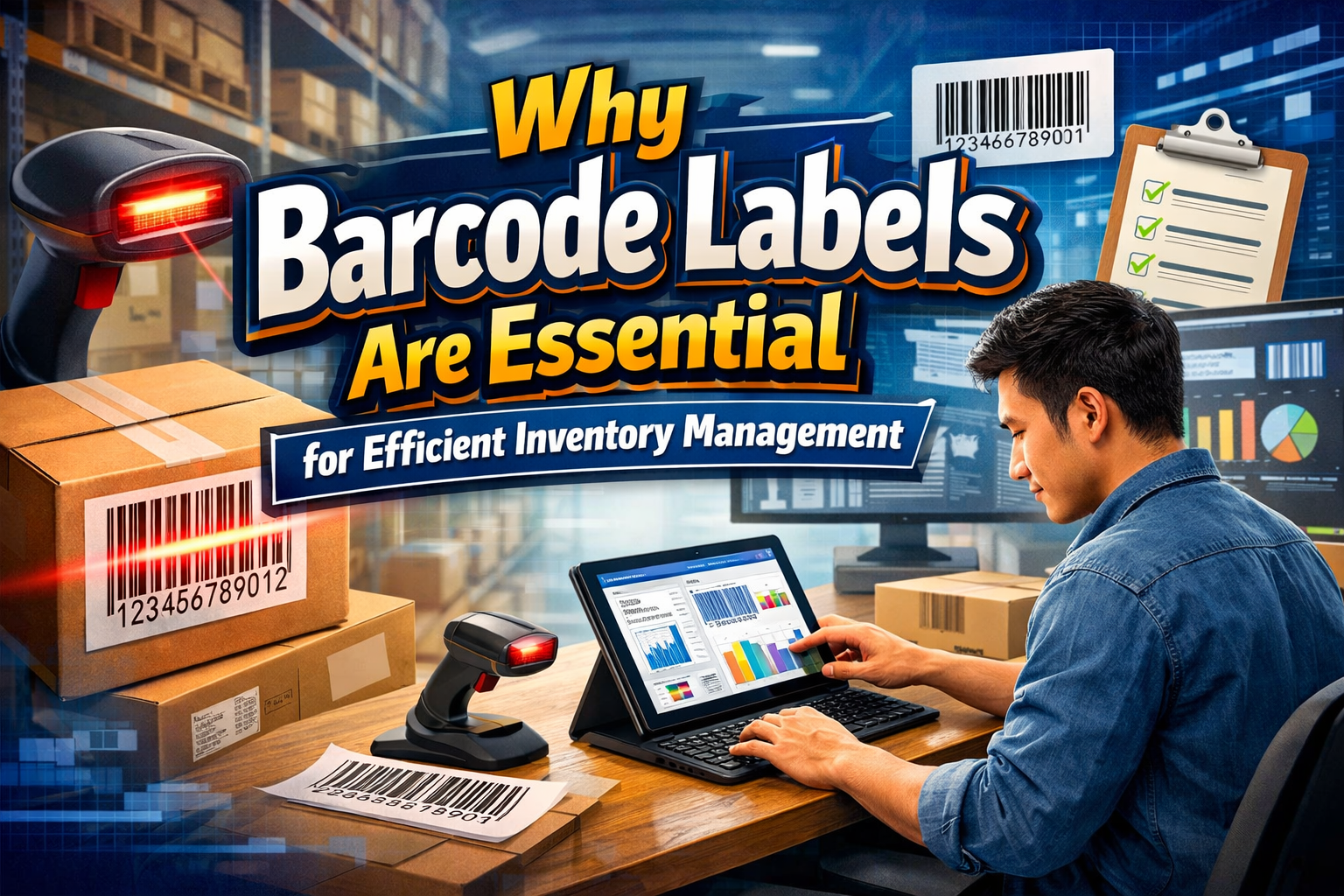
The Importance of Barcode Labels in Modern Inventory Control
Introduction: Small Labels, Big Operational Impact
In modern business operations, speed and accuracy are no longer optional. Whether in retail stores, logistics warehouses, manufacturing plants, or healthcare facilities, inventory management must operate with precision. A single data entry mistake can lead to stock discrepancies, shipment delays, financial losses, or even safety risks.
One technology that quietly powers modern inventory systems is the barcode label. At first glance, a barcode appears to be a simple pattern of lines or a square QR code printed on packaging. However, behind that visual simplicity lies a powerful system that improves efficiency, accuracy, transparency, and security.
Barcode labels are not merely visual identifiers. They are data-driven tools that enable businesses to streamline stock control, reduce human error, and build reliable supply chains.
This guide explores how barcode labels work, their strategic benefits, types, and how different industries rely on them to maintain operational excellence.
What Is a Barcode Label?
A barcode label is a printed tag containing encoded data in the form of lines (1D barcode) or pixel-based squares (2D barcode or QR code). These codes store product information such as:
- product ID
- batch number
- manufacturing date
- price
- tracking data
When scanned using a barcode scanner or mobile device, the encoded data is instantly translated into readable information within a digital inventory system.
The key advantage of barcode labels lies in their ability to automate data capture. Instead of manually typing product details into a system, employees scan the label and retrieve accurate information within seconds.
How Barcode Labels Work in Inventory Systems
The barcode inventory process typically follows four steps:
- Data Encoding – Product information is generated and encoded into a barcode format.
- Label Printing – The barcode is printed and attached to products, packaging, or pallets.
- Scanning – A scanner reads the barcode when goods move in or out of storage.
- System Update – Inventory software automatically updates stock records in real time.
This seamless integration between physical goods and digital records creates a synchronized inventory environment.
Key Functions in Inventory Management
Barcode labels support several essential inventory functions.
Simplifying Incoming and Outgoing Goods Recording
When new stock arrives, scanning barcode labels immediately records items into the system. Similarly, outgoing shipments are logged instantly upon scanning.
This eliminates manual entry errors and speeds up warehouse processes.
Reducing Manual Input Errors
Human error is one of the most common causes of inventory discrepancies. Manual typing increases the risk of incorrect product codes or quantity mistakes.
Barcode scanning dramatically reduces these errors by automating data input.
Speeding Up Stock Audits
Inventory audits traditionally required time-consuming manual counting and verification. With barcode systems, employees can scan items quickly to confirm stock levels.
This improves audit efficiency and reduces operational downtime.
Strategic Benefits of Barcode Labels
Efficiency
Barcode labels significantly accelerate business processes. Faster scanning means quicker transactions at retail checkout counters and smoother warehouse operations.
In retail, scanning barcodes speeds up payment processing while simultaneously updating stock levels.
Accuracy
Accurate inventory data is essential for forecasting demand, preventing stockouts, and avoiding overstocking.
Barcode technology minimizes data inconsistencies, improving overall reliability.
Transparency
Modern supply chains require visibility across multiple stages. Barcode labels enable tracking of goods from manufacturing to final delivery.
Businesses can monitor movement in real time, enhancing supply chain transparency.
Security
Inventory shrinkage due to theft or data manipulation is a major concern for many organizations. Barcode systems create traceable records of item movement, reducing opportunities for fraud.
In industries such as healthcare, barcode tracking ensures that medications and equipment are distributed accurately, preventing potentially dangerous errors.
Types of Barcodes Used in Inventory Control
Understanding barcode types helps businesses choose the right system.
1D Barcodes
1D barcodes consist of vertical lines of varying thickness.
Characteristics:
- simple design
- widely used in retail
- limited data capacity
Commonly seen on supermarket products, 1D barcodes are efficient for basic identification purposes.
2D Barcodes (QR Codes)
2D barcodes store data in both horizontal and vertical patterns.
Advantages:
- larger data capacity
- supports URLs and detailed tracking information
- ideal for modern logistics systems
QR codes are increasingly used in advanced inventory management and digital marketing integration.
Business Applications Across Industries
Retail Industry
In retail environments, barcode labels:
- speed up checkout processes
- reduce cashier errors
- automatically update stock records
Accurate inventory data improves customer satisfaction by preventing out-of-stock situations.
Logistics and Supply Chain
In logistics operations, barcode labels enable real-time tracking of packages and shipments.
Warehouses use scanning systems to monitor:
- shipment location
- delivery status
- transfer history
This improves coordination and reduces delays.
Manufacturing
Manufacturing facilities rely on barcode labels to track raw materials and finished products.
Benefits include:
- production efficiency
- quality control
- traceability of components
This ensures accurate production planning and compliance with industry standards.
Healthcare
In healthcare settings, barcode labels enhance patient safety by:
- verifying medication accuracy
- tracking medical equipment
- managing supply inventories
Accurate tracking reduces risks associated with incorrect treatments.
Design and Label Clarity Matter
Although barcode functionality depends on data encoding, label design also plays an important role.
Readable typography and clear layout improve usability in warehouse and retail environments. Fonts used for labeling should prioritize clarity and legibility.
For example:
- Clean serif styles like Gilded Winter Serif Display can enhance premium packaging design.
- Bold display fonts such as Mogzilla Bold improve visibility on shipping labels.
- Modern styles like Antiquera offer balanced readability in branding-focused packaging.
Well-designed labels combine aesthetic appeal with functional clarity, supporting both branding and operational efficiency.
Quick Summary Table
| Aspect | Advantage | Example Use |
|---|---|---|
| Efficiency | Faster processes | Retail checkout |
| Accuracy | Fewer errors | Stock audits |
| Transparency | Clear tracking | Supply chain |
| Security | Protected data | Healthcare logistics |
Why Barcode Labels Remain Essential in the Digital Era
Despite advancements in RFID and other tracking technologies, barcode labels remain widely used due to their affordability, simplicity, and reliability.
They provide a scalable solution suitable for small businesses and large enterprises alike.
As digital transformation continues, barcode systems increasingly integrate with:
- cloud-based inventory software
- ERP systems
- real-time analytics platforms
This integration strengthens business decision-making and operational performance.
Conclusion
Barcode labels are the foundation of modern inventory control systems. While they may appear simple, their impact on efficiency, accuracy, transparency, and security is significant.
By automating data capture and synchronizing physical goods with digital systems, barcode technology helps businesses reduce costs, improve productivity, and build customer trust.
From retail and logistics to manufacturing and healthcare, barcode labels remain an indispensable tool for modern operations.
Thank you for taking the time to read this article. If you are looking for more great articles, feel free to visit Putracetol Blog
Additionally, if you want to explore some free typography options, you can check out Putracetol Studio on Dafont. Happy reading and designing!