
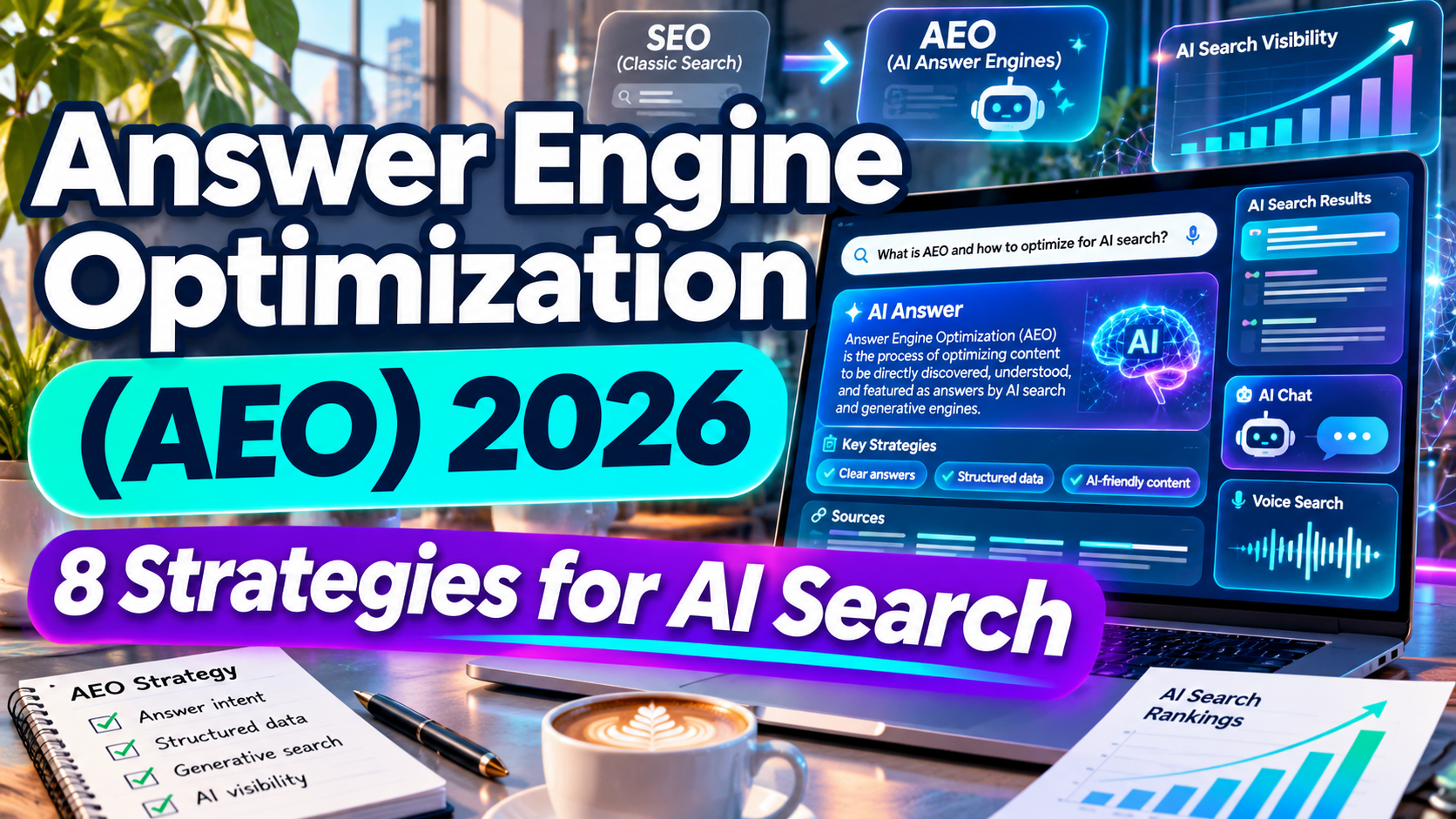
Answer Engine Optimization (AEO) 2026: 8 Strategies to Improve AI Search Visibility
Search is evolving beyond traditional lists of website links. AI-powered search engines can now generate direct answers, summarize multiple sources, and help users explore complex topics through conversational interactions.
Answer engine optimization (AEO) 2026 focuses on making website content easier for AI-powered systems to discover, understand, and reference when responding to user questions.
From Google AI Overviews and AI Mode to Microsoft Copilot and other conversational search experiences, businesses have new opportunities to increase brand visibility.
However, successful AEO is not about manipulating AI algorithms. It involves creating trustworthy, well-organized, and genuinely useful information that deserves to be referenced.
Optimize for Answers, Not Just Keywords
Traditional search engine optimization focuses on improving visibility in search results, while AEO emphasizes helping answer engines identify relevant information.
Start by understanding the questions your audience actually asks.
For example, instead of targeting only “best branding fonts,” a typography website could answer questions such as “What font styles work best for luxury branding?” or “How do I choose a font for a professional logo?”
Provide clear explanations immediately, followed by practical examples, comparisons, and supporting information.
This answer-first approach improves usability for readers while making important information easier for search systems to interpret.
8 Best Answer Engine Optimization Strategies for 2026
1. Create Clear, Direct Answers to User Questions
AI-powered search experiences frequently address questions written in natural language.
Structure your content around specific informational needs and provide concise answers near relevant headings.
For example, an article discussing typography could include:
What is a geometric font?
A geometric font is a typeface whose letterforms emphasize shapes such as circles, straight lines, and consistent proportions, often creating a clean, modern appearance.
Continue with examples and additional explanations that help readers understand the subject.
2. Strengthen Content Quality and Topical Authority
High-quality information remains essential for both traditional SEO and AI-powered search.
Develop comprehensive content around topics where your business has genuine expertise.
A design website might publish connected articles covering font selection, typography principles, logo development, and brand identity.
Include original examples, practical insights, and credible references rather than repeating generic information.
Google’s helpful-content guidance emphasizes reliability, originality, and content created primarily for people.
3. Organize Content With Structured Headings
A clear heading hierarchy helps visitors navigate information and helps search engines interpret page structure.
Use descriptive H2 headings for primary topics and H3 headings for supporting explanations.
Organize complex subjects with comparisons, short paragraphs, and clearly labeled sections.
For example, a guide about website typography could separate readability, font pairing, licensing, and performance into distinct sections.
Logical organization makes information easier to locate, understand, and summarize.
4. Implement Relevant Structured Data
Structured data provides search engines with machine-readable information about webpage content.
Schema.org vocabulary can describe articles, products, organizations, businesses, and other supported entities.
For example, a digital font marketplace could implement appropriate Product structured data containing accurate product information.
However, structured data must reflect visible page content and follow search engine guidelines.
Google confirms that no special AI-specific schema is required for AI Overviews or AI Mode, and markup does not guarantee inclusion.
5. Build Brand Credibility and Reliable Sources
Trustworthy content is more valuable when readers can understand who created it and why the information is credible.
Include accurate author information, relevant expertise, trustworthy references, and transparent business details.
Original research, documented experience, and genuinely useful case studies can strengthen the overall quality of your content.
For example, a branding agency could publish a detailed case study explaining its design decisions and measurable results.
These practices support credibility without guaranteeing AI citations.
6. Optimize Website Accessibility and Crawlability
AI search visibility depends partly on whether relevant systems can access and interpret website information.
Maintain indexable pages, descriptive internal links, readable HTML text, and appropriate technical SEO settings.
Review robots.txt restrictions, canonical URLs, and indexing status to identify potential problems.
For Google’s AI search features, existing SEO fundamentals remain relevant. Google does not require special AI text files or additional machine-readable markup.
7. Target Conversational and Voice Search Queries
People often phrase voice searches and chatbot questions differently from traditional keyword searches.
Instead of typing “modern logo fonts,” someone might ask, “Which modern fonts are suitable for a technology company?”
Create content that addresses these conversational questions naturally.
Use descriptive headings, straightforward explanations, and relevant semantic keywords.
Avoid forcing exact-match phrases into every paragraph, since readability and meaningful answers should remain priorities.
8. Monitor AI Search Visibility and Performance
AEO requires continuous evaluation as AI-powered search experiences develop.
Track organic search performance, brand mentions, referral traffic, and conversions from relevant channels.
In February 2026, Microsoft introduced an AI Performance dashboard in Bing Webmaster Tools that provides citation-related insights across supported AI experiences.
Google Search Console also includes traffic from Google’s AI search features within its overall web search reporting.
Use available measurements to evaluate trends, identify useful content, and refine your strategy without assuming every AI citation generates website visits.
Traditional SEO vs. AEO in 2026
SEO and AEO share essential foundations but emphasize different discovery experiences.
| Aspect | Traditional SEO | AEO |
|---|---|---|
| Primary goal | Search visibility and organic traffic | Visibility in generated answers |
| Content focus | Search intent and topical relevance | Clear, useful answers |
| Search experience | Search results and website links | Conversational and AI-generated responses |
| Optimization | Technical SEO, content, links | SEO foundations, answer clarity, credibility |
| Measurement | Rankings, clicks, conversions | Citations, mentions, referral traffic |
Should Businesses Prioritize SEO or AEO?
Businesses should treat AEO as an extension of effective SEO rather than a replacement.
Strong technical foundations, useful content, and trustworthy information support both approaches.
For example, PutraCetol Studio can support search discovery by publishing informative typography guides that answer practical branding questions while helping readers explore relevant font products.
Common Mistakes in Answer Engine Optimization
One common mistake is assuming that adding FAQ sections, excessive keywords, or special AI-related markup automatically improves visibility in generative search. AI-powered search systems use different retrieval and ranking methods, and no optimization technique guarantees that a particular website will be cited. Businesses should focus on genuinely useful information, accurate technical implementation, and clear content organization rather than chasing unsupported ranking shortcuts.
Another mistake is publishing large quantities of generic AI-generated content without providing original value. Repetitive articles, unsupported claims, outdated statistics, and fabricated references can weaken credibility. Content creators should prioritize editorial review, source verification, relevant expertise, and regular updates. They should also avoid measuring AEO success exclusively through AI-generated mentions, since actual business outcomes, including qualified visitors, customer inquiries, and conversions, remain important.
Conclusion
Answer engine optimization (AEO) 2026 represents an important development in how businesses approach digital visibility.
As AI-powered search becomes more conversational, websites need content that is accurate, accessible, clearly structured, and genuinely helpful.
Combining established SEO practices with answer-focused writing, credible information, and performance monitoring provides a practical foundation for long-term discoverability.
For creative businesses developing memorable brand identities, explore professional typography at PutraCetol Studio and strengthen your visual branding alongside an effective AI search content strategy.
Explore these fonts and many more at PutraCetol.com to build a business identity that looks professional, trustworthy, and memorable.
Additionally, if you want to explore some free typography options, you can check out Putracetol Studio on Dafont. Happy reading and designing!