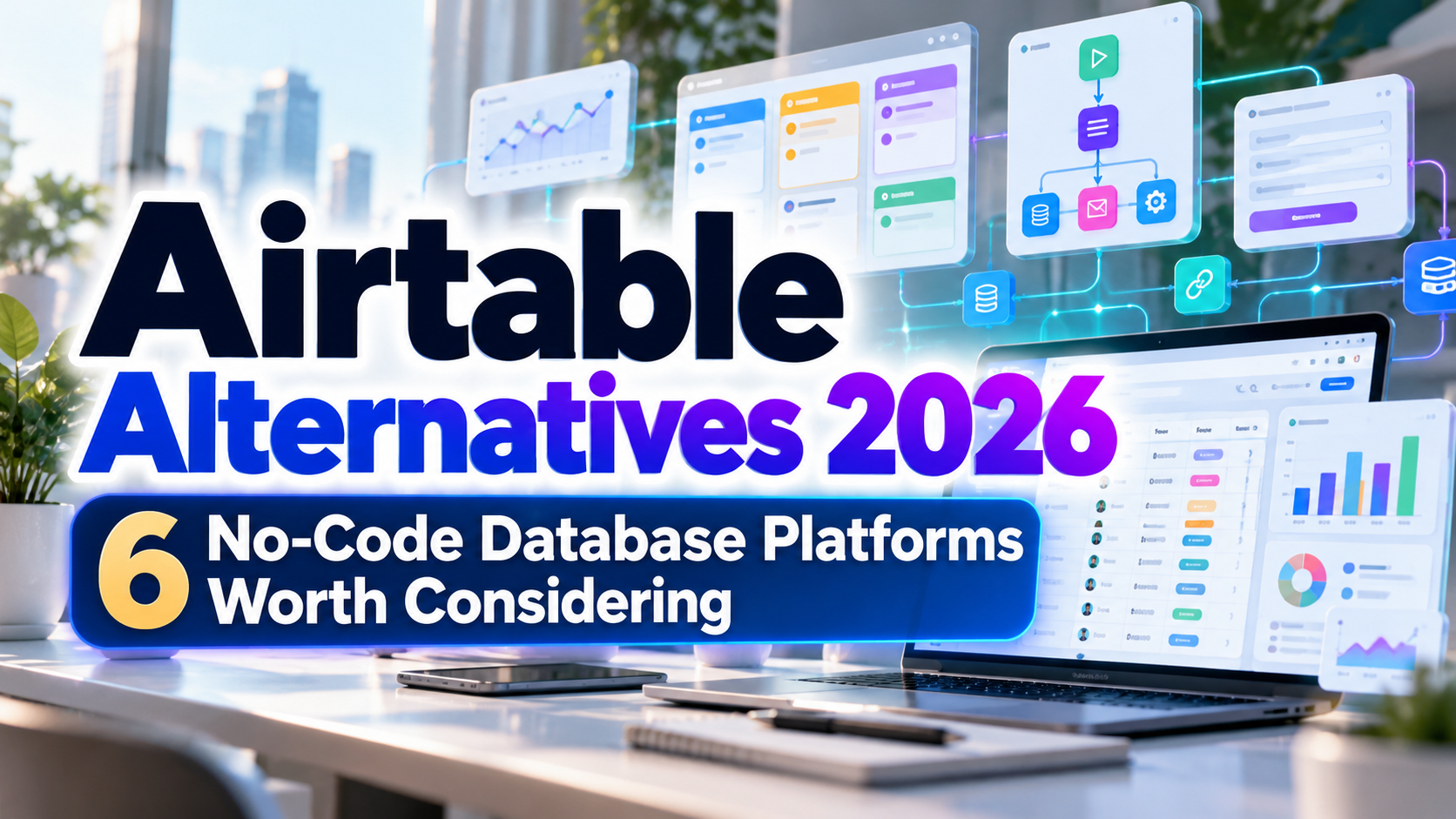
Airtable Alternatives 2026: 6 Platforms for Flexible No-Code Data Management
Airtable helped make relational data approachable by combining spreadsheet familiarity with database structure. But as businesses grow, different requirements begin to appear.
Some teams need self-hosting and stronger data control. Others want to connect directly to existing SQL databases, build complete internal applications, automate complex workflows, or use a production-grade backend behind customer-facing software.
That is why the best Airtable alternatives 2026 are no longer simple spreadsheet competitors.
Modern alternatives increasingly combine relational data, dashboards, automation, permissions, AI, APIs, application builders, and developer tooling. The right choice depends on whether your priority is business operations, internal apps, SaaS development, or infrastructure control.
Decide Whether You Need a Workspace or a Backend
Before migrating from Airtable, identify what role the platform actually plays.
If marketing and operations teams mainly manage campaigns, inventory, approvals, or CRM records, a visual no-code workspace may be ideal.
If the data powers a production SaaS application, priorities change. APIs, authentication, PostgreSQL compatibility, security rules, and application performance become much more important.
Also consider data ownership. Cloud convenience may be enough for many teams, while regulated organizations or technical companies may prefer self-hosted or on-premise deployment.
Recommended Airtable Alternatives for 2026
1. Baserow: Best Overall Open-Source Airtable Alternative
Baserow is one of the closest Airtable alternatives while extending the concept into full application development.
It combines relational databases with multiple views, dashboards, workflow automation, and a no-code Application Builder for internal tools, portals, CRMs, and operational apps. Baserow can run through its cloud service, managed private environments, or self-hosted infrastructure.
Its 2026 releases have expanded dashboards, workflow controls, field-level permissions, AI management, and application-building capabilities.
PROS: Open source, self-hosting, relational database, app builder, automation, API-first architecture.
BEST FOR: Airtable migrations, internal apps, privacy-conscious companies, operations teams, no-code builders.
2. NocoDB: Best for Existing SQL Databases
NocoDB is particularly attractive when the business already has real databases behind its systems.
It provides a spreadsheet-style no-code interface while supporting external PostgreSQL and MySQL data sources, with SQL Server and Oracle options available for enterprise use. Teams can work with views, formulas, links, lookups, dashboards, workflows, and APIs without replacing the original database.
Its current platform also includes workflow automation, NocoAI, dashboards, document collaboration, syncing, and REST API access.
PROS: Works with existing databases, no-code UI, workflows, API access, self-hosting options.
BEST FOR: Developers, IT teams, SQL-backed operations, companies modernizing existing databases.
3. SmartSuite: Best for Business Operations and Workflow Management
SmartSuite approaches the Airtable problem from the perspective of complete business processes.
Its platform combines a relational data model with tables, linked records, dashboards, collaboration, permissions, forms, automation, AI, and integrations. Teams can visually design workflows without coding while maintaining structured data and governance.
Its automation engine supports triggers, filters, multi-step actions, conditional logic, looping, webhooks, and AI-powered workflow steps.
PROS: Strong business workflows, relational structure, dashboards, advanced automation, enterprise governance.
BEST FOR: Operations, project management, GRC, IT teams, cross-department business systems.
4. Grist: Best for Spreadsheet Power Users
Grist sits between traditional spreadsheets and relational databases.
It preserves a familiar grid experience while allowing teams to create structured relational data, use Python-powered formulas, build forms, define detailed access rules, and extend workflows through APIs, webhooks, and custom widgets.
Grist is also highly portable. It supports self-hosting and stores documents in an SQLite-based format that can be exported, which can be attractive for organizations concerned about vendor lock-in or data residency.
PROS: Familiar spreadsheet workflow, relational data, Python formulas, self-hosting, strong portability.
BEST FOR: Analysts, technical operations teams, researchers, spreadsheet-heavy organizations.
5. Supabase: Best for SaaS and Application Backends
Supabase is not a direct visual Airtable replacement, but it becomes much more powerful when the database is intended to support a real application.
Every project receives a full PostgreSQL database alongside authentication, storage, realtime capabilities, APIs, and globally distributed Edge Functions.
Developers can manage tables visually while still accessing SQL, Row Level Security, database functions, and programmatic APIs.
This makes Supabase significantly more technical than conventional no-code tools, but also much better suited to scalable customer-facing applications.
PROS: Full PostgreSQL, authentication, realtime, storage, APIs, server-side functions.
BEST FOR: SaaS startups, developers, web applications, mobile apps, production backends.
6. Coda: Best for Documents Connected to Structured Data
Coda is best when database-style information needs to coexist with documents, team planning, and collaborative workflows.
Its tables can support operational systems inside a document-like environment, while automations use triggers, filters, and actions to handle recurring processes.
Coda is less database-centric than Baserow or NocoDB, but it can be very effective for product planning, project tracking, meeting systems, lightweight CRMs, and collaborative team hubs.
PROS: Documents and data together, flexible tables, collaborative workflows, automation.
BEST FOR: Product teams, project managers, startups, team documentation, lightweight operations.
Comparison: Airtable Alternatives 2026
| Platform | Main Strength | Best For |
|---|---|---|
| Baserow | Open-source no-code apps | Airtable replacement |
| NocoDB | Existing SQL databases | Technical teams |
| SmartSuite | Business workflows | Operations |
| Grist | Spreadsheet + database | Analytical teams |
| Supabase | Production backend | SaaS and developers |
| Coda | Docs + structured data | Collaborative teams |
For the closest overall Airtable-style alternative, Baserow is the strongest starting point. NocoDB is better when the database already exists, SmartSuite excels in operational workflows, Grist suits spreadsheet power users, Supabase is far stronger as a true application backend, and Coda works well when documents and data need to live together.
Common Mistakes
A common mistake is choosing an Airtable alternative solely because its interface looks familiar. The important questions are what happens when records grow, workflows become more complex, permissions need to become granular, or customer-facing applications begin depending on the data.
Another mistake is treating every no-code database as a production application backend. Tools designed for internal collaboration can be excellent for CRM or operations but may not provide the architecture, security model, or performance needed behind a SaaS product. For those projects, a backend platform such as Supabase may be the better foundation.
Finally, avoid migrating before mapping integrations and automations. A database rarely works alone. Document every API connection, webhook, formula, view, permission, and automation before moving data so the replacement system preserves the complete workflow rather than only the records.
Conclusion
The best Airtable alternatives 2026 serve very different needs.
Baserow offers an open-source no-code ecosystem, NocoDB brings friendly interfaces to existing databases, SmartSuite organizes complex business processes, Grist combines spreadsheets with relational power, Supabase provides a developer-grade application backend, and Coda connects structured data with collaborative documents.
For businesses building internal tools, client portals, operational systems, or SaaS products, the strongest choice is the one that can support the next stage of complexity without forcing another migration.
And once the system is built, presentation still matters. Businesses can use distinctive typography from PutraCetol Studio for dashboards, client portals, launch campaigns, documentation covers, and other branded visual assets around their digital products.
Explore these fonts and many more at PutraCetol.com to build a business identity that looks professional, trustworthy, and memorable.
Additionally, if you want to explore some free typography options, you can check out Putracetol Studio on Dafont. Happy reading and designing!