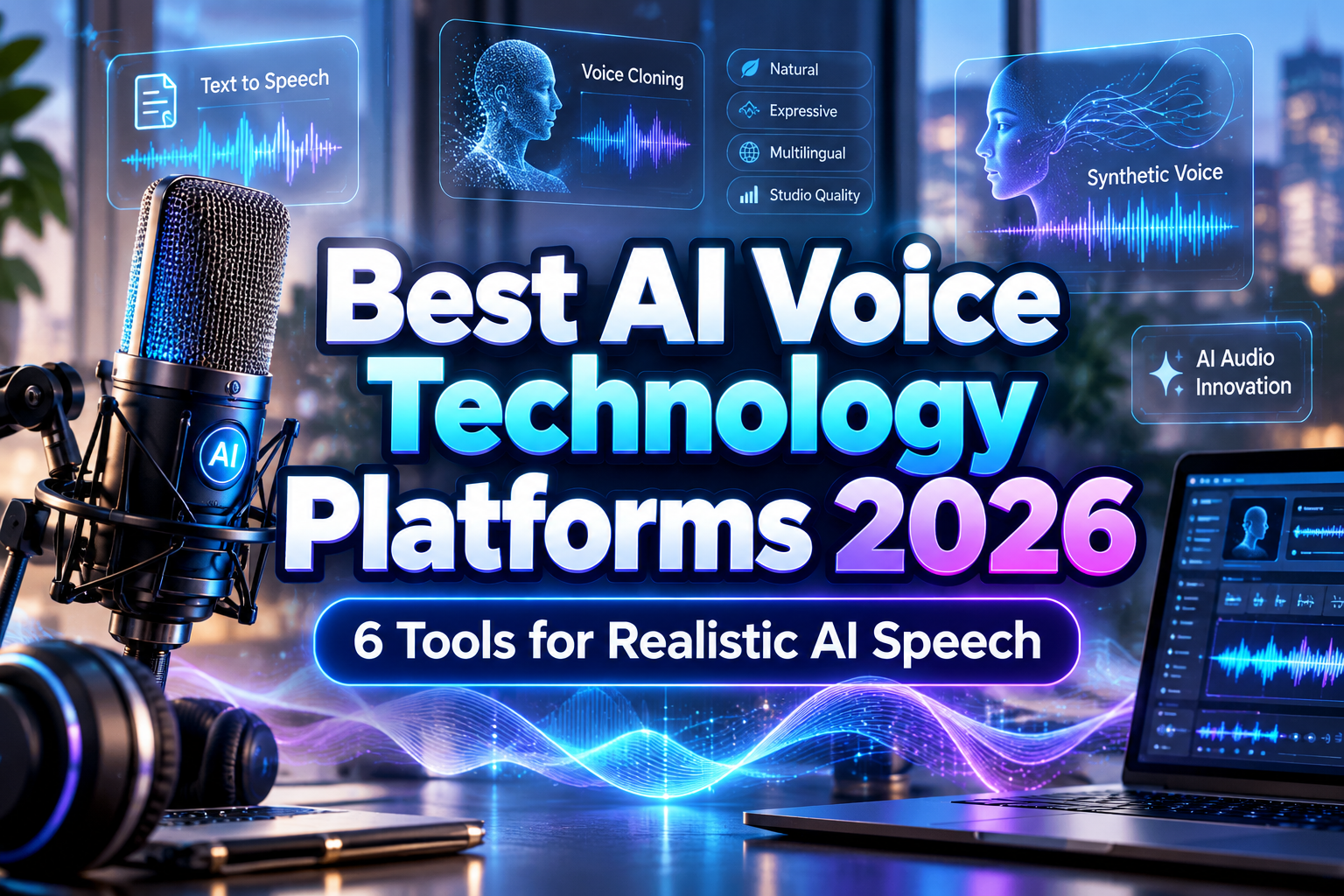
Best AI Voice Technology Platforms 2026: 6 Powerful Tools Compared
Synthetic speech has moved far beyond the robotic text-to-speech voices of the past. Modern AI can generate expressive narration, reproduce an authorized speaker’s vocal characteristics, switch languages, control emotion and pacing, and stream speech quickly enough for conversational applications.
The best AI voice technology platforms 2026 therefore serve several very different users. A YouTuber may want natural narration without recording every revision. A startup may need low-latency speech for an AI assistant. An e-learning company may prioritize multilingual production, while an enterprise may care more about governance, APIs, and controlled custom voices.
The following recommendations are ranked editorially based on voice quality, flexibility, integration potential, and relevance to modern creative and business workflows rather than a single laboratory benchmark.
Initial Suggestion: Choose the Workflow Before the Voice
Do not choose an AI voice platform simply because one demo sounds impressive.
First determine what you actually need: prerecorded narration, voice cloning, multilingual dubbing, real-time conversation, API integration, or enterprise deployment.
For a weekly YouTube channel, an easy studio editor may matter more than API latency. For an AI customer-support system, streaming response time and developer tooling become much more important. Organizations cloning real voices should also verify consent requirements and usage policies before production.
Recommended AI Voice Technology Platforms
1. ElevenLabs: Best Overall for Creators and Expressive Voice
ElevenLabs remains one of the strongest all-around options for creators who prioritize natural, expressive speech. Its platform includes text-to-speech, Studio, dubbing, APIs, and both instant and professional voice cloning. ElevenLabs says Instant Voice Cloning can work from roughly a minute of audio, while Professional Voice Cloning uses 30 or more minutes to capture more of a speaker’s vocal characteristics. ElevenLabs
Its combination of creator-friendly tools and developer integration makes it particularly versatile.
PROS: Expressive speech, voice cloning, multilingual output, creator tools and API.
BEST FOR: YouTube, podcasts, audiobooks, marketing, narration, creative agencies.
2. OpenAI: Best for AI Applications and Conversational Voice
OpenAI is particularly compelling when speech is part of a broader AI product. Its text-to-speech system supports streaming output and voice instructions covering properties such as tone, accent, speed, emotional range, and intonation. The current API also supports built-in and eligible custom voices, with consent required when creating a voice from an audio sample. OpenAI Developers
This makes it well suited to developers building assistants or applications where language understanding and speech generation need to work together.
PROS: Strong API integration, steerable speech, streaming, custom voice capabilities.
BEST FOR: AI assistants, conversational applications, SaaS products, developer workflows.
3. Google Cloud Text-to-Speech: Best for Multilingual Cloud Deployment
Google Cloud’s current voice stack includes Chirp 3 HD and Gemini TTS models. Chirp 3 HD is designed for realistic, emotionally nuanced speech, while Google’s Gemini TTS lineup supports dozens of voices and broad multilingual coverage with natural-language control over characteristics such as pace, accent, style, and emotion. Google Cloud Documentation
Google Cloud is especially attractive for companies already operating within Google’s cloud infrastructure.
PROS: Broad language support, high-quality generative voices, cloud-scale infrastructure.
BEST FOR: International applications, large-scale narration, enterprise products, multilingual services.
4. Microsoft Azure Speech: Best for Enterprise Voice Systems
Microsoft’s Azure Speech platform provides neural text-to-speech across more than 100 languages and locales, along with custom voice capabilities. Its Custom Voice system can create a brand-specific synthetic voice from recorded speech and supports controls such as pitch, rate, pronunciation, intonation, and speaking styles through SSML. Access to custom voice is restricted according to eligibility and responsible-AI requirements. Microsoft Learn
Azure’s enterprise ecosystem makes it especially relevant to organizations that need governance and structured deployment.
PROS: Extensive language coverage, enterprise integration, custom voices, strong speech controls.
BEST FOR: Corporate applications, contact centers, branded voice systems, enterprise software.
5. Murf AI: Best for Business Voiceover Workflows
Murf combines AI voice production with workflows aimed at presentations, training, marketing, and business content. In 2026, Murf also expanded its API capabilities with instant voice cloning for eligible Enterprise users, allowing a clone to be created from a short sample of up to 30 seconds and used across Falcon 2-supported locales. Murf AI
This makes Murf attractive to teams that want professional voice production without building an entire speech system themselves.
PROS: Accessible production workflow, multilingual cloning, API availability, business focus.
BEST FOR: Training videos, presentations, advertising, corporate narration, e-learning.
6. Resemble AI: Best for Custom Deployment and Voice Control
Resemble AI is particularly interesting for organizations that need deeper control over how voice technology is deployed. Its platform supports voice cloning, text-to-speech, streaming, custom pronunciation, voice design, and on-premise or air-gapped deployment options. Resemble also provides rapid cloning workflows and production-oriented API integration. Resemble AI
Its deployment flexibility can be important for companies operating in privacy-sensitive or regulated environments.
PROS: Voice cloning, low-latency streaming, pronunciation control, on-premise options.
BEST FOR: Voice agents, enterprises, regulated industries, custom applications.
Comparison: Best AI Voice Platforms 2026
| Platform | Main Strength | Best For |
|---|---|---|
| ElevenLabs | Expressive realistic speech | Creators and narration |
| OpenAI | Conversational AI integration | AI apps and agents |
| Google Cloud | Multilingual cloud TTS | Global applications |
| Microsoft Azure | Enterprise speech ecosystem | Corporate deployment |
| Murf AI | Easy business production | Marketing and e-learning |
| Resemble AI | Deployment flexibility | Custom and regulated systems |
The best platform depends less on which service has the most voices and more on how the generated speech fits your production pipeline.
AI Voice Branding Goes Beyond Sound
A recognizable digital identity combines sound and visual communication.
If a business uses a consistent AI narrator across videos, courses, advertisements, or product demonstrations, the surrounding visual language should reinforce the same personality. Typography, color, motion graphics, and voice tone can work together to make content feel intentionally branded.
Creators and businesses building that identity can explore PutraCetol Studio for distinctive fonts for video titles, podcast artwork, advertising, social campaigns, presentations, and other visual assets surrounding AI-generated audio.
Common Mistakes When Using AI Voice Technology
A common mistake is choosing a voice based on one impressive demo without testing longer scripts. A voice may sound excellent during ten seconds of promotional speech but perform differently with numbers, unusual names, technical terminology, emotional dialogue, or a 20-minute narration. Test the actual content and listen for pronunciation, pacing, consistency, and listener fatigue.
Another mistake is cloning someone else’s voice without proper authorization. Voice cloning creates serious consent, impersonation, and reputational risks. Platforms increasingly implement consent requirements, restricted access, watermarking, or other safeguards. Businesses should document permission and clearly define how cloned voices may be used.
Finally, do not allow synthetic speech to make every brand sound identical. Adjust tone, pacing, pronunciation, vocabulary, music, typography, and visual design around the voice. AI can accelerate production, but creative direction is what turns generated audio into recognizable communication.
Conclusion
The best AI voice technology platforms 2026 serve different priorities.
ElevenLabs is an excellent all-around choice for expressive creator content. OpenAI stands out for conversational applications, Google Cloud for multilingual cloud deployment, Microsoft Azure for enterprise speech systems, Murf for accessible business production, and Resemble AI for customizable deployment and voice control.
Choose based on workflow, not hype. Test real scripts, confirm licensing and consent, evaluate language quality, and consider whether you need a studio interface, API, streaming, cloning, or enterprise infrastructure.
Used responsibly, AI voice technology can dramatically accelerate audio production while giving creators and businesses new ways to communicate across platforms, languages, and audiences.
Explore these fonts and many more at PutraCetol.com to build a business identity that looks professional, trustworthy, and memorable.
Additionally, if you want to explore some free typography options, you can check out Putracetol Studio on Dafont. Happy reading and designing!