
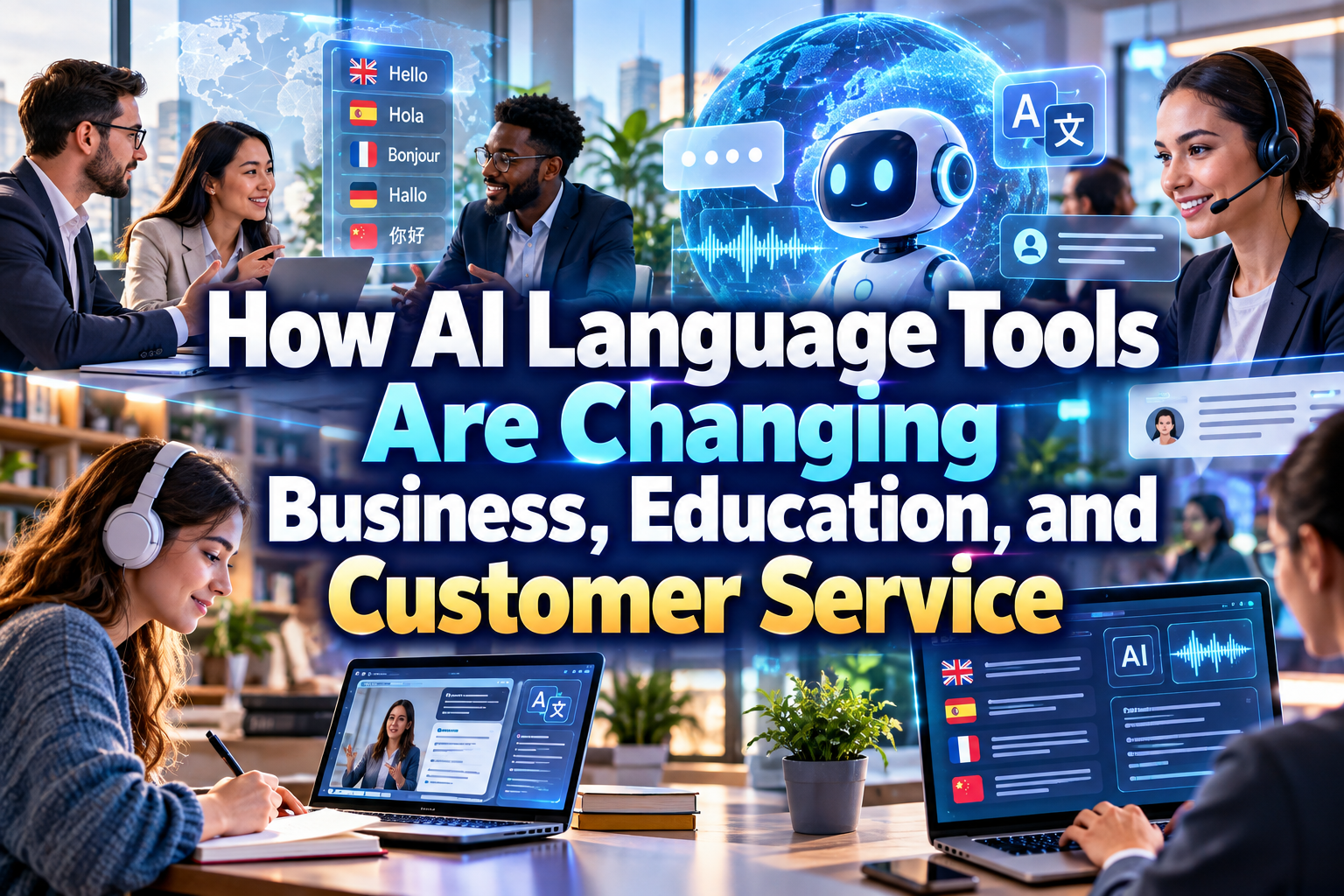
AI Language 2026: How Artificial Intelligence Is Reshaping Human Communication
Language has always been one of the most difficult areas for computers to understand. Words change meaning depending on context, tone, culture, industry, and even the relationship between the people communicating.
Artificial intelligence has changed that relationship dramatically.
In AI language 2026, language technology is moving beyond simple keyword recognition. Modern systems can summarize documents, translate conversations, classify text, answer questions, assist customer-service teams, analyze sentiment, generate marketing copy, and work with multiple languages within the same workflow.
For businesses, the opportunity is efficiency and global communication. For educators and public institutions, it is broader access to information. For developers, language has increasingly become an interface through which people interact with software.
The important question is no longer whether AI can process language. It is how to use that capability responsibly and effectively.
Initial Suggestion: Start With a Specific Communication Problem
Organizations should avoid implementing AI simply because conversational technology is popular.
Begin with the task.
A retailer may need faster responses to repetitive customer questions. A government service could need multilingual information. A marketing department might want to categorize thousands of customer comments. A publisher may need first-pass translation before professional localization.
Once the problem is clear, it becomes easier to choose between a chatbot, translation model, text-classification system, speech interface, or another AI language solution.
This approach also makes results measurable. Instead of asking whether an AI system seems impressive, measure response time, translation quality, support resolution, editing time, customer satisfaction, or another relevant outcome.
Natural Language Processing Is the Foundation
Natural language processing, commonly called NLP, describes technologies that allow computers to work with human language.
Traditional NLP applications include classification, entity extraction, sentiment analysis, search, and language detection. Modern language models extend these capabilities by handling more complex instructions and generating natural responses.
Consider a company receiving 20,000 customer reviews.
Instead of manually reading every comment, an NLP workflow could group them into topics such as delivery, packaging, product quality, pricing, and customer support. The system could then summarize recurring issues for the marketing or operations team.
AI does not remove the need for human interpretation, but it can dramatically reduce the amount of text that needs to be processed manually.
Machine Translation Is Becoming More Context-Aware
Automatic translation is one of the clearest examples of AI language technology.
Earlier systems often translated individual words or phrases mechanically. Current AI translation systems can consider surrounding sentences and broader context, producing more natural results across many common use cases.
For businesses, this makes multilingual communication easier.
An ecommerce company might create first-pass translations for product information, support articles, and internal documents. A content creator could adapt captions for international audiences. Customer-service systems may translate conversations between agents and customers.
However, machine translation should not automatically become the final version of every text.
Legal agreements, healthcare instructions, advertising slogans, culturally sensitive messaging, and important brand communication may still require professional review. AI can accelerate localization, but cultural meaning is more complex than replacing words between languages.
Chatbots Are Moving From Scripts to Conversations
Older chatbots often relied on predefined menus:
“Press 1 for billing.”
“Press 2 for technical support.”
AI-powered conversational systems can interpret much more flexible questions.
A customer might type, “My package arrived damaged and I need another one before Friday,” and the system can potentially identify the damaged-order problem, urgency, and requested replacement without requiring the customer to navigate several menus.
This makes conversational AI useful for ecommerce, banking, software support, travel, education, and many other industries.
The strongest implementations also know when not to answer.
Complex complaints, sensitive medical questions, unusual financial issues, or high-risk decisions should have clear escalation paths to qualified humans.
Multilingual AI Can Expand Access to Information
One of the most promising aspects of AI language 2026 is lowering language barriers.
Multilingual systems can help organizations provide information to audiences that previously required separate workflows for every language.
Public institutions could make general service information more accessible. Educational platforms can provide explanations in multiple languages. International companies can make internal knowledge easier to search across regional teams.
This has important implications for digital inclusion.
However, performance can vary significantly between languages, dialects, and specialized terminology. Widely represented languages may receive better results than low-resource languages.
Organizations should therefore test AI language systems with real native speakers rather than assuming equal quality across every supported language.
Sentiment Analysis Helps Understand Large Audiences
AI can also classify how people communicate.
Sentiment analysis attempts to identify whether text expresses positive, negative, neutral, or more specific attitudes.
Marketing teams can use it to examine reviews, surveys, support tickets, or social-media conversations.
For example, a restaurant chain might notice that overall reviews remain positive while complaints about waiting time are increasing. That insight could reveal an operational problem before average ratings decline significantly.
Sentiment analysis is useful for identifying patterns, but human language contains sarcasm, humor, cultural differences, and ambiguity. Scores should support analysis rather than be treated as perfect representations of human emotion.
Voice and Language AI Are Converging
Language technology is increasingly connected with speech recognition and voice generation.
A modern system can potentially convert spoken language into text, interpret the request, generate an answer, translate it, and return the result using synthesized speech.
This creates opportunities for voice assistants, accessibility tools, customer service, education, travel, and hands-free interfaces.
It also introduces new design challenges.
Voice systems need clear confirmation when performing important actions, especially when names, numbers, addresses, payments, or medical information are involved.
When language becomes an interface, communication design becomes as important as the underlying AI model.
AI Language and Brand Communication
AI-generated communication can increase production speed, but businesses should avoid allowing every message to sound generic.
Brand voice still matters.
Define vocabulary, formality, sentence style, terminology, prohibited phrases, and rules for customer communication. AI can then support those guidelines rather than creating a different personality every time content is generated.
Visual identity should remain consistent as well. Businesses creating multilingual websites, social campaigns, presentations, or digital products can use distinctive typography from PutraCetol Studio to strengthen their visual branding alongside AI-assisted communication.
For multilingual projects, always confirm that the chosen font supports the characters and writing systems required by the content.
Comparison: Major AI Language Applications
| Technology | Main Purpose | Typical Use |
|---|---|---|
| Machine translation | Convert languages | Global content |
| NLP classification | Organize text | Reviews and documents |
| Chatbots | Conversational support | Customer service |
| Sentiment analysis | Detect attitudes | Marketing research |
| AI writing | Generate and rewrite text | Content workflows |
| Speech AI | Process spoken language | Voice interfaces |
| Multilingual assistants | Cross-language interaction | International services |
The most effective organizations often combine several of these capabilities rather than treating them as isolated technologies.
Common Mistakes With AI Language Systems
One common mistake is trusting fluent language as proof of accuracy. An AI response can sound confident, grammatically correct, and professional while still containing incorrect information. Important outputs should therefore be verified against reliable sources, especially in healthcare, finance, law, and other high-impact situations.
Another mistake is sending confidential information into AI systems without understanding how data is processed, stored, or governed. Organizations should define clear policies covering customer records, internal documents, personal information, and access permissions before integrating language AI into sensitive workflows.
Finally, avoid removing humans completely from communication. Automation is excellent for repetitive tasks, first drafts, classification, translation assistance, and basic support. Difficult conversations often require empathy, accountability, cultural understanding, and professional judgment. The most effective system is frequently AI for scale combined with humans for exceptions and important decisions.
Conclusion
AI language 2026 is transforming the way people communicate with businesses, software, institutions, and one another.
Natural language processing, translation, chatbots, sentiment analysis, speech technology, and multilingual AI can reduce repetitive work and make information more accessible across languages.
But better language technology does not eliminate the importance of human communication.
Organizations should combine AI efficiency with verification, privacy protection, thoughtful UX, cultural awareness, and consistent brand identity.
Used carefully, AI language technology can become more than a content-generation tool. It can serve as a bridge between people, languages, information, and digital services that previously remained difficult to connect.
Explore these fonts and many more at PutraCetol.com to build a business identity that looks professional, trustworthy, and memorable.
Additionally, if you want to explore some free typography options, you can check out Putracetol Studio on Dafont. Happy reading and designing!