
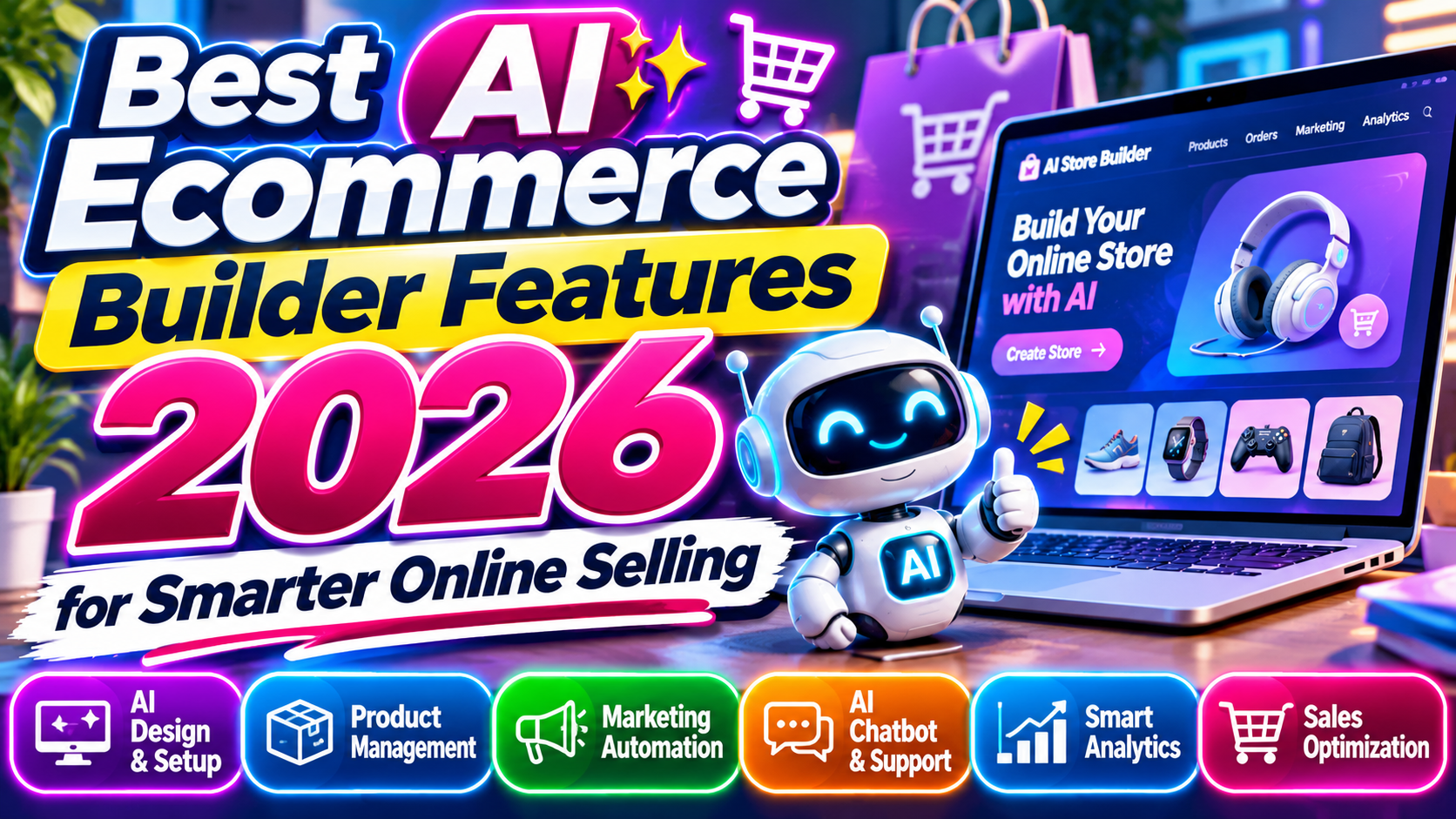
AI Ecommerce Builder Features 2026: 7 Essential Tools for Smarter Online Stores
Building a successful online store no longer requires extensive programming knowledge or a large development team. Artificial intelligence is changing how entrepreneurs create, manage, and improve ecommerce websites.
The most important AI ecommerce builder features 2026 combine automated website design, product management, intelligent marketing, and customer support into accessible digital platforms.
These capabilities help businesses reduce repetitive tasks, personalize shopping experiences, and make better operational decisions.
Whether you’re launching a small boutique, managing a dropshipping business, or expanding an established online store, understanding these features can help you choose the right ecommerce platform.
What Is an AI Ecommerce Builder?
An AI ecommerce builder is a website creation platform that uses artificial intelligence to assist with building and operating online stores.
Unlike conventional website builders that primarily rely on manual customization, AI-powered platforms can generate layouts, suggest product descriptions, automate selected workflows, and analyze business information.
Platforms such as Wix and Shopify offer different combinations of AI-assisted creation and ecommerce management tools.
However, available features depend on the platform, subscription, and integrations.
Identify Your Store’s Biggest Challenges
Before selecting an AI ecommerce builder, identify which business activities consume the most time.
If your biggest challenge is launching a website, prioritize AI design generation and visual customization.
For stores managing hundreds of products, inventory integrations and automated content creation may provide greater value.
Businesses struggling with customer inquiries could benefit from intelligent chat assistance.
Choose a platform based on operational requirements rather than the number of AI features advertised.
7 Essential AI Ecommerce Builder Features for 2026
1. AI-Powered Website Design and Customization
AI website generators help entrepreneurs create professional storefront layouts without designing every section manually.
By describing a business, its products, and target audience, users can generate suggested page structures, colors, and visual arrangements.
For example, an AI builder could create an initial homepage for a skincare boutique with product collections and promotional sections.
However, strong branding still requires human customization.
Distinctive typography also helps differentiate online stores. Explore professional fonts at PutraCetol Studio to personalize logos, promotional banners, and website headlines.
KEY BENEFITS: Faster website creation, easier customization, and consistent branding.
BEST FOR: Startups, small businesses, and first-time ecommerce entrepreneurs.
2. AI Product Descriptions and Catalog Management
Managing product information becomes challenging as online stores expand.
AI-assisted tools can generate product descriptions, suggest titles, and help organize catalog information.
For example, a fashion retailer could use AI to draft descriptions based on clothing materials, sizes, and product characteristics.
Store owners must still verify specifications, availability, and marketing claims before publishing.
KEY BENEFITS: Reduced manual writing, organized product catalogs, and faster content preparation.
BEST FOR: Fashion retailers, dropshipping stores, and businesses with large inventories.
3. Smart Inventory and Order Management
Efficient inventory management helps businesses maintain accurate stock information and fulfill orders reliably.
Modern ecommerce builders can connect inventory tracking, order processing, and fulfillment workflows.
AI-assisted insights may help merchants identify purchasing patterns or anticipate inventory requirements.
For example, a retailer could examine historical sales to prepare for seasonal demand.
Inventory synchronization and automated notifications remain essential even when AI forecasting is unavailable.
KEY BENEFITS: Better inventory visibility, fewer manual tasks, and improved operational planning.
BEST FOR: Retail businesses, growing online stores, and multichannel sellers.
4. AI Marketing Automation and Campaign Creation
Marketing automation helps online businesses communicate with customers more consistently.
AI-powered tools can assist with promotional emails, advertising copy, audience segmentation, and campaign recommendations.
For example, an online accessories store could create personalized email campaigns highlighting products related to previous purchases.
Automated abandoned-cart reminders can also encourage customers to return and complete unfinished transactions.
Businesses should respect customer consent and relevant marketing regulations.
KEY BENEFITS: Faster campaign creation, targeted communication, and reduced repetitive marketing work.
BEST FOR: Digital marketers, ecommerce brands, and small marketing teams.
5. AI Chatbots and Customer Support
Customer support is an important part of a positive online shopping experience.
AI chatbots can answer frequently asked questions, explain product information, and guide customers toward relevant resources.
For example, a chatbot could help shoppers understand shipping policies or compare available product options.
Wix Smart Chat combines automated assistance with human chat capabilities.
Effective systems should provide escalation options when questions require human attention.
KEY BENEFITS: Faster responses, convenient assistance, and more accessible customer support.
BEST FOR: Online retailers, service businesses, and stores receiving frequent inquiries.
6. Intelligent Analytics and Personalized Recommendations
AI-powered analytics help merchants interpret business information and recognize important customer behavior patterns.
Instead of reviewing numerous reports manually, businesses can use AI assistance to explore sales performance, customer segments, and purchasing trends.
Product recommendation systems may suggest relevant items based on available shopping data.
For example, a technology store could recommend compatible accessories alongside selected devices.
These recommendations should be evaluated through measurable business results.
KEY BENEFITS: Clearer business insights, relevant product discovery, and informed decision-making.
BEST FOR: Growing ecommerce stores, marketing teams, and established retailers.
7. SEO, Checkout Optimization, and Business Scalability
An ecommerce builder needs reliable business infrastructure beyond AI-generated content.
Look for customizable SEO titles, mobile-friendly layouts, secure checkout integration, and dependable hosting.
AI can help draft metadata, identify content improvements, and suggest marketing opportunities.
However, payment processing, shipping integrations, accessibility, and website performance require appropriate technical systems.
Choose platforms that can accommodate increasing product catalogs and transaction volumes.
KEY BENEFITS: Better usability, search visibility opportunities, and sustainable business growth.
BEST FOR: Expanding online stores, digital businesses, and long-term ecommerce projects.
Comparison: Traditional vs. AI Ecommerce Builders
| Feature | Traditional Builder | AI Ecommerce Builder |
|---|---|---|
| Website design | Manual customization | AI-generated starting layouts |
| Product content | Manually written | AI-assisted descriptions |
| Marketing | Manual campaign setup | AI-assisted automation |
| Customer support | Manual or rule-based | AI chatbot options |
| Analytics | Standard reports | AI-assisted insights |
| Personalization | Manual configuration | Data-driven recommendations |
| Store management | Conventional tools | Automation and AI assistance |
Note: AI capabilities vary by platform and may require additional plans or integrations.
Common Mistakes When Choosing an AI Ecommerce Builder
One common mistake is assuming artificial intelligence can automatically create a successful online business. Although AI simplifies website design, content generation, and selected operational tasks, it cannot replace market research, accurate product information, or customer service. Automatically generated descriptions may contain incorrect specifications, while recommended layouts may not reflect a brand’s identity. Store owners should review AI-generated outputs carefully and customize important elements before launching their websites.
Another mistake is focusing entirely on AI features while overlooking fundamental ecommerce requirements. Secure payments, reliable inventory tracking, mobile usability, shipping integrations, and customer data protection remain essential. Businesses should also evaluate subscription costs, supported payment methods, platform limitations, and future scalability. An advanced chatbot provides little value if customers encounter complicated checkout processes or inaccurate product availability. Effective ecommerce platforms balance intelligent automation with dependable operations.
Conclusion
The AI ecommerce builder features 2026 landscape demonstrates how artificial intelligence can make online store creation and management more accessible.
Automated design, product content generation, inventory insights, marketing assistance, chatbots, and intelligent analytics help businesses work more efficiently.
However, successful ecommerce still depends on customer understanding, reliable technology, and distinctive branding.
Choose tools that solve real business challenges, then refine your online store through consistent design and measurable improvements.
Explore creative typography at PutraCetol Studio to give your AI-powered ecommerce website a professional and recognizable visual identity.
Explore these fonts and many more at PutraCetol.com to build a business identity that looks professional, trustworthy, and memorable.
Additionally, if you want to explore some free typography options, you can check out Putracetol Studio on Dafont. Happy reading and designing!