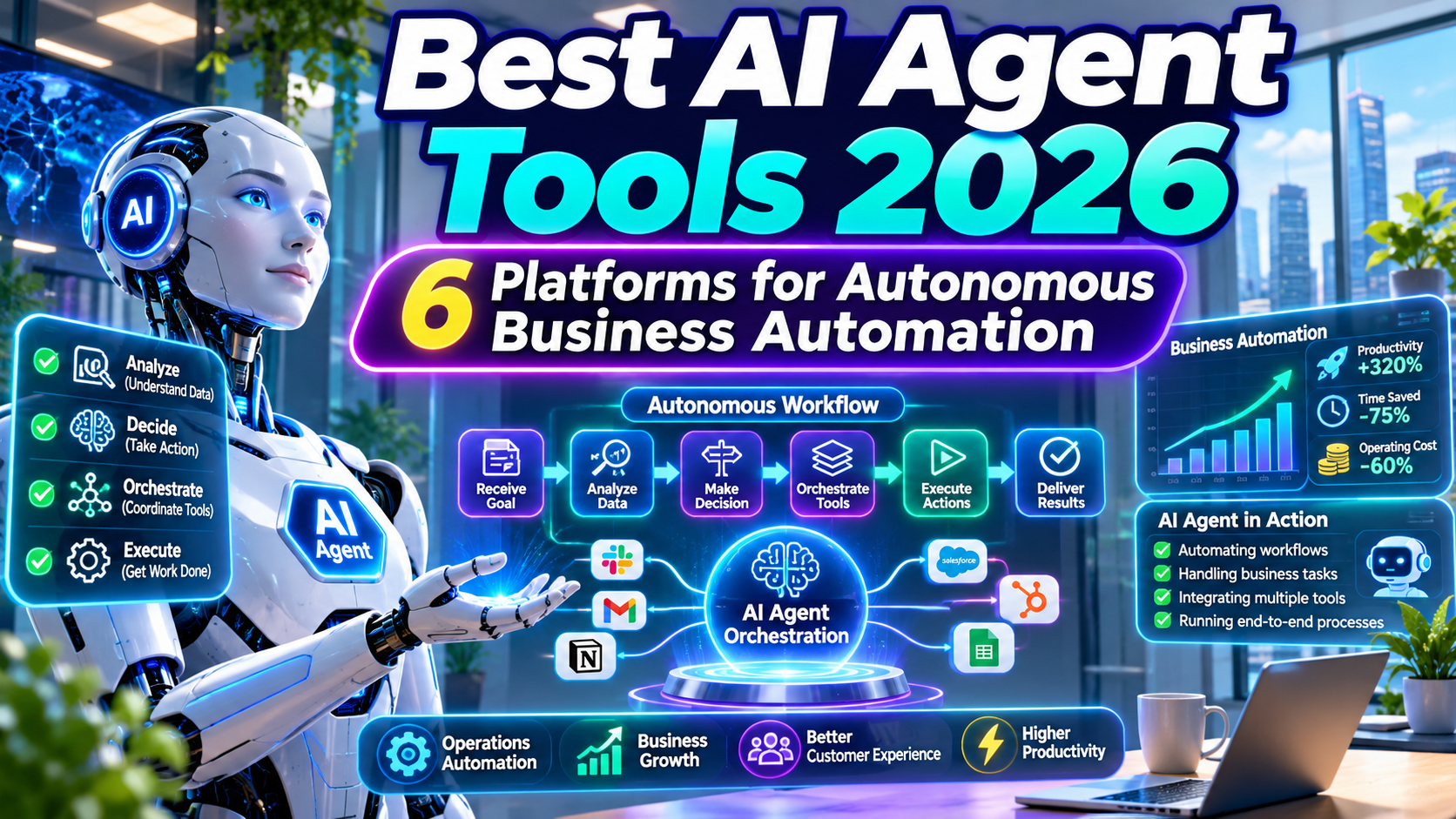
Best AI Agent Tools 2026 for Business Automation
AI agents are moving beyond the chatbot model.
Instead of simply receiving a question and generating a response, modern agents can interpret goals, plan multiple steps, call external tools, access business data, execute actions, maintain context, and decide when human approval is required.
That evolution makes the best AI agent tools 2026 relevant far beyond customer support.
Businesses can now use agents to investigate incidents, qualify leads, analyze data, process requests, coordinate workflows, update CRM records, research information, handle service cases, and automate repetitive operations.
The challenge is choosing the right platform. Some tools give developers deep control over orchestration and runtime behavior, while others focus on low-code business automation or enterprise governance.
Start With the Job, Not the Agent
Before choosing a platform, define the task you want the agent to own.
A useful agent should have a clear goal, access only to the tools required for that goal, and explicit boundaries around what it can change.
For example, a lead-qualification agent might research a company, update CRM information, score the opportunity, and prepare a sales briefing. A customer-service agent might check an order, initiate an approved return, and escalate exceptions.
The best implementations combine AI reasoning for uncertain decisions with deterministic workflows for predictable actions.
Recommended AI Agent Tools for 2026
1. OpenAI Agents Platform: Best for Developer-Built Agentic Applications
OpenAI provides several ways to build agents, including the Agents API, Agents SDK, and Responses API.
The Agents SDK supports tools, handoffs, guardrails, human review, tracing, and multi-agent orchestration, while the managed Agents API can maintain sessions, execute code in sandbox environments, connect to MCP servers, delegate work to subagents, and resume long-running tasks.
This makes OpenAI especially suitable when developers want significant control over how agents reason and interact with application infrastructure.
PROS: Strong tool use, managed or custom orchestration, MCP, multi-agent workflows, sandbox execution.
BEST FOR: SaaS products, custom AI applications, developer teams, data agents, complex automation.
2. Microsoft Copilot Studio: Best for Microsoft-Centric Business Automation
Copilot Studio is designed for organizations that want agents connected directly to enterprise systems.
Agents can use Power Platform connectors, REST APIs, workflows, and MCP servers to read data and perform actions. Microsoft also supports autonomous agents that respond to events and execute workflows without waiting for a user message.
Its strongest advantage is the surrounding Microsoft ecosystem, including Teams, Microsoft 365, Dynamics, SharePoint, and Power Platform.
PROS: Low-code builder, enterprise connectors, event-driven agents, workflows, Microsoft integration.
BEST FOR: Microsoft 365 organizations, operations teams, employee agents, enterprise automation.
3. Salesforce Agentforce: Best for CRM and Customer-Facing Agents
Agentforce is strongest when AI agents need direct access to customer, sales, service, and operational data already stored inside Salesforce.
Agents can reason about requests, use CRM and connected data, select actions, chain workflows, and operate within configured guardrails. Salesforce’s current platform also supports purpose-built agents, multi-agent orchestration, long-horizon tasks, observability, and human escalation.
Typical use cases include customer service, sales development, scheduling, employee support, and field service.
PROS: Deep CRM context, business actions, low-code building, governance, multi-agent orchestration.
BEST FOR: Salesforce enterprises, customer service, sales, CRM automation, large organizations.
4. Gemini Enterprise Agent Platform: Best for Google Cloud Enterprise AI
Google’s newly released Gemini Enterprise Agent Platform brings its former Vertex AI agent capabilities into a broader agent platform.
Teams can build agents with a low-code Agent Studio or Google’s Agent Development Kit, access more than 200 models, deploy through a managed Agent Runtime, maintain long-term memory, manage agent identities, enforce tool policies, and evaluate agent behavior.
The 2026 platform also supports long-running operations of up to seven days.
PROS: Managed runtime, long-term memory, model choice, enterprise governance, evaluation.
BEST FOR: Google Cloud enterprises, multi-model AI, complex enterprise agents, data-heavy applications.
5. n8n Agents: Best for Technical Workflow Automation
n8n introduced its new Agents experience in September 2026.
Users define what an agent should do, choose a model, and provide the tools and workflows it can access. Agents can operate through Slack, schedules, or existing n8n workflows, while traditional workflows can also invoke an agent when reasoning is required.
This combination is particularly valuable because businesses can keep deterministic automation for predictable tasks and introduce agentic reasoning only where it adds value.
PROS: Agent + workflow combination, model flexibility, reusable workflows as tools, automation-first architecture.
BEST FOR: Technical teams, operations automation, internal workflows, integration-heavy businesses.
6. AI by Zapier: Best for No-Code Cross-App Agents
Zapier’s former standalone Agents product is being folded into AI by Zapier inside the Zap editor.
The new model combines AI reasoning and tool calling with Zapier triggers, filters, paths, approvals, run history, and access to thousands of business applications. Teams can require human approval for individual tools rather than treating an agent as entirely autonomous.
Zapier currently connects AI workflows across more than 9,000 apps, making it particularly useful for business users who do not want to build custom integrations.
PROS: Huge app ecosystem, no-code automation, granular approvals, business-friendly workflows.
BEST FOR: Marketing, sales, operations, startups, small businesses, cross-app automation.
Comparison: Best AI Agent Tools 2026
| Platform | Main Strength | Best For |
|---|---|---|
| OpenAI Agents | Developer control | Custom AI products |
| Copilot Studio | Microsoft workflows | Enterprise automation |
| Agentforce | CRM-driven agents | Sales and service |
| Gemini Enterprise Agent Platform | Managed enterprise AI | Google Cloud |
| n8n Agents | Agent + workflow logic | Technical automation |
| AI by Zapier | Cross-app no-code automation | Business teams |
What Makes a Good AI Agent Platform?
The strongest platforms combine four capabilities: reasoning, tools, context, and governance.
Reasoning lets the agent decide what to do. Tools let it perform real actions. Context helps it understand previous steps and business data. Governance limits what it is allowed to access or change.
As agents gain more autonomy, approval controls and observability become increasingly important. Sending an email, modifying a customer record, issuing a refund, or updating production data should not necessarily have the same permission requirements.
Businesses building AI products can also use distinctive typography from PutraCetol Studio for product branding, launch pages, presentations, dashboards, and AI campaign graphics while keeping functional interface text clear and readable.
Common Mistakes
A common mistake is using an AI agent when a normal workflow would be more reliable. If every step is predictable, deterministic automation is usually cheaper and easier to audit. Agents add the most value when the system needs to interpret context, choose between actions, or respond to changing conditions.
Another mistake is giving an agent excessive permissions. Start with the minimum tools and data required for its role. Add human approval before high-impact actions such as payments, external communication, account changes, or deletion.
Finally, do not evaluate agents only through impressive demos. Production systems need tracing, evaluations, failure handling, security controls, predictable costs, and clear escalation paths. Measure completed business outcomes rather than the number of tasks the agent attempted.
Conclusion
The best AI agent tools 2026 serve very different users.
OpenAI provides deep developer flexibility, Copilot Studio excels in Microsoft environments, Agentforce connects agents directly with CRM workflows, Google’s Gemini Enterprise Agent Platform targets governed enterprise deployments, n8n combines agents with technical workflow automation, and AI by Zapier makes cross-app agentic automation accessible to business teams.
The future of AI automation is not simply more autonomous software.
It is giving agents enough intelligence to make useful decisions while keeping humans in control of the actions that matter most.
Explore these fonts and many more at PutraCetol.com to build a business identity that looks professional, trustworthy, and memorable.
Additionally, if you want to explore some free typography options, you can check out Putracetol Studio on Dafont. Happy reading and designing!