
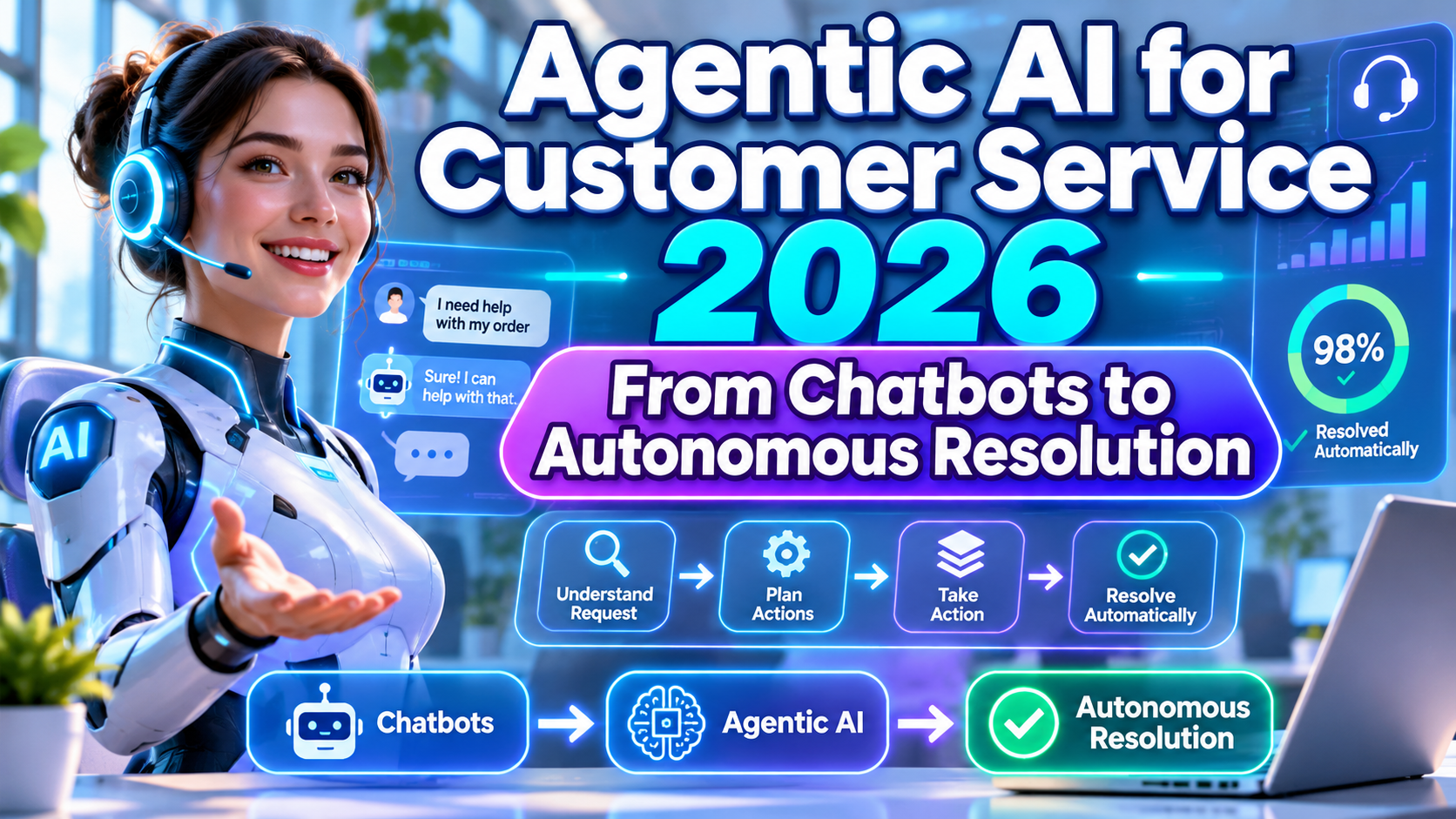
Agentic AI for Customer Service 2026: From Conversation to Autonomous Resolution
Customer-service automation is entering a different phase.
Traditional chatbots were designed mainly to answer predefined questions. Generative AI improved those conversations by making responses more natural and flexible. Agentic AI for customer service 2026 goes further by giving AI systems the ability to understand goals, plan steps, access business data, use tools, execute authorized actions, and adapt as the situation changes.
Instead of simply explaining how to change a booking, an AI agent may be able to identify the reservation, check applicable rules, find alternatives, update the booking, issue confirmation, and escalate only when the request falls outside its authority.
This shift from answering questions to completing outcomes is becoming increasingly important. Genesys reports that 40% of CX organizations surveyed in 2026 are already using agentic AI, while customer expectations continue to move toward faster and more connected service experiences.
Start With Resolvable Customer Journeys
Do not begin by asking, “How much customer service can we automate?”
Instead ask, “Which customer journeys can an AI agent complete safely from beginning to end?”
Good early use cases include order tracking, account updates, basic troubleshooting, appointment changes, returns, password issues, subscription management, and other predictable workflows.
The important difference is resolution.
Zendesk’s 2026 AI agents can move beyond knowledge-base answers into goal-oriented procedures, authorized actions, API integrations, and autonomous decision-making during conversations.
That is the foundation of agentic service.
1. Agentic AI Understands Goals, Not Just Keywords
Traditional bots often depend on intents, menus, and predefined conversation trees.
Agentic systems interpret the broader customer objective.
Salesforce describes its autonomous agents as applications capable of analyzing conversational context, determining next steps, creating action plans, and executing sequences of tasks using company data and predefined guardrails.
Consider a customer saying:
“My package still hasn’t arrived, and I’m traveling tomorrow.”
A conventional bot might provide a tracking link.
An agentic system could inspect delivery status, understand the urgency, evaluate replacement or pickup options, check account eligibility, execute an approved solution, and communicate what happens next.
2. AI Agents Can Execute Real Business Actions
The defining capability of agentic AI is action.
Customer-service systems increasingly connect AI with CRM records, billing platforms, order-management systems, scheduling software, APIs, and back-office workflows.
Genesys’ Agentic Virtual Agent, introduced in February 2026, is designed to understand customer goals, determine next steps, and execute actions across front- and back-office systems rather than stopping at conversational guidance.
Possible actions include:
- Rescheduling appointments
- Updating customer information
- Processing eligible returns
- Changing subscriptions
- Checking account status
- Creating or updating support cases
- Triggering delivery or service workflows
The customer asks for an outcome, not instructions for doing the work manually.
3. Agentic Support Can Adapt as Conditions Change
Real customer problems are rarely perfectly linear.
An item may suddenly become unavailable. Payment authorization may fail. A customer’s account tier may change the available solution.
Agentic systems can evaluate updated information and adjust the next step rather than relying exclusively on a static script.
Zendesk describes modern AI agents as capable of autonomous planning and adaptive execution while working through complex or vague customer problems.
This flexibility is what separates agentic workflows from traditional automation.
4. Customer Context Becomes Essential
Autonomy without context creates poor customer experiences.
An AI agent needs access to appropriate customer history, account details, previous interactions, permissions, products, and relevant business knowledge.
Context also needs to survive channel changes.
Genesys’ 2026 CX research found that 95% of consumers consider carrying context across channels important, while 48% of companies still fail to pass information already provided by customers to a human agent.
Modern agentic architectures therefore increasingly coordinate AI, human employees, workflows, and enterprise systems around one continuing customer journey.
5. Human Handoff Remains Part of the Architecture
Agentic AI does not remove the need for human service.
It changes when humans become involved.
Sensitive financial disputes, medical concerns, unusual exceptions, fraud, angry customers, policy overrides, and low-confidence situations may require human judgment.
Salesforce’s Agentforce Service Agent is designed to resolve common requests autonomously while escalating more sensitive or complex issues to human representatives.
Intercom similarly allows teams to define escalation guidance, data-driven rules, human-in-the-loop inputs, and post-escalation workflows for Fin.
The best system does not avoid escalation. It escalates intelligently and transfers the context already gathered.
6. Guardrails Become More Important as Autonomy Increases
A chatbot that provides a bad answer creates frustration.
An autonomous AI agent that performs the wrong action can create a much larger problem.
Governance therefore becomes central to agentic customer service.
Permissions should define what the agent can access, which actions it may perform, monetary or policy limits, when approval is required, and which situations must immediately transfer to humans.
Genesys emphasizes action-level explainability, auditability, policy controls, and configurable guardrails as part of its agentic virtual-agent architecture.
Autonomy should increase only as confidence in the underlying workflow increases.
Comparison: Chatbot vs. Generative AI vs. Agentic AI
| Capability | Traditional Chatbot | Generative AI | Agentic AI |
|---|---|---|---|
| Answer FAQs | Yes | Yes | Yes |
| Natural conversation | Limited | Strong | Strong |
| Reason across context | Limited | Moderate | Strong |
| Plan multiple steps | No | Limited | Yes |
| Execute business actions | Basic workflows | Sometimes | Core capability |
| Adapt during workflow | Limited | Moderate | Strong |
| Proactive action | Rare | Limited | Yes |
| Human escalation | Scripted | Contextual | Contextual + policy-driven |
The biggest shift is from conversation automation to outcome automation.
Common Mistakes
One common mistake is calling every generative chatbot “agentic.” A system that writes excellent answers but cannot plan, use tools, execute actions, or adapt toward a business objective is still primarily conversational AI. Evaluate what the system can actually accomplish rather than relying on marketing terminology.
Another mistake is granting too much autonomy too early. Begin with predictable workflows, clear permissions, measurable outcomes, and strong monitoring. High-risk financial, medical, legal, identity, or security processes should use stricter controls and human approval where appropriate.
Finally, avoid optimizing only for containment or reduced headcount. Agentic AI should improve resolution quality and customer effort. Measure successful resolution, repeat contacts, escalation quality, satisfaction, action accuracy, and time-to-resolution rather than celebrating automation percentages alone.
Conclusion
Agentic AI for customer service 2026 represents a major evolution from chatbots that answer questions toward AI systems that can actively solve customer problems.
The most capable agents understand goals, use customer context, reason through multiple steps, interact with enterprise systems, complete authorized actions, adapt to changing conditions, and bring humans into the process when judgment matters.
For customer education graphics, help-center campaigns, presentations, and branded service materials surrounding these new AI experiences, businesses can also explore professional typography from PutraCetol Studio.
The future of customer service is not AI replacing every human interaction.
It is AI handling more of the work while humans focus on the moments where expertise, empathy, judgment, and trust matter most.
Explore these fonts and many more at PutraCetol.com to build a business identity that looks professional, trustworthy, and memorable.
Additionally, if you want to explore some free typography options, you can check out Putracetol Studio on Dafont. Happy reading and designing!