
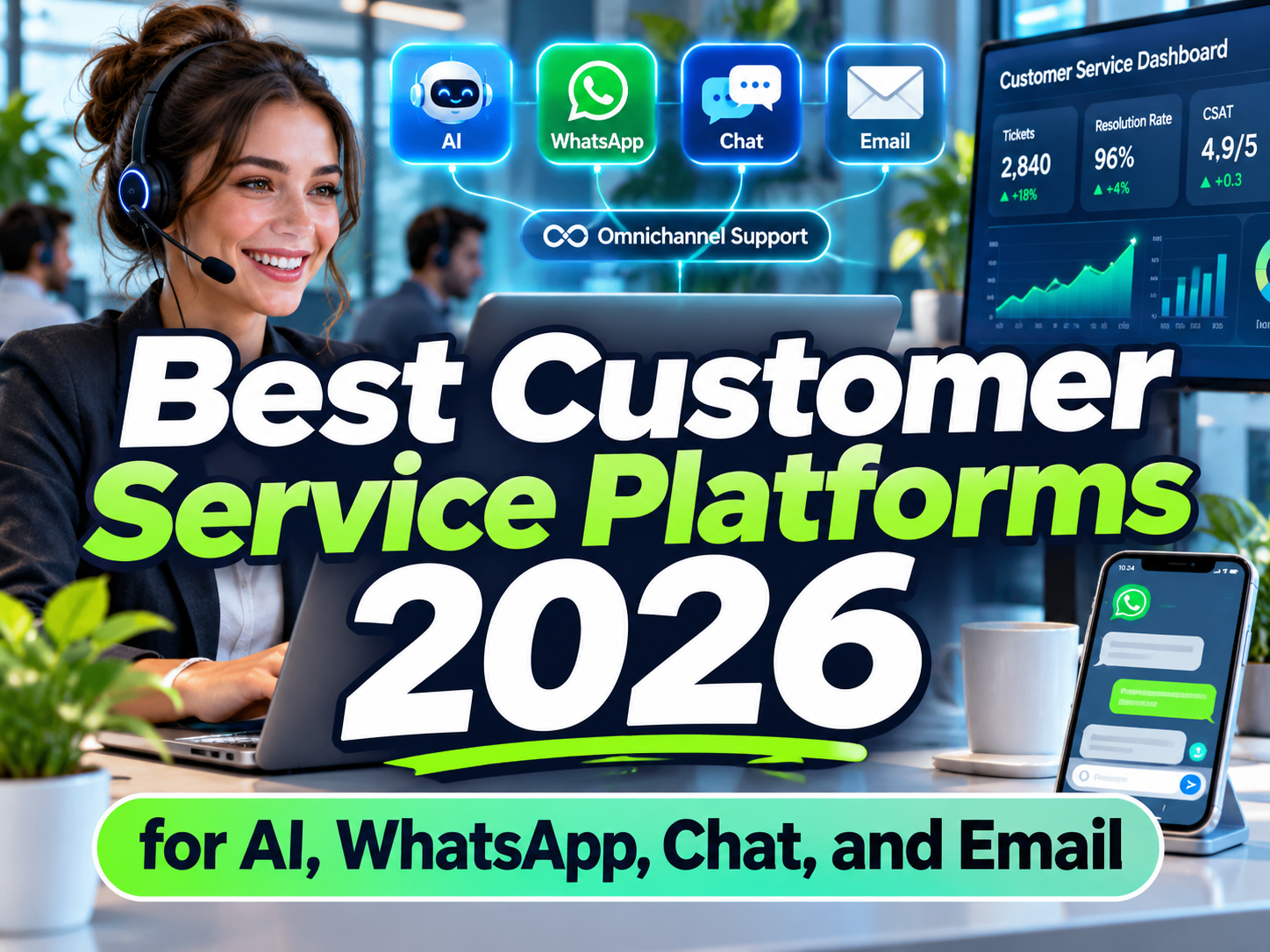
Customer Service Platform 2026: 6 Platforms for Omnichannel Support
Customer service has moved far beyond the traditional ticket inbox.
Customers now expect to contact businesses through WhatsApp, email, website chat, social media, SMS, and sometimes voice without repeating their story every time they switch channels.
At the same time, AI agents are moving from simple FAQ bots toward systems that can understand intent, use company knowledge, perform authorized actions, route conversations, and collaborate with human support teams.
Choosing the right customer service platform 2026 therefore means evaluating more than ticketing.
The strongest platforms connect channels, customer context, automation, knowledge, AI, analytics, and human escalation into one operating environment.
Choose Around Your Support Model
Start with the channels your customers actually use.
A Shopify brand receiving Instagram, WhatsApp, and order-related questions has very different needs from a bank running a large voice contact center. Likewise, a SaaS company may prioritize in-app chat, email, knowledge management, and technical support workflows.
Then evaluate four areas: channel coverage, AI capability, customer context, and human handoff.
AI should make service faster without creating a separate disconnected support experience.
Recommended Customer Service Platforms for 2026
1. Zendesk: Best Overall for Mature Support Operations
Zendesk remains one of the strongest general-purpose customer service platforms for organizations that need structured ticketing combined with increasingly autonomous AI.
The Zendesk AI agents can operate across messaging, email, and voice and can perform authorized actions rather than only answering questions. In 2026, Zendesk expanded its Resolution Platform around omnichannel AI agents, Copilots, knowledge, workflows, data, and governance. WhatsApp and other social messaging channels can also be connected directly to AI agents through Zendesk Messaging.
PROS: Mature ticketing, omnichannel AI, routing, knowledge management, automation, enterprise workflows.
BEST FOR: SaaS, enterprise support teams, marketplaces, complex service organizations.
2. Intercom + Fin: Best for AI-First SaaS Customer Service
Intercom combines its helpdesk with Fin AI Agent in one environment.
The Intercom Helpdesk includes an omnichannel inbox, AI-powered ticketing, workflows, reporting, a help center, knowledge management, and Copilot assistance for human agents. Fin can be deployed across Messenger, email, WhatsApp, SMS, Facebook, and Instagram, making it especially attractive for digital businesses that want AI and human support to share the same context.
Fin can also work with external helpdesks, which gives companies more flexibility if they want its AI capabilities without completely replacing their existing support platform.
PROS: Strong AI agent, in-app support, knowledge grounding, omnichannel inbox, modern SaaS workflow.
BEST FOR: SaaS, software companies, startups, subscription businesses, product-led companies.
3. Freshdesk Omni: Best Value for Growing Omnichannel Teams
Freshdesk Omni brings email, web chat, WhatsApp, Facebook, Instagram, phone, and portal support into one workspace.
Its current platform combines routing, SLA management, ticketing, Freddy AI Agents, AI Copilot capabilities, and AI-driven insights. Businesses can configure AI Agents to handle conversations first on channels such as WhatsApp, Web Chat, Instagram, and Facebook before handing them to human agents when needed.
This combination makes Freshdesk Omni particularly attractive to growing businesses that want broad omnichannel functionality without immediately adopting the complexity of a large contact-center platform.
PROS: Unified inbox, WhatsApp and social support, Freddy AI, ticketing, routing, accessible pricing tiers.
BEST FOR: Growing support teams, SMEs, SaaS, ecommerce, multi-channel service operations.
4. Gorgias: Best for Ecommerce Customer Service
Gorgias is much more specialized than the other platforms because it focuses heavily on ecommerce.
Its AI Agent can support both pre-purchase shopping conversations and post-purchase issues such as returns, cancellations, missing items, and order tracking. It currently operates across email, chat, SMS, Instagram, Facebook Messenger, and WhatsApp and can perform configured actions in connected systems.
In 2026, Gorgias also made its AI Agent on social channels generally available, bringing automated conversations into Instagram DMs, Facebook Messenger, and WhatsApp with same-thread handoff to human teams.
PROS: Ecommerce specialization, order context, shopping assistance, social messaging, automation, AI actions.
BEST FOR: Shopify brands, DTC ecommerce, retail, high-volume online stores.
5. Salesforce Agentforce Service: Best for CRM-Centric Enterprises
Salesforce Agentforce Service is strongest when customer service needs deep access to CRM, sales, account, and operational data.
Agentforce combines AI agents, human service teams, customer data, workflows, messaging, and routing. Salesforce Messaging supports channels such as WhatsApp, Facebook Messenger, SMS, LINE, and other connected messaging experiences, while Enhanced Omni-Channel can route customer requests to queues, human representatives, bots, or Agentforce agents.
For larger contact centers, Agentforce Contact Center connects voice, messaging, WhatsApp voice, AI, and CRM context in one service environment.
PROS: Deep CRM data, enterprise automation, AI agents, sophisticated routing, extensive workflow integration.
BEST FOR: Enterprises, banks, insurance, healthcare organizations, large Salesforce environments.
6. Genesys Cloud CX: Best for Large Contact Centers
Genesys Cloud CX is the strongest option here when voice and digital contact-center operations are equally important.
The platform combines digital channels, voice, omnichannel routing, AI, workforce management, analytics, social engagement, and customer-journey capabilities. Genesys supports connected conversations across chat, email, SMS, messaging apps, social media, and voice.
Its 2026 platform direction increasingly focuses on agentic orchestration, coordinating customer intent across AI, human employees, data, and enterprise systems. WhatsApp capabilities have also expanded to combine messaging, voice, and AI within the same broader Genesys environment.
PROS: Advanced contact-center capabilities, voice, omnichannel routing, workforce management, AI orchestration.
BEST FOR: Large call centers, telecom, travel, banking, BPO, enterprise CX operations.
Comparison: Customer Service Platforms 2026
| Platform | Main Strength | Best For |
|---|---|---|
| Zendesk | Mature omnichannel support | General enterprise support |
| Intercom + Fin | AI-first digital service | SaaS |
| Freshdesk Omni | Accessible omnichannel suite | Growing teams |
| Gorgias | Ecommerce automation | Shopify and DTC |
| Salesforce Agentforce | CRM-connected service | Large enterprises |
| Genesys Cloud CX | Contact center and voice | High-volume CX |
What Makes a Good Customer Service Platform in 2026?
A modern platform should preserve context when customers switch channels.
If someone begins on WhatsApp and later sends an email, the support team should not treat those as completely unrelated interactions. Unified history, routing, customer identity, and CRM context reduce repetition and help both AI and human agents respond more accurately.
Visual consistency also matters across help centers, chat interfaces, educational graphics, onboarding materials, and service campaigns. Businesses can use typography from PutraCetol Studio for branded customer communication and promotional assets while keeping support interfaces optimized for clarity and readability.
Common Mistakes
A common mistake is choosing software based only on the number of channels listed on a pricing page. Real omnichannel service requires shared context, routing, customer identity, reporting, and consistent handoffs. Several disconnected inboxes are still multichannel, not truly omnichannel.
Another mistake is automating support without defining escalation rules. AI works extremely well for repetitive questions and standardized actions, but billing disputes, sensitive account issues, angry customers, medical questions, and complex exceptions may require human judgment. Clear handoff logic should be part of the implementation from the beginning.
Finally, avoid measuring customer service only through ticket closure. Track resolution quality, first-contact resolution, customer satisfaction, response time, repeat contacts, AI containment, and the reasons customers contact support. The strongest service platforms help reduce customer effort, not merely process conversations faster.
Conclusion
The ideal customer service platform 2026 depends on the structure of your customer journey.
Zendesk provides mature all-around support, Intercom and Fin excel in AI-first SaaS environments, Freshdesk Omni offers strong value for growing teams, Gorgias specializes in ecommerce, Salesforce Agentforce connects service deeply with CRM, and Genesys Cloud CX handles complex enterprise contact centers.
The best platform should make every channel feel like part of one conversation.
When customer data, AI, automation, and human expertise work together, service becomes more efficient without becoming less personal.
Explore these fonts and many more at PutraCetol.com to build a business identity that looks professional, trustworthy, and memorable.
Additionally, if you want to explore some free typography options, you can check out Putracetol Studio on Dafont. Happy reading and designing!