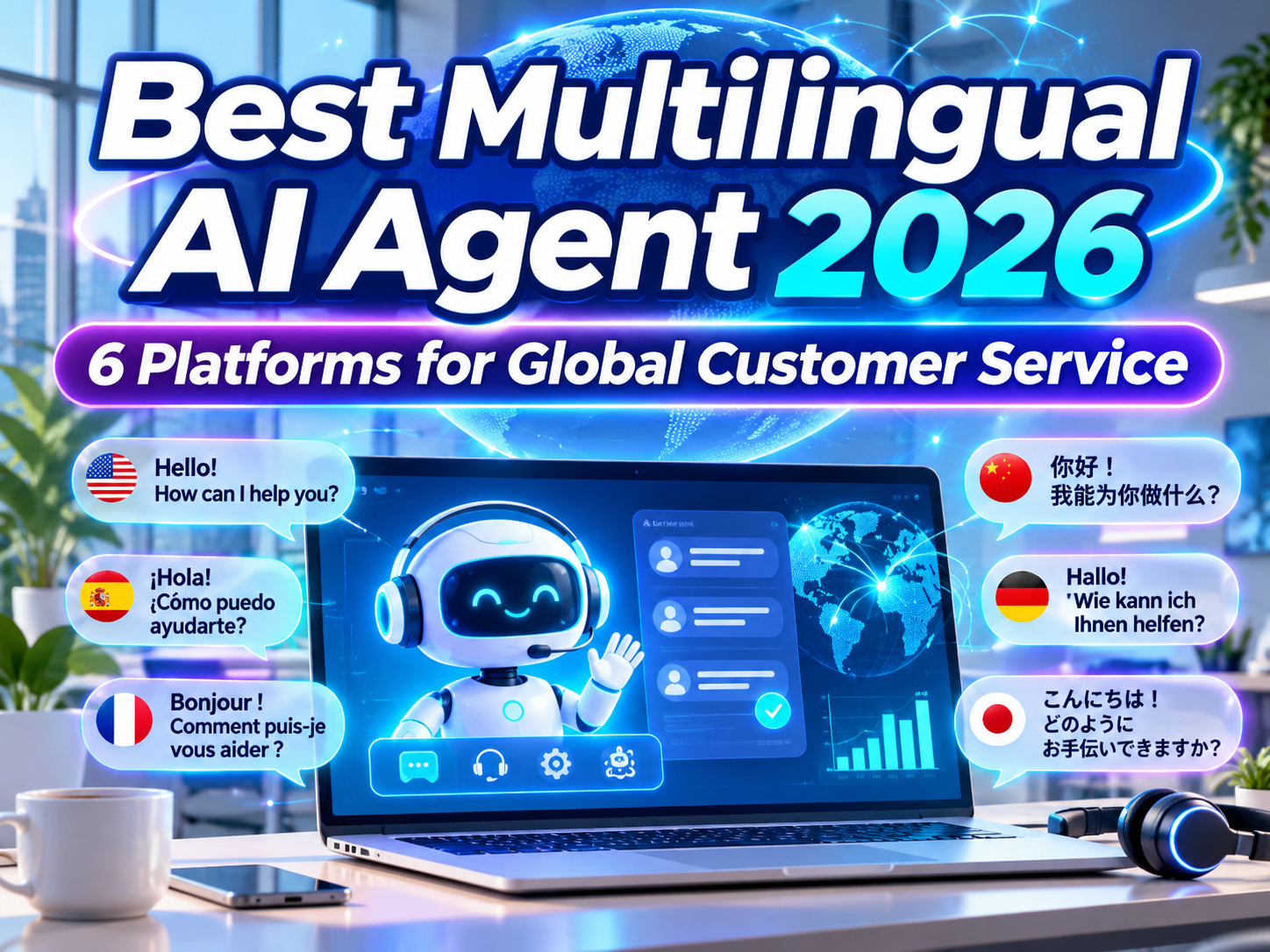
Best Multilingual AI Agent 2026 for Global Customer Service
International customer support used to require separate teams for different languages, regions, and time zones.
AI agents are changing that model.
The best multilingual AI agent 2026 can recognize a customer’s language, understand the intent behind a question, retrieve relevant company knowledge, complete supported actions, and respond naturally without forcing every conversation through a traditional translation workflow.
For ecommerce, SaaS, banking, travel, healthcare, and global service organizations, this can make 24/7 multilingual support significantly more scalable.
However, multilingual capability is more complicated than simply asking an LLM to translate text. Businesses should consider language coverage, regional nuance, knowledge grounding, voice quality, human handoff, channels, integrations, security, and whether language support is generally available or still in beta.
Test Real Conversations, Not Language Lists
Do not choose an AI agent simply because it claims to support the largest number of languages.
Create a multilingual evaluation set using real customer questions. Test product terminology, slang, formal and informal language, mixed-language conversations, refund requests, technical problems, and escalation scenarios.
A customer asking the same question in Indonesian, Japanese, Spanish, and Arabic should receive answers that are not only grammatically correct but also consistent with company policy.
For regulated industries such as healthcare and financial services, have qualified speakers review important languages before allowing autonomous responses to sensitive requests.
Recommended Multilingual AI Agents for 2026
1. Intercom Fin: Best Overall for Digital Customer Support
Intercom Fin offers one of the strongest combinations of multilingual support and customer-service workflow integration.
Fin automatically detects supported customer languages and can answer using knowledge available in that language. Its real-time translation feature can also use content from a configured fallback language when localized content is unavailable, allowing businesses to support additional markets without maintaining a complete duplicate knowledge base for every language. Intercom currently lists support across dozens of languages, including Indonesian, Japanese, Korean, Arabic, Hindi, Chinese, Spanish, French, German, Thai, and Vietnamese.
Fin can operate across Messenger, email, WhatsApp, SMS, Facebook, and Instagram. Human support teams can separately use AI Inbox Translation to communicate across language barriers.
PROS: Automatic detection, real-time translation, strong knowledge grounding, broad digital channels.
BEST FOR: SaaS, ecommerce, digital businesses, international customer-support teams.
2. Zendesk AI Agents: Best for Existing Support Operations
Zendesk is particularly attractive when customer service already runs through the Zendesk ecosystem.
Its AI agents support a broad set of languages for generative responses and agentic AI, including major European and Asian languages as well as Indonesian, Arabic, Hindi, Korean, Japanese, Thai, Vietnamese, Swahili, and many others. Zendesk also supports automatic translation for a subset of languages.
That means multilingual automation can become part of the same environment used for tickets, human agents, workflows, and customer-service reporting.
PROS: Extensive language coverage, translation, established support ecosystem, agentic workflows.
BEST FOR: Customer-service organizations, help desks, ecommerce, SaaS, existing Zendesk customers.
3. Ada: Best for Native Multilingual Digital Conversations
Ada places multilingual functionality near the center of its AI-agent architecture.
Its current documentation lists 60 supported languages across messaging and email. The Reasoning Engine generates responses directly in supported languages rather than relying entirely on a separate translation layer, and the platform can automatically detect language and allow customers to switch languages during conversations.
Ada can ingest multilingual knowledge, use matching localized content where available, and fall back to English knowledge when necessary while generating the final response in the customer’s language. Voice is available for a subset of those languages.
PROS: 60 languages, native response generation, multilingual knowledge, language switching.
BEST FOR: Global digital support, ecommerce, SaaS, brands requiring localized customer experiences.
4. Salesforce Agentforce: Best for CRM-Driven Enterprise Service
Agentforce is a strong choice for organizations where customer context already lives inside Salesforce.
Salesforce’s 2026 language support covers a large range of languages and regional variants, although some are explicitly marked beta and therefore require additional testing. Supported generally available languages include Indonesian, Japanese, Korean, Hindi, Chinese, German, Spanish, French, Portuguese, Thai, Vietnamese, and others.
Agentforce uses settings for end-user language, default language, and allowed languages. Salesforce also expanded Agentforce Voice language support in 2026, with numerous additional spoken languages available in beta.
PROS: Deep CRM context, broad language support, enterprise workflows, expanding multilingual voice.
BEST FOR: Large enterprises, Salesforce customers, financial services, complex CRM-driven support.
5. NiCE Cognigy: Best for Multilingual Voice and Contact Centers
NiCE Cognigy stands out when multilingual customer service includes substantial phone traffic.
Its AI agents support 100+ languages, and its Voice AI platform combines multilingual speech with real-time translation, enterprise integrations, human handoff, and contact-center infrastructure. Cognigy also reports support for more than 25,000 concurrent AI-agent interactions and over 110 prebuilt integrations.
Its Voice Gateway supports built-in machine translation across more than 100 languages and integrates with existing telephony and contact-center systems.
PROS: 100+ languages, advanced voice AI, real-time translation, enterprise contact-center integration.
BEST FOR: Airlines, telecom, BPO, banks, travel, large contact centers.
6. Decagon: Best for Modern Conversational Voice Experiences
Decagon is another strong option for organizations building multilingual customer experiences across digital and voice channels.
The Decagon Voice supports 70+ languages with automatic language detection and switching. Its conversational system is designed to handle interruption, changing topics, and natural dialogue while maintaining brand-specific terminology and tone.
For human customer-service teams, Decagon also provides live translation, while its email and chat products integrate with support systems including Zendesk, Salesforce, and Intercom.
PROS: 70+ voice languages, automatic detection, natural conversation, cross-channel support.
BEST FOR: Consumer brands, fintech, subscription businesses, high-volume customer service.
Comparison: Best Multilingual AI Agents 2026
| Platform | Main Strength | Best For |
|---|---|---|
| Intercom Fin | Digital multilingual support | SaaS and ecommerce |
| Zendesk AI Agents | Support operations | Existing help desks |
| Ada | Native multilingual responses | Global digital brands |
| Salesforce Agentforce | CRM-connected AI | Enterprise service |
| NiCE Cognigy | Multilingual voice | Contact centers |
| Decagon | Natural voice + digital CX | High-volume support |
For primarily digital support, Intercom Fin and Ada are particularly strong. Zendesk fits established service operations, Salesforce is compelling when CRM context is critical, while Cognigy has a major advantage for multilingual contact centers and voice-heavy environments.
Build a Consistent Global Customer Experience
Language is only one component of localization.
Customers should also receive consistent terminology, brand tone, escalation rules, privacy treatment, and service quality regardless of their language.
That consistency extends into visual communication. Businesses expanding internationally can use professional typography from PutraCetol Studio for campaign graphics, customer education materials, social content, presentations, and global brand assets while ensuring that interface fonts properly support every required writing system.
Common Mistakes
A common mistake is assuming machine translation and multilingual AI are identical. Translation may convert one response into another language, while a stronger multilingual system must also understand intent, retrieve the correct knowledge, preserve business terminology, execute actions, and recognize when human escalation is required.
Another mistake is enabling dozens of languages without quality testing. Language capabilities can differ by channel, and some providers mark particular languages or voice features as beta. Build test conversations for every strategically important market and continuously review accuracy, tone, policy compliance, and escalation quality.
Finally, avoid automating high-risk conversations without appropriate controls. Medical, financial, legal, identity-verification, or account-security interactions can require additional safeguards and human review. Global scale should never come at the expense of accuracy or customer trust.
Conclusion
The best multilingual AI agent 2026 depends on how customers actually contact your business.
Intercom Fin offers excellent digital support, Zendesk connects multilingual AI with established service operations, Ada provides strong native multilingual experiences, Salesforce Agentforce integrates deeply with enterprise CRM, Cognigy leads strongly in multilingual contact-center and voice use cases, and Decagon provides modern conversational automation across voice and digital channels.
The goal is not merely to translate customer service.
It is to make customers in every market feel that the support experience was designed for them from the beginning.
Explore these fonts and many more at PutraCetol.com to build a business identity that looks professional, trustworthy, and memorable.
Additionally, if you want to explore some free typography options, you can check out Putracetol Studio on Dafont. Happy reading and designing!