
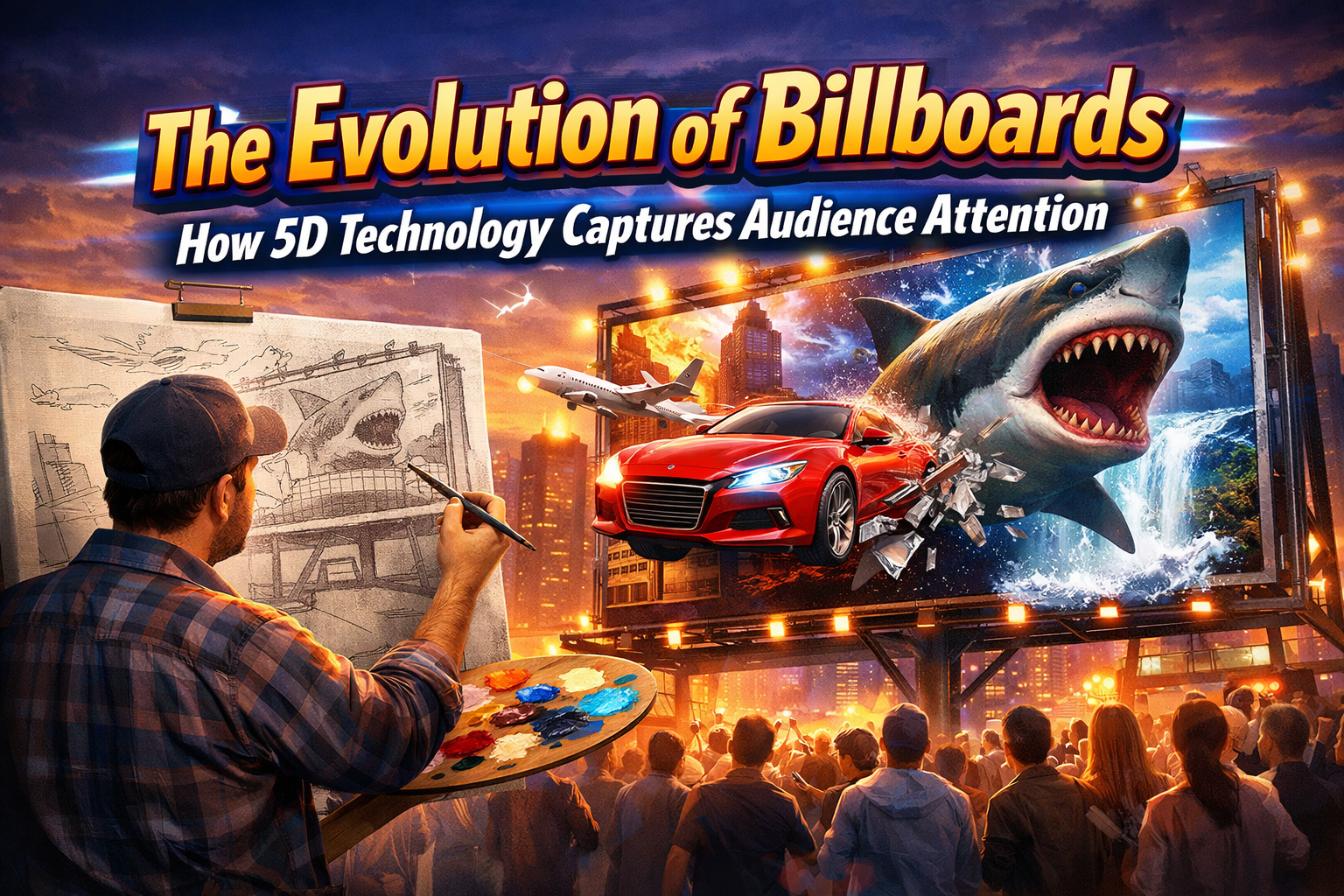
5D Billboards and How They Create Immersive Visual Experiences
Introduction: The Evolution of Outdoor Advertising
Outdoor advertising has undergone a remarkable transformation over the past decade. Traditional billboards once relied on static visuals and simple messaging to attract attention. While these methods were effective in their time, modern audiences have become more visually sophisticated and harder to impress.
Digital technology has reshaped the advertising landscape, introducing new formats that combine motion, interactivity, and immersive storytelling. One of the most exciting developments is the emergence of 5D billboard technology.
5D billboards go beyond standard digital displays. They use advanced visual effects, sensor-driven interactions, and multi-dimensional animation to create experiences that feel almost tangible. These installations blur the line between advertising and entertainment, transforming public spaces into dynamic storytelling environments.
This article explores what 5D billboards are, how they work, why brands are adopting them, and the challenges involved in implementing this innovative technology.
What Is a 5D Billboard?
A 5D billboard is a next-generation digital advertising medium that combines advanced visual technology with immersive design principles.
Unlike traditional billboards, which present static or basic digital content, 5D billboards incorporate:
- three-dimensional illusions
- dynamic motion effects
- interactive elements
- real-time environmental adjustments
The term “5D” refers to the integration of multiple sensory and visual dimensions. While not literally adding new physical dimensions, these billboards simulate depth, movement, and responsiveness to create highly realistic experiences.
For viewers, the effect can feel almost cinematic. Objects appear to move beyond the screen’s boundaries, creating a sense of physical presence that captures attention instantly.
How 5D Billboard Technology Works
Behind the visual spectacle lies a sophisticated combination of hardware and software technologies.
High-Resolution LED Displays
Modern 5D billboards rely on ultra-high-resolution LED panels capable of producing vibrant colors and seamless motion.
Curved or corner-mounted screens are often used to enhance perspective illusions, making visuals appear three-dimensional even from a distance.
Advanced 3D and AR Animation
Creative teams use specialized software to design animations that simulate depth and perspective.
Techniques include:
- forced perspective rendering
- realistic lighting simulations
- dynamic camera movement
These elements work together to create illusions that appear to extend beyond the screen.
Sensors and Interactive Systems
Many 5D billboards incorporate motion sensors, light sensors, or camera-based tracking.
These technologies enable:
- content adjustments based on viewer position
- interactive responses to audience movement
- adaptive brightness depending on environmental conditions
This interactivity transforms passive viewing into active engagement.
Why 5D Billboards Capture Attention More Effectively
High Visual Attraction
Human attention is naturally drawn to movement and novelty. The immersive depth effects of 5D billboards stand out dramatically compared to traditional advertising.
Large-scale examples often become viral social media content, extending reach beyond physical locations.
Interactive Engagement
Interactivity increases emotional connection. When audiences feel involved in an experience, they are more likely to remember the brand message.
Premium Brand Positioning
Using advanced advertising technology signals innovation and modernity. Brands deploying 5D billboards often position themselves as forward-thinking leaders.
Typography and visual design play an essential role in achieving this premium perception. Display fonts like Mogzilla Bold can emphasize dynamic headlines, while stylish serif fonts such as Gilded Winter Serif Display reinforce luxury branding aesthetics. Modern styles like Antiquera support clarity in motion-based layouts.
Real-World Applications of 5D Billboards
5D billboard installations are increasingly visible in high-traffic urban environments.
City Centers
Major metropolitan areas use immersive billboards to attract attention in crowded advertising spaces.
Shopping Malls
Retail brands leverage 5D visuals to create memorable shopping experiences and drive foot traffic.
Events and Exhibitions
Trade shows and product launches benefit from immersive displays that showcase products in visually compelling ways.
Industries that commonly use 5D billboards include:
- fashion brands promoting new collections
- automotive companies showcasing vehicle features
- technology brands highlighting innovation
- entertainment companies promoting films or games
Strategic Advantages for Brands
Enhanced Storytelling
5D visuals allow brands to tell stories through motion and perspective rather than static imagery.
Increased Social Media Exposure
Eye-catching installations often attract crowds and generate organic social sharing.
Stronger Brand Recall
Immersive experiences create memorable moments that improve brand recall.
Implementation Challenges
Despite their advantages, 5D billboards present several challenges.
High Production and Installation Costs
Designing immersive animations and installing large LED structures requires significant investment.
Location Dependence
The effectiveness of a 5D billboard depends heavily on placement.
High-traffic areas with optimal viewing angles are essential for achieving maximum impact.
Creative Complexity
Content must be specifically designed for immersive environments. Simply adapting traditional ads may not produce the desired effect.
Creative teams must understand both technical constraints and storytelling principles.
Design Principles Behind Successful 5D Billboard Campaigns
Successful campaigns combine technology with strong visual design fundamentals.
Key considerations include:
- clear visual hierarchy
- minimal text for readability
- strong contrast and motion direction
- strategic use of typography
Fonts such as Retro Cloud can add playful character for creative campaigns, while structured styles like Antiquera ensure clarity in complex motion scenes.
Quick Summary Table
| Aspect | Advantage | Challenge |
|---|---|---|
| Visual | Immersive and eye-catching | Requires creative content |
| Interactive | Engages audiences | Complex technology |
| Branding | Premium positioning | High cost |
| Location | Effective in busy areas | Limited placement options |
The Future of Outdoor Advertising
As digital technology continues to evolve, outdoor advertising will likely become even more immersive.
Future developments may include:
- AI-driven adaptive content
- real-time personalization based on audience data
- integration with augmented reality experiences via smartphones
5D billboards represent an early stage in a broader shift toward experiential advertising.
Conclusion
5D billboards represent a major leap forward in outdoor advertising, transforming static displays into immersive visual experiences that capture attention and enhance brand storytelling.
By combining advanced LED technology, interactive sensors, and creative animation, these billboards offer brands a powerful way to stand out in crowded environments.
While implementation requires significant investment and strategic planning, the potential rewards include stronger engagement, enhanced brand perception, and memorable audience experiences.
For more insights into branding, typography, and digital design strategies, visit Putracetol.com and explore creative resources that support innovative visual communication.
Thank you for taking the time to read this article. If you are looking for more great articles, feel free to visit Putracetol Blog
Additionally, if you want to explore some free typography options, you can check out Putracetol Studio on Dafont. Happy reading and designing!