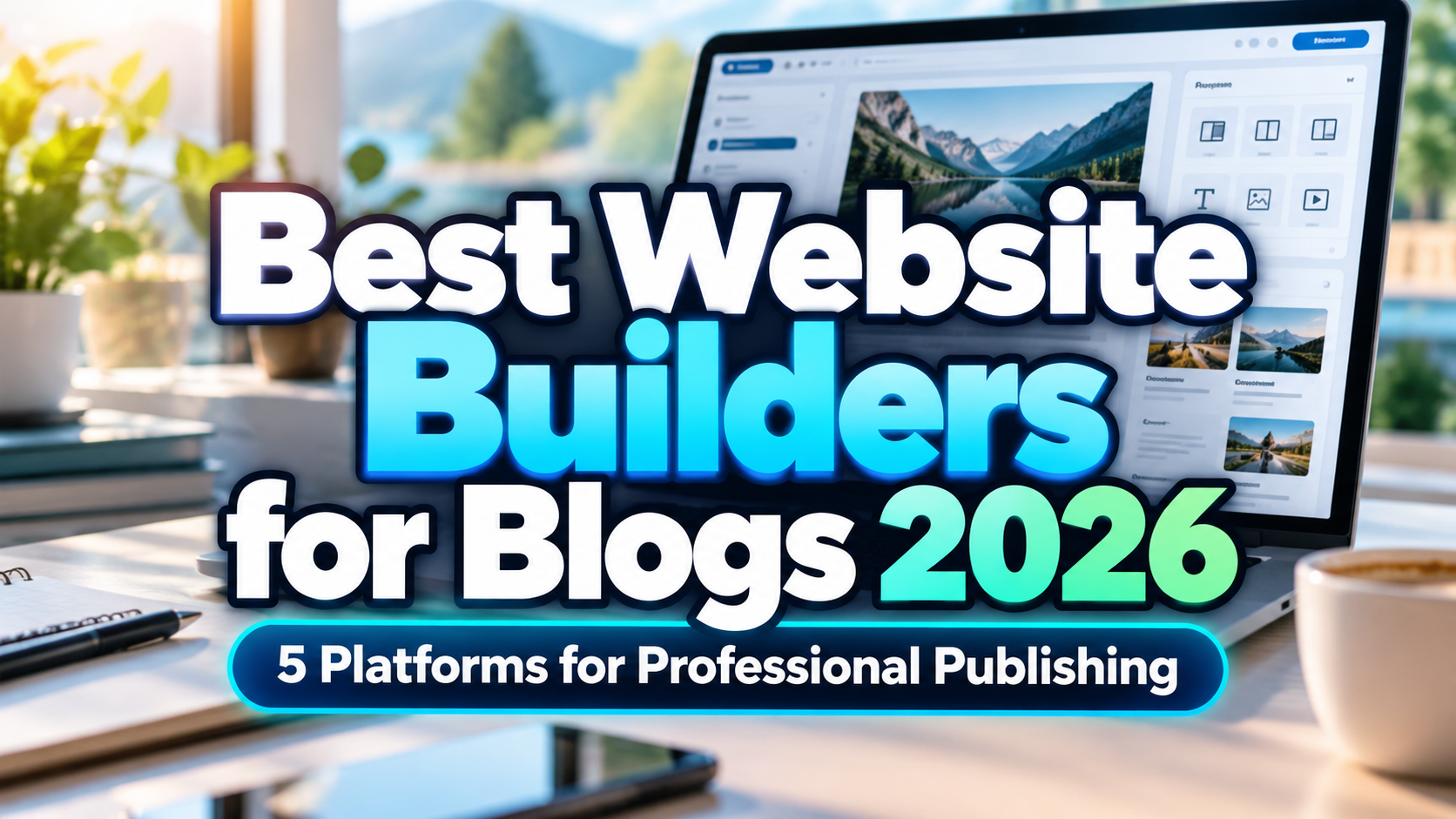
Best Website Builders for Blogs 2026: 5 Platforms for Professional Publishing
Building a professional blog no longer requires manually coding pages or configuring a complicated server.
Modern website builders combine hosting, visual design, content management, analytics, SEO tools, newsletters, memberships, and increasingly AI-assisted workflows into platforms that can be managed by individuals or small teams.
However, the best website builders for blogs 2026 are not interchangeable.
A lifestyle blogger may prioritize visual templates and simplicity. A publication needs an efficient editorial workflow. A business may want SEO, landing pages, analytics, and integrations. A creator building recurring revenue might care more about email newsletters and paid memberships.
The right platform is therefore the one that supports both how you publish today and how you expect the blog to grow.
Initial Suggestion: Decide What Your Blog Needs to Become
Before choosing a website builder, look beyond your first ten articles.
Ask whether the blog will eventually include hundreds of posts, multiple authors, newsletters, paid subscriptions, digital products, landing pages, or custom integrations.
Moving a mature publication between platforms can be significantly harder than switching when only a few posts exist.
Also evaluate content ownership and portability. Your blog is a long-term digital asset, so exporting articles, managing URLs, controlling metadata, and using a custom domain should matter just as much as the visual template.
Recommended Website Builders for Blogs in 2026
1. WordPress.com: Best Overall for Long-Term Blogging
WordPress.com remains one of the strongest all-around choices because publishing is at the center of the platform rather than being an optional feature.
Even its free offering includes unlimited pages and posts, built-in newsletters and RSS, social sharing, responsive themes, revisions, subscriber tools, and basic statistics. In a major 2026 change, WordPress.com also made plugin installation available across all current paid plans, starting with Personal, dramatically increasing the flexibility available to smaller publishers. WordPress.com
Writers can schedule articles, manage featured images and multimedia, invite multiple contributors, and expand the site with SEO, membership, ecommerce, analytics, or publishing plugins as requirements evolve. WordPress.com
PROS: Mature blogging system, huge plugin ecosystem, newsletters, scalability, extensive customization.
BEST FOR: Serious bloggers, business blogs, publications, SEO-driven sites, long-term content projects.
2. Wix: Best for Beginners and All-in-One Simplicity
Wix is particularly attractive to people who want to build the visual website and blog without learning a traditional CMS.
The Wix Blog includes layouts, categories, tags, comments, scheduling, multiple writers, mobile management, community features, and monetization options. Its SEO controls allow publishers to customize titles, descriptions, URLs, canonical settings, and other search information for individual posts or across the blog. Wix Support
This creates a convenient environment for small businesses that need a company website, service pages, contact forms, and regular articles within the same interface.
PROS: Beginner-friendly builder, attractive layouts, integrated SEO, community and monetization options.
BEST FOR: Beginners, freelancers, service businesses, personal brands, small business blogs.
3. Squarespace: Best for Visual and Lifestyle Blogs
Squarespace is a strong choice when presentation carries nearly as much importance as the writing.
Its blogging system supports categories, tags, multiple blog pages, drafts, scheduled publishing, author profiles, RSS, comments, social sharing, and reusable layouts. Publishers can also place blog content behind signup or paid-access requirements. Squarespace Support
This makes Squarespace particularly suitable for photography, architecture, fashion, food, travel, interior design, and other categories where large imagery and polished layouts are central to the reading experience.
PROS: Refined visual design, integrated blogging, straightforward editing, membership options.
BEST FOR: Lifestyle bloggers, photographers, designers, portfolios, premium personal brands.
4. Ghost: Best for Newsletters and Paid Publishing
Ghost takes a publishing-first approach that is especially compelling for writers building a direct relationship with readers.
It combines a website, visual editor, email newsletters, member management, and paid subscriptions in one open-source publishing platform. Publishers can create multiple newsletters, segment audiences, offer member-only content, and generate recurring subscription revenue without assembling a large collection of separate plugins. ghost.org
Ghost has continued expanding these capabilities in 2026 with automated email sequences for new members, publisher gift links, member filtering, and tools aimed at improving visibility in AI-powered search. ghost.org
PROS: Excellent writing experience, built-in newsletters, memberships, paid subscriptions, publishing focus.
BEST FOR: Independent writers, newsletters, membership publications, niche media businesses.
5. Webflow: Best for Maximum Visual Design Control
Webflow occupies a different position from conventional beginner website builders.
Its visual canvas gives designers extensive control over layout while the CMS manages dynamic content such as blog posts, authors, categories, case studies, and related content. Editors can manage content visually, control metadata and alt text, use structured Collections, and collaborate through publishing workflows. Webflow
In 2026, Webflow completed the rollout of its next-generation CMS architecture to all customers, expanding nested content capabilities and improving the flexibility of structured content for SEO and AI-driven discovery. Webflow
The trade-off is a steeper learning curve compared with Wix or Squarespace.
PROS: Exceptional design freedom, powerful CMS, structured content, strong brand control.
BEST FOR: Designers, agencies, ambitious branded blogs, content-led company websites.
Comparison: Best Blog Website Builders 2026
| Platform | Strongest Advantage | Best For |
|---|---|---|
| WordPress.com | Flexibility and publishing depth | Long-term blogs |
| Wix | Ease of use | Beginners and SMBs |
| Squarespace | Visual presentation | Lifestyle and creative blogs |
| Ghost | Newsletters and memberships | Independent publishers |
| Webflow | Design and CMS control | Agencies and premium brands |
For most serious long-term publishers, WordPress.com offers the broadest growth path. Wix is easier for beginners, Squarespace emphasizes aesthetics, Ghost excels at reader-supported publishing, and Webflow provides greater control to design-focused teams.
Build the Blog Around a Recognizable Brand
A good CMS makes publishing easier, but the platform alone does not create a memorable publication.
Establish consistent typography, photography, colors, article covers, category graphics, and social-media assets. The same visual system should connect the website with newsletters and promotional channels.
Bloggers and businesses can explore PutraCetol Studio for distinctive fonts used in article covers, hero sections, campaign graphics, visual branding, and promotional materials. For long article text, prioritize readability and reserve more expressive typography for titles and brand-facing elements.
Common Mistakes
A common mistake is choosing a website builder based entirely on the homepage template. Templates can change, while CMS structure, URL management, publishing workflow, integrations, and export capabilities become much more important once a blog contains hundreds of articles. Evaluate the system behind the design rather than the demo alone.
Another mistake is installing too many features before publishing consistently. Analytics tools, popups, AI assistants, complicated automation, membership systems, and dozens of integrations cannot compensate for weak content. Start with reliable publishing, categories, SEO fundamentals, an email signup, and a clear visual identity, then expand when actual requirements appear.
Finally, avoid ignoring website performance and mobile reading. Large images, excessive animation, custom scripts, and unnecessary widgets can make an attractive blog frustrating to use. Test real articles on mobile devices and keep navigation, typography, and page speed central to the design.
Conclusion
The best website builders for blogs 2026 serve different publishing strategies.
WordPress.com provides outstanding long-term flexibility, Wix makes website building approachable, Squarespace excels at polished visual storytelling, Ghost combines publishing with newsletters and memberships, and Webflow gives designers exceptional control over content-driven websites.
Choose according to where the blog needs to be several years from now, not simply which builder lets you publish the first article fastest.
With the right CMS, consistent content, strong SEO foundations, and recognizable visual branding, a blog can grow from a simple publishing channel into a valuable long-term digital asset.
Explore these fonts and many more at PutraCetol.com to build a business identity that looks professional, trustworthy, and memorable.
Additionally, if you want to explore some free typography options, you can check out Putracetol Studio on Dafont. Happy reading and designing!