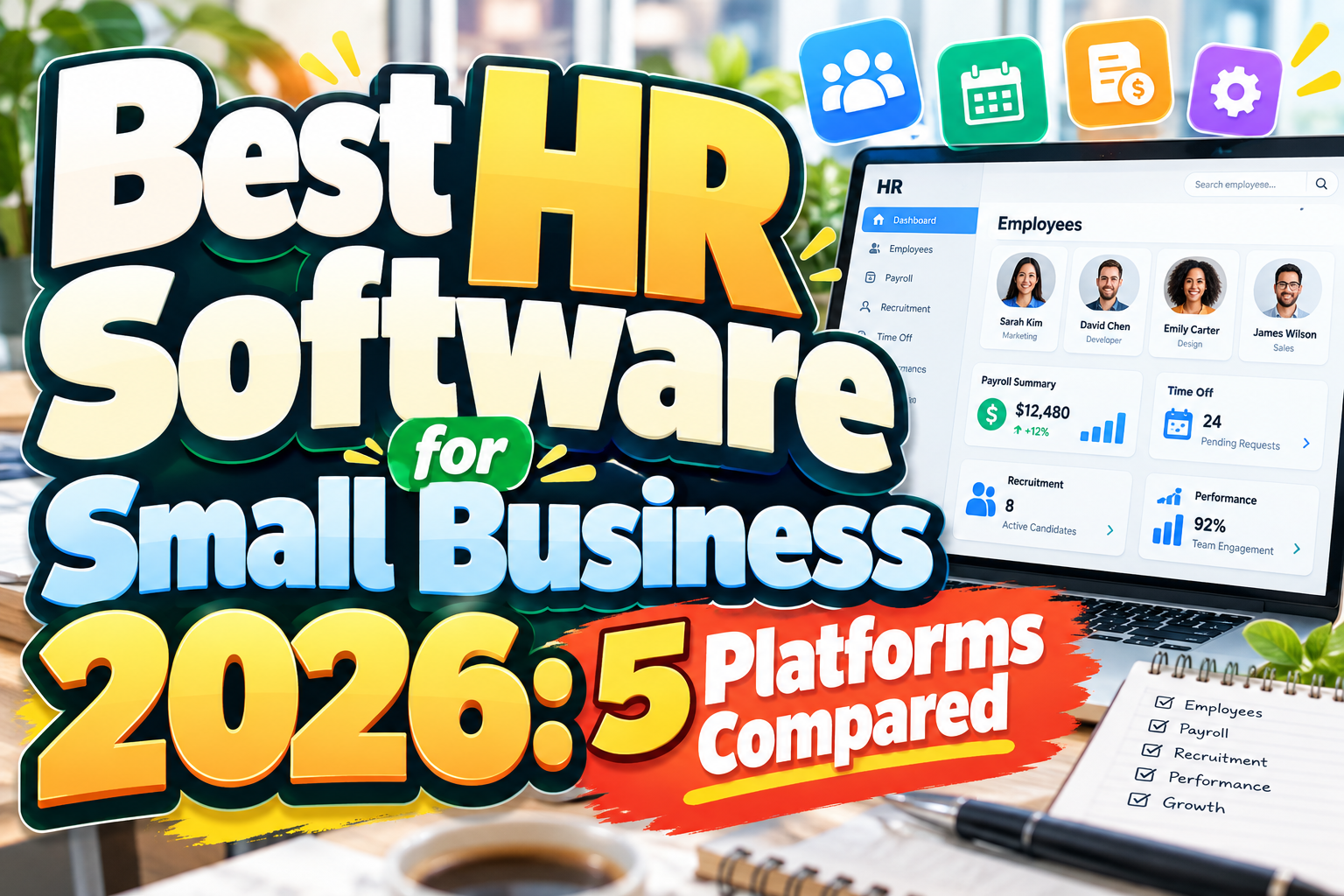
Best HR Software for Small Business 2026: 5 Platforms for Growing Teams
Small businesses rarely begin with a dedicated HR department.
The founder may handle hiring, a bookkeeper manages payroll, and team leaders approve time off through spreadsheets or messaging apps. That system can work with five employees, but it becomes increasingly difficult as the company grows.
The best HR software for small business 2026 brings employee information, payroll, attendance, hiring, onboarding, documents, and compliance workflows into a more organized system.
The objective is not simply automation. Good HR software should reduce duplicated work while making important employee information easier to find, update, and protect.
For small businesses, affordability and ease of implementation are just as important as the number of features available.
Initial Suggestion: Solve Your Biggest HR Problem First
Before comparing platforms, identify where your team currently loses the most time.
An hourly restaurant may struggle with schedules, missed clock-ins, overtime, and payroll. A 25-person professional-services company might need centralized employee records, onboarding, PTO, and performance management. A remote startup could have a completely different problem: hiring and paying workers across several countries.
Build a shortlist around those priorities.
Also calculate the real cost, not only the advertised subscription. Payroll, time tracking, recruiting, benefits administration, compliance support, and additional locations may be separate modules depending on the platform.
Recommended HR Software for Small Business 2026
1. Gusto: Best Overall for Payroll-Focused Small Businesses
Gusto remains one of the most straightforward options for U.S. small businesses that want payroll at the center of their HR system.
The platform combines payroll, automated tax filing, employee and contractor payments, benefits, hiring, onboarding, PTO, and time tracking. Gusto also supports applicant tracking and offer letters, making it practical for businesses that want to manage the transition from candidate to employee without introducing several disconnected products. Gusto
Its current Simple plan starts at $49 per month plus $6 per person, while higher tiers add features such as multi-state payroll, time tracking, scheduling, HR guidance, and more advanced support. Gusto
BEST FOR: Small U.S. businesses, startups, accounting firms, payroll-first HR operations.
2. BambooHR: Best for Building a Complete HR System
BambooHR is better suited to businesses that want a broader HRIS rather than primarily a payroll product.
Its platform covers employee records, reporting, applicant tracking, onboarding, payroll, benefits administration, time and attendance, performance management, compensation, compliance, and employee experience. BambooHR has also expanded its AI capabilities for reporting, recommendations, and routine HR workflows. BambooHR
For companies with 25 employees or fewer, BambooHR says pricing uses a monthly flat-rate structure, while larger organizations move to per-employee pricing. BambooHR
In 2026, BambooHR also expanded Time & Attendance with integrated shift scheduling, making it more relevant for growing teams with hourly employees. BambooHR
BEST FOR: Growing SMBs, dedicated HR teams, companies needing onboarding and performance management.
3. Homebase: Best for Hourly and Shift-Based Businesses
Homebase is particularly strong for restaurants, retail stores, cafés, salons, hospitality businesses, and other teams where scheduling and time tracking matter every day.
Its platform connects employee scheduling, time clocks, timesheets, hiring, onboarding, messaging, PTO, HR compliance, and payroll. Hours can flow directly from the time clock into payroll, including overtime, tips, and time-off information. Homebase
Homebase also has one of the more accessible entry points. Its Basic plan is currently free for one location with up to 10 employees, while paid plans use per-location pricing. Payroll can be added separately. Homebase
BEST FOR: Restaurants, retail, hospitality, service businesses, hourly teams.
4. Zoho People: Best for Customizable HR at a Flexible Scale
Zoho People is attractive to small businesses that want structured HR workflows without necessarily adopting a payroll-first platform.
It includes employee management, onboarding, attendance, leave, timesheets, performance management, learning, HR help desk capabilities, document workflows, and reporting. Zoho also integrates People with other Zoho applications and third-party systems. Zoho
The platform continues to receive frequent updates in 2026, including expanded shift scheduling, attendance-based leave accrual, regional leave rules, compensation schedules, and HR service automation. Zoho
Because Zoho uses flexible per-user plans and provides a 30-day trial, it can be attractive for smaller companies that want to scale modules gradually. Zoho
BEST FOR: Budget-conscious SMBs, existing Zoho users, customizable HR processes.
5. Deel: Best for Small Businesses Hiring Internationally
Deel solves a different small-business problem: global employment.
Startups and remote companies can use Deel to hire, onboard, manage, and pay employees or contractors across more than 150 countries while handling country-specific compliance requirements. Its HR platform also includes workflows, employee records, time off, documents, analytics, payroll, and compliance monitoring. Deel
For a company hiring locally in one country, Deel may offer more international infrastructure than necessary. But for a startup hiring its first engineer overseas or building a distributed team, those capabilities can remove substantial administrative complexity.
BEST FOR: Remote startups, international hiring, global contractors, cross-border payroll.
Comparison: Best Small Business HR Software 2026
| Software | Strongest Advantage | Best Fit |
|---|---|---|
| Gusto | Payroll + HR simplicity | U.S. small businesses |
| BambooHR | Complete HR lifecycle | Growing SMBs |
| Homebase | Scheduling + hourly payroll | Retail and hospitality |
| Zoho People | Flexible HR workflows | Budget-conscious teams |
| Deel | Global hiring and payroll | International startups |
There is no single winner for every small business. A ten-person café and a 30-person remote software startup have fundamentally different HR requirements.
What Features Should Small Businesses Prioritize?
Start with employee records, onboarding, PTO, payroll integration, time tracking, document management, and employee self-service.
If you hire frequently, add applicant tracking and recruiting. If you manage hourly employees, scheduling and overtime controls become more important. For international teams, worker classification, local contracts, tax requirements, currencies, and country-specific compliance should move much higher on the checklist.
Also evaluate accounting integrations. Payroll and HR data should connect cleanly with the systems your finance team already uses.
Good HR software should reduce administrative work without forcing a small company to adopt enterprise-level complexity.
Brand experience matters too. Companies developing employee handbooks, recruitment pages, onboarding documents, presentations, and employer-branding materials can use professional typography from PutraCetol Studio to create a more consistent visual identity around the employee experience.
Common Mistakes
One common mistake is buying the platform with the largest feature list. Small businesses frequently pay for performance management, advanced analytics, workforce planning, and automation modules they rarely use. Start with the processes causing real administrative friction and choose a system that can expand later.
Another mistake is underestimating payroll and compliance differences. A platform that works perfectly for a single-state U.S. company may not be appropriate for a team hiring contractors in Indonesia, designers in Europe, and employees across multiple U.S. states. Always confirm geographic coverage, tax support, employment rules, and integrations before migrating employee data.
Finally, do not ignore implementation. Even easy software requires clean employee records, properly configured PTO policies, permission levels, payroll information, and onboarding workflows. Automating inaccurate data simply creates faster mistakes.
Conclusion
The best HR software for small business 2026 depends on how your team actually works.
Gusto is excellent for payroll-first U.S. businesses, BambooHR offers a more complete HRIS, Homebase stands out for hourly teams, Zoho People provides flexible HR administration, and Deel is particularly valuable for international hiring.
Choose the simplest system that solves today’s problems while leaving enough room for tomorrow’s growth.
The right HR platform should make hiring, paying, organizing, and supporting employees easier, allowing a small business to spend less time administering its team and more time developing it.
Explore these fonts and many more at PutraCetol.com to build a business identity that looks professional, trustworthy, and memorable.
Additionally, if you want to explore some free typography options, you can check out Putracetol Studio on Dafont. Happy reading and designing!