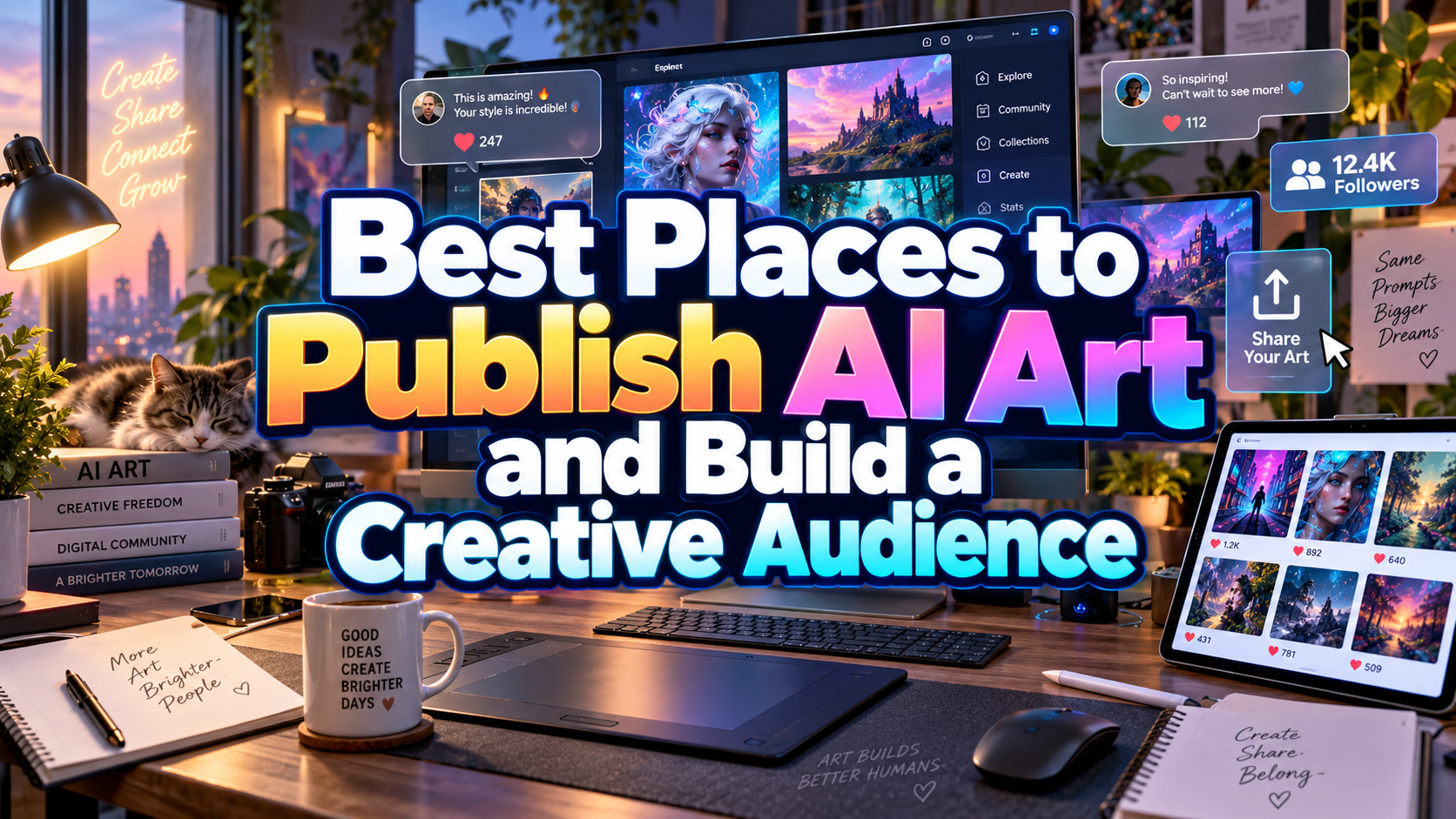
Where to Share AI Art in 2026: Find the Right Audience
Choose a Purpose Before a Platform
Start with the outcome you want: professional inquiries, creative feedback, public discovery, or a regular practice community. Choose one portfolio destination and one supporting channel instead of publishing everywhere.
For example, an agency could present an AI-assisted campaign as a detailed case study, then share selected visuals and process clips elsewhere. A student might prioritize discussion and challenges before building a client-facing portfolio.
Treat the following options as different publishing environments, not a universal ranking.
Five Platforms for Sharing AI Art
1. Behance: Project Presentations
Behance hosts generative-AI projects within its wider creative portfolio network.
Use it to explain the brief, visual development, selected results, and final applications. Identify which elements were generated and what you contributed through photography, editing, composition, or typography.
Present a coherent project rather than a folder of unrelated outputs. Label fictional campaigns as personal concepts instead of implying that a recognizable brand commissioned the work.
2. DeviantArt: Labeled Artwork and Community Feedback
DeviantArt supports AI-created submissions and provides a “Created using AI tools” label. Its guidance applies the label to work made entirely or primarily from AI-generated components and recommends describing AI involvement.
Organize related pieces into a series and ask specific questions about composition or storytelling. Respect audience preferences: DeviantArt also lets viewers suppress AI content.
3. Instagram: Visual Storytelling and Process
Consider Instagram for introducing a recurring visual series through selected images, carousels, and short process videos.
Meta labels AI-generated content using detected technical signals and creator disclosures. Its published approach distinguishes generated imagery from content that was only edited with AI.
Explain the creative method in captions, apply required disclosures, and avoid presenting synthetic scenes as documentary photographs. Show revisions alongside finished work so the audience can understand your decisions.
4. Pinterest: Searchable Visual Collections
Pinterest supports saving images from websites as Pins with titles, descriptions, and board organization. Build collections around specific subjects, such as botanical surrealism or futuristic editorial concepts, and connect relevant posts to a complete project.
Pinterest can label content “AI modified” through detection or creator disclosures. Identify imaginary products and environments clearly rather than suggesting they are purchasable items or real locations.
5. NightCafe: AI-Focused Creative Participation
NightCafe combines image generation with publishing, comments, chat rooms, and themed challenges. It is a practical option when the goal is exchanging ideas with people already exploring AI creativity.
Use challenges as focused exercises, explain useful experiments, and offer constructive feedback. Check each challenge’s submission requirements rather than assuming every externally generated or edited image qualifies.
Turn Sharing Into a Recognizable Creative Practice
Publish the Thinking Behind the Image
Give each project a clear title, short concept statement, and accurate tool credits. Describe meaningful manual changes without exaggerating your contribution.
For a fictional “Future Gardens” series, show the initial direction, one rejected variation, the edited artwork, and its poster application. This gives viewers something more specific to discuss than whether the image looks impressive.
Build Consistent Visual Branding
Repeat a small set of typography, colors, and cover layouts across your portfolio and promotional posts. PutraCetol Studio offers display, retro, and handwritten font directions for that exploration.
Use an expressive font for project titles and a readable companion for process notes. Add lettering in your design software so names and captions remain deliberate and editable.
Comparison
Use this as a planning framework rather than a promise of reach.
| Platform | Suggested Goal | Content to Test |
|---|---|---|
| Behance | Present professional thinking | Project case study |
| DeviantArt | Discuss related artwork | Labeled visual series |
| Introduce your creative voice | Artwork and process carousel | |
| Organize themed discovery | Descriptive project Pins | |
| NightCafe | Develop through participation | Challenge entry and discussion |
Common Mistakes
The first mistake is assuming that platform access means every audience welcomes AI art. Read site policies and individual community rules before posting. Do not hide AI involvement or treat labels as obstacles to bypass. Behance also prohibits artificial engagement schemes and automated bulk uploading, so avoid tools promising instant portfolio growth.
Another mistake is measuring success only through likes or publishing every generation. Curate carefully, inspect visual errors, and monitor useful feedback, portfolio visits, and qualified inquiries. Before selling or licensing work, review generator terms and permissions for references, likenesses, music, and fonts. Keep original files and an independent portfolio archive.
Conclusion
Choosing where to share AI art in 2026 is about matching your work with the right purpose and community. Start small, explain your process, and learn from meaningful responses.
Combine carefully selected artwork with distinctive PutraCetol Studio typography and consistent presentation. Build a recognizable creative practice rather than simply a larger collection of uploads.
Explore these fonts and many more at PutraCetol.com to build a business identity that looks professional, trustworthy, and memorable.
Additionally, if you want to explore some free typography options, you can check out Putracetol Studio on Dafont. Happy reading and designing!