
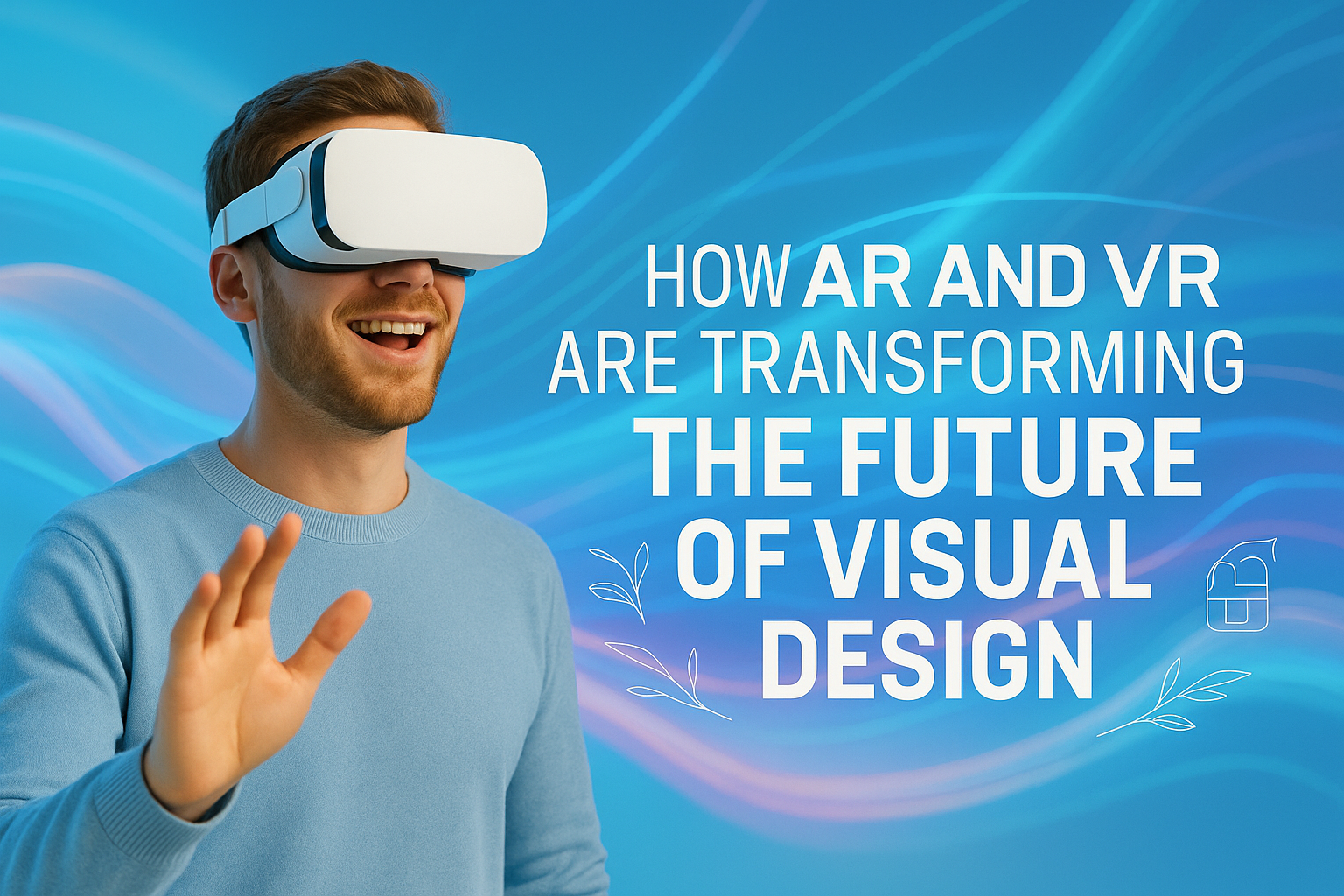
In an era where technology shapes every aspect of creativity, Augmented Reality (AR) and Virtual Reality (VR) stand at the forefront of innovation. These immersive tools have evolved from futuristic concepts into core instruments of modern visual design, changing how artists, architects, educators, and brands interact with their audiences.
Both AR and VR expand the boundaries of imagination, one by blending digital visuals into the real world, the other by transporting users into entirely new environments. Together, they are not just tools, but catalysts for creativity, innovation, and interaction.
Augmented Reality (AR): Blending Digital and Physical Worlds
Augmented Reality enhances our perception of reality by overlaying digital content, such as animations, graphics, or text, onto the physical world through smartphones, tablets, or AR glasses.
In visual design, AR allows artists and designers to merge creativity with interactivity. Imagine a mural that “comes alive” when viewed through a camera, or a product label that reveals hidden storytelling when scanned. These experiences turn static visuals into dynamic narratives that engage and excite viewers.
AR in Marketing and Branding
AR has become a game-changer in marketing design. Brands now use AR to create interactive packaging or virtual try-on experiences, allowing customers to visualize products before buying. This not only increases engagement but also builds trust by connecting emotion with interaction.
For example, beauty brands employ AR filters to let users test makeup shades in real time, while furniture companies use AR apps to project 3D models of sofas or tables into customers’ rooms. These immersive visuals are more than promotional tools, they’re storytelling mediums that strengthen brand identity.
AR in Education and Learning Design
In educational settings, AR has redefined how students learn about visual design. Instead of viewing static images in textbooks, learners can explore 3D models of structures, typography, or artwork directly on their devices.
This hands-on experience bridges theory and practice. Students can visualize complex design principles, such as perspective, form, and balance, within real-world contexts, fostering active and experiential learning.
Virtual Reality (VR): Immersion in Digital Creativity
While AR enhances reality, Virtual Reality (VR) transports users into entirely digital worlds. Using a VR headset, designers can immerse themselves in 360-degree spaces where they can walk through architectural environments, sculpt in 3D, or experiment with lighting and composition from inside their own creations.
Spatial Visualization and Design Simulation
For architects and interior designers, VR is revolutionary. It enables virtual walkthroughs of buildings before construction begins, allowing professionals to evaluate spatial relationships, proportions, and lighting. This not only improves design accuracy but also reduces project costs by identifying potential issues early.
Similarly, product designers can use VR simulations to visualize how an item looks and functions in a real environment, long before manufacturing begins.
Collaboration Without Boundaries
VR also promotes remote collaboration in visual design. Teams can meet in a shared digital workspace, review 3D models, and exchange feedback in real time, no matter where they are in the world. This makes VR an essential tool for global design studios and creative agencies managing large-scale projects.
Creative Exploration in Virtual Space
Tools such as Tilt Brush and Gravity Sketch allow artists to paint, draw, and sculpt directly in a 3D environment, offering a completely new form of artistic expression. Designers can experiment with scale and depth in ways impossible in 2D media.
When paired with 3D printing, these virtual artworks can even transition into the physical world, merging digital creativity with tangible craftsmanship. This intersection of virtual creation and physical realization symbolizes the future of design innovation.
The Power of AR and VR in Combination
Although AR and VR have distinct functions, their integration creates even greater potential for visual design. Imagine an interior designer who first conceptualizes a space in VR and then uses AR to preview the design directly within a client’s physical room.
This seamless workflow between virtual simulation and real-world application is transforming not only creative industries but also education, healthcare, retail, and entertainment.
The Role of Artificial Intelligence (AI) in AR and VR Design
When AI joins forces with AR and VR, the creative potential multiplies. AI algorithms can analyze environments, recognize objects, and generate contextual design recommendations.
For example, an AI-powered AR app can scan a living room and automatically suggest color palettes, decorations, or furniture layouts. During holidays, it might even generate custom Christmas décor concepts based on the existing interior theme.
In education, AI enhances AR and VR by personalizing learning paths. It adjusts the difficulty of design exercises to each student’s skill level, ensuring that beginners and advanced learners alike receive meaningful, growth-oriented feedback.
This intelligent interactivity not only makes learning more engaging but also fosters deeper comprehension of design principles such as composition, symmetry, and spatial logic.
Industry Applications: Beyond Design Studios
The influence of AR and VR in visual design extends across industries:
- Architecture and Urban Design: Virtual walkthroughs, site visualization, and urban simulation.
- Marketing and Retail: Immersive advertising and product previews.
- Education: Interactive lessons, 3D modeling, and skill-based design training.
- Healthcare: Visualizing medical models and simulation-based learning.
- Entertainment and Gaming: Immersive storytelling and digital environments.
Each application demonstrates how these technologies bridge creativity and function, creating experiences that resonate emotionally and intellectually.
Fonts and Visual Identity in AR/VR Design
Typography plays a vital role in immersive environments. In AR or VR interfaces, typefaces must be clear, scalable, and emotionally aligned with the design context.
Fonts like Digitron Futures or Zeta Drive from Putracetol Studio are perfect examples of futuristic display fonts optimized for digital interfaces.
For more expressive or narrative environments, such as AR storytelling or VR exhibitions, fonts like Hexaline Multiline and Hypergame Cyberpunk offer flexibility and elegance suitable for immersive titles and motion graphics.
These typefaces reinforce brand identity and ensure readability even in dynamic or layered virtual contexts, proving that typography remains as critical in 3D spaces as it is on traditional screens.
The Future of Visual Design: Interaction, Immersion, and Intelligence
The integration of AR and VR marks the beginning of a new creative paradigm, one where design is no longer confined to flat screens but experienced spatially and emotionally. As these technologies evolve, designers will continue to push the boundaries of what’s possible, crafting experiences that are both interactive and deeply human.
From virtual classrooms to immersive brand experiences, AR and VR allow audiences not just to view design, but to live it. And as AI adds contextual intelligence and personalization, the future of visual design becomes even more adaptive, intuitive, and inspiring.
Conclusion: Redefining the Creative Experience
AR and VR are more than emerging technologies, they are transformative tools that redefine how we design, learn, and communicate. By bridging imagination with immersion, they empower creators to build experiences that blend beauty, functionality, and emotion.
As designers continue to adopt these technologies, the visual design industry will transition from storytelling to story-living, where audiences don’t just see creativity, they participate in it.
In this new dimension of digital artistry, the only true limitation is imagination itself.
Thank you for taking the time to read this article. If you are looking for more great articles, feel free to visit Putracetol Blog
Additionally, if you want to explore some free typography options, you can check out Putracetol Studio on Dafont. Happy reading and designing!